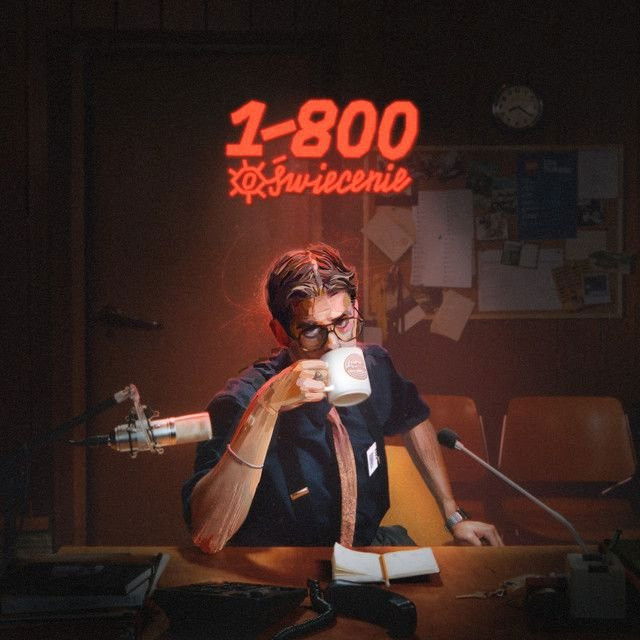
Why “1-800-OŚWIECENIE” Feels Like a Panic Call
The meaning of 1-800-OŚWIECENIE Taco Hemingway comes into focus once listeners hear the song as a conversation with a frayed mind. It is not a clean story with one event and one lesson. Instead, it sounds like someone scrolling through possible reasons they feel broken, then jokingly dialing a fake hotline for enlightenment because ordinary coping is no longer enough.
"1-800-OŚWIECENIE" - Taco Hemingway
W oparach płaczu czołgałem się po dnie
Być może w strachu, że jestem skończony
Loading lyrics...
Unable to load lyrics
We're unable to display the lyrics at this time. Please try again later.
Taco Hemingway, born Filip Szcześniak, is one of Poland’s biggest rap artists, with a career that stretches from early English-language releases to major Polish-language albums and more than a billion Spotify streams, according to public career summaries. That scale matters here. A song like this lands differently when it comes from an artist known for sharp urban writing and emotional self-observation.
A Mind Listing Every Possible Cause
The opening verse works like an anxious checklist. The speaker keeps asking whether the problem came from addiction, fear, travel, fitness obsession, marriage, betrayal, grief, karma, or simple disconnection from reality. That repetition matters more than any single answer.
When they say Być może
again and again, the phrase acts like a verbal shrug. In paraphrase, they cannot settle on one truth, so they test many. That makes the song feel less like confession and more like spiraling thought.
Interpretation: the point is not solving the mystery. The point is showing what a mind looks like when it is too tired to trust its own diagnosis.
The Chorus Sells Escape Like an Ad
The hook is one of the smartest parts of the song. 1-800-OŚWIECENIE
turns spiritual peace into a phone number, as if enlightenment could be ordered on demand. Then the song adds cosmic comfort with phrases like Niechaj pochłonie Cię kosmos
and Wszechświat Cię kocha
.
In plain terms, the chorus sounds soothing, but it is also a little suspicious. It resembles wellness branding, hotline language, and new-age reassurance all at once. That double effect gives the chorus its power.
Interpretation: Taco Hemingway seems less interested in mocking belief than in showing how tempting easy belief becomes when adulthood keeps failing to deliver stability.
W moich wspomnieniach pulsuje stroboskop
Znowu mnie rozczarowała dorosłość
Those lines condense the song’s emotional core: memory flashes too brightly, and adult life keeps disappointing them.
Adulthood as Noise, Routine, and Tiny Defeats
One reason the song feels relatable is its focus on small details. The lyrics move from spiritual panic to calorie-tracking watches, dumbbells, rushing out the door, and getting snagged on a handle. None of those moments are dramatic on their own.
Together, though, they build a portrait of a person who manages everything except peace. The line Niechaj decyzje podejmie horoskop
is especially revealing. In paraphrase, they are so drained by constant thinking that they almost want astrology to make choices for them.
That is funny, but it is not only funny. It captures the modern wish to surrender responsibility for a minute when every decision feels loaded.
The Voice Keeps Splitting in Two
Another key to the meaning of 1-800-OŚWIECENIE Taco Hemingway is the way the speaker shifts perspective. At times, the song sounds like private self-talk. At other times, it becomes a second-person interrogation: why can’t they rest, why did joy fade, why did silence become noise?
Then a new frame appears: a radio-host style sign-off that says, in effect, it is good to speak again and callers should phone in even if no one can really help. That is a clever twist. It turns the song into a late-night broadcast for the spiritually exhausted.
Interpretation: the speaker may be talking to themselves, to listeners, or to a past version of themselves. The instability is the point. They are not sure who needs saving.
Sound and Structure Support the Anxiety
Even without reproducing the full production credits, the writing itself suggests a track built on repetition and return. The chorus circles back like a commercial jingle or intrusive thought, while the verses pile image on image. That structure mirrors overthinking.
Taco Hemingway’s catalog often mixes conversational detail with hooks strong enough to feel public-facing, and this song uses that balance well. The verses are crowded and restless; the refrain opens outward into cosmic language. So the music likely functions as emotional contrast: tight mental pressure in the rap sections, false relief in the hook.
That contrast helps explain why the song feels both sincere and ironic at once.
Artist Context Makes the Doubt Hit Harder
Taco Hemingway has long been associated with writing that blends urban realism, introspection, and cultural observation. Public biographies also note that he rarely gives interviews, which has added to his mystique over time. In that context, a song built from self-questioning carries extra weight.
The lyrics even hint at artistic fatigue, asking why someone wanted to leave music and unclip the microphone. That detail widens the song beyond everyday burnout. It suggests creative burnout too, along with the fear of no longer recognizing the self in older work.
For a major artist, that is a vulnerable idea: success does not protect them from disorientation.
What the Song Finally Suggests
At its core, this track is about living in a culture full of solutions and still feeling unsolved. Fitness, travel, romance, mysticism, discipline, nostalgia, and self-analysis all appear, but none fully heal the speaker.
So the song’s fake hotline becomes a perfect symbol. It is hopeful, absurd, catchy, and sad. It promises wisdom in one step because real life rarely does.
That is why the meaning of 1-800-OŚWIECENIE Taco Hemingway feels so current. It captures the sound of someone who is overwhelmed by adulthood, suspicious of easy cures, and still desperate for one.
Interpretation disclaimer: song meanings are not fixed. This reading is based on the lyrics provided, artist context, and the track’s recurring imagery and tone.







