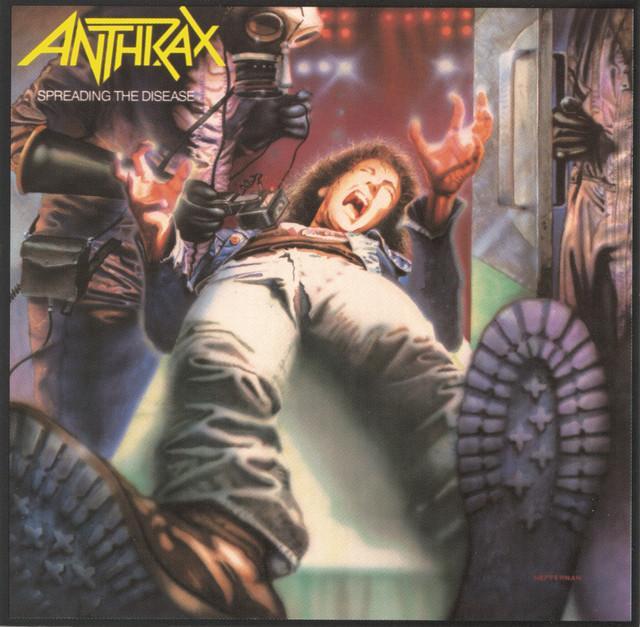
Why 'A.I.R.' by Anthrax Still Hits Hard
The meaning of A.I.R. Anthrax becomes clear almost right away: this is a song about being young, angry, and pushed around by people who think they know best. Anthrax turns that tension into a fast, confrontational anthem about resisting pressure and choosing an independent life.
"A.I.R." - Anthrax
A childhood's end, it's lunacy
Pure dictation, they don't listen
Loading lyrics...
Unable to load lyrics
We're unable to display the lyrics at this time. Please try again later.
Factually, A.I.R.
opens Spreading the Disease, Anthrax's second studio album, released in October 1985. It was the band's first full album with Joey Belladonna on lead vocals and Frank Bello on bass, and it was produced by Carl Canedy and Anthrax. Research sources also note that the acronym stands for Adolescence in Red
, a play on Rhapsody in Blue.
The Core Idea Behind the Song
At its heart, the song is about a teenager or young adult facing a world full of demands. Parents, teachers, authority figures, and social rules all seem to tell them who to become. Anthrax frames that pressure as damaging, even soul-crushing.
The opening lines paint youth as something powerful but temporary. From there, the song moves into frustration: adults give orders, but they do not really listen. That conflict drives the whole lyric. The person at the center feels trapped between what others expect and what they actually want.
Interpretation: The song is not just rebelling for the sake of rebellion. It argues that identity must be earned through personal choices. In that reading, the real enemy is not one parent or one institution, but the larger habit of conformity.

Watch the official A.I.R.
music video
A Chorus About Choice, Not Chaos
The chorus is where the song sharpens its message. When Anthrax says Welcome to your nightmare
, they are not describing a horror-movie setting. They are describing adolescence itself when it is controlled by outside pressure.
That phrase matters because it changes the song from a complaint into a warning. The young person cannot simply drift. They have to choose a direction, or someone else will choose for them.
Another key phrase is choose your fate
. That line makes the song sound dramatic, but it also keeps the theme simple. This is a battle over agency. The song says growing up becomes a nightmare when they surrender control of their own life.
How the Verses Build the Conflict
The verses work almost like a pep talk mixed with a threat. They describe a person who is judged as misunderstood
while adults project their own plans onto them. That tension gives the song its emotional force.
Anthrax keeps returning to two ideas:
- society wants obedience
- the individual wants self-definition
That split becomes even clearer when the lyrics describe conformity as a locked space and authority as a force that can imprison the soul. Those are strong images, but they are easy to grasp. The band turns abstract pressure into physical barriers: doors, walls, prisons.
Interpretation: The song can be heard as a classic metal defense of personal freedom. But it also sounds very specific to adolescence, when every choice can feel like a test of identity.
Symbols of Walls, Prisons, and Second Lives
The imagery in break right through the wall
gives the song a simple but effective symbol. The wall is whatever separates a person from a freer life: family pressure, school expectations, social labels, or fear.
The idea of a second life
is also important. Anthrax seems to suggest that real life does not begin until someone rejects that imposed identity. In other words, the song imagines freedom not as a small adjustment, but as a rebirth.
This is where the title's color imagery helps. Adolescence in Red
suggests youth seen through anger, danger, heat, and urgency. Red is not calm reflection. It is conflict in motion.
Why the Sound Matters So Much
The production and arrangement help sell the message. Spreading the Disease was recorded at Pyramid Sound Studios in Ithaca, New York, and its sound is often praised for being tighter and more confident than Anthrax's debut. That matters because A.I.R.
is not a loose garage rant. It is precise aggression.
The guitars move quickly, but the riffs are clean enough to feel deliberate rather than chaotic. Dan Spitz and Scott Ian's lead and rhythm work push the song forward like a machine under pressure. Charlie Benante's drumming adds constant motion, while Belladonna's voice gives the track a sharper melodic edge than some harsher thrash records of the era.
Interpretation: That balance between speed and control mirrors the lyric's point. The song advocates rebellion, but not mindlessness. It is about taking command of one's life, not just smashing everything in sight.
The Song in Anthrax's 1985 Moment
Context helps explain why the track lands so well. Spreading the Disease was a breakthrough-era album for Anthrax and became an important early thrash release. Critics later praised its songwriting, riffs, and energy, and the record reached No. 113 on the Billboard 200.
Opening the album with A.I.R.
feels intentional. It announces the band's identity fast: intelligent, aggressive, and deeply interested in youth under pressure. The song's rebellion also fits the wider metal tradition, but Anthrax gives it a more focused emotional shape than a generic anti-authority slogan.
The Last Word on the Meaning of A.I.R. Anthrax
The meaning of A.I.R. Anthrax is ultimately about self-possession. The song sees adolescence as a fight between imposed identity and chosen identity, and it urges the listener to break out before obedience becomes permanent.
That is why the song still connects. Beneath the speed and volume, it speaks to a common fear: becoming the person everyone else designed.
Disclaimer: This interpretation combines documented band context with close reading of the lyrics. As with most songs, individual listeners may hear different meanings in it.







