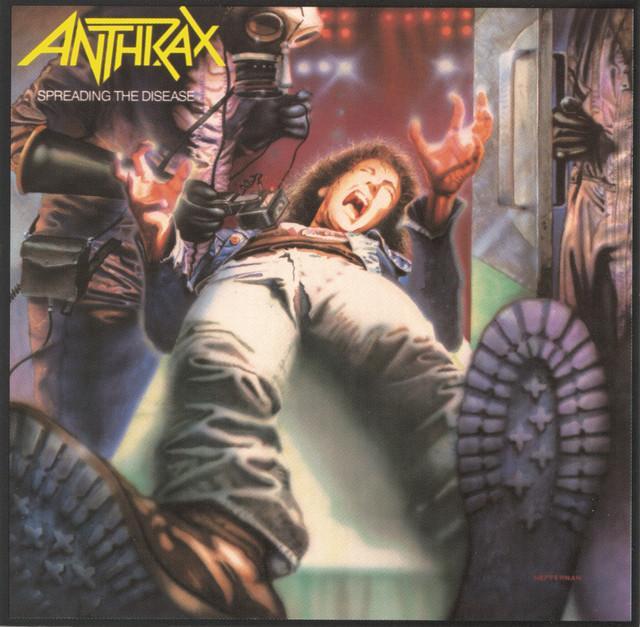
Gung-Ho by Anthrax
The meaning of Gung-Ho Anthrax starts with intensity. This is not a reflective war ballad or a song about regret. It throws listeners into the middle of battle and stays there. Anthrax use blunt images, shouted momentum, and fast thrash metal attack to show a mindset built on action, obedience, and survival.
"Gung-Ho" - Anthrax
Fighting hand to hand
Troops are thrusting onwards
Loading lyrics...
Unable to load lyrics
We're unable to display the lyrics at this time. Please try again later.
Released on Spreading the Disease in 1985, the song came from Anthrax's early thrash era, when the band helped define the genre alongside other major metal acts of the decade. According to widely cited discographies, Gung-Ho
appears on that album and is credited to members including Charlie Benante, Dan Lilker, Dan Spitz, Frank Bello, Joey Belladonna, Neil Turbin, and Scott Ian. The term "gung ho" itself commonly means highly enthusiastic or overzealous, a useful clue for how the title works.
A Song About War Fever, Not Heroism
On the surface, the lyric is simple: soldiers advance, attack, and kill. The opening commands and descriptions establish a battlefield with no pause for thought. Short phrases like fighting hand to hand
and time to take command
make the song feel immediate, like orders shouted in motion.
But the song's deeper force comes from what it leaves out. There is almost no personal backstory, no politics, and no moral debate. Interpretation: that absence matters. By stripping away context, Anthrax focus on the psychology of combat itself. The song becomes less about a specific war and more about what happens when people are trained to become instruments of force.

Watch the official Gung-Ho
music video
The Voice Sounds Like a Unit
The narrator does not feel like one person telling a personal story. Instead, the lyrics often sound collective, as if a group speaks with one mind. When the song says we move in by night
, it frames the soldiers as a single body acting together.
That choice feeds the main theme: individuality disappears inside war. There is command, movement, pain, and attack, but very little selfhood. Interpretation: the song may be showing how military identity can flatten emotion until the only values left are speed, toughness, and victory.
How the Hook Sharpens the Meaning
The repeated chorus is just one phrase, Gung-Ho
, chanted again and again. That simplicity is important. It sounds like a rally cry, but also like brainwashing. The repetition turns a common term for enthusiasm into a slogan of total commitment.
Because the verses are so graphic, the hook does not sound cheerful. It sounds obsessive. Interpretation: Anthrax may be using the title to suggest overcommitment gone violent, where motivation becomes frenzy.
Violence Without Distance
The song's imagery is physical and close-range. It mentions blades, throats, bullets, barbed wire, and damaged bodies. This keeps the violence personal rather than abstract. Even when the lyrics describe group movement, the details stay at ground level, where pain is felt directly.
One brief section captures the song's brutal philosophy:
Draw fast, cut first
Live hard, die hard
These lines summarize the worldview in miniature. Speed comes before thought. Hardness becomes a moral code. Life and death are treated almost as matching parts of the same warrior identity.
Sound and Speed Do Half the Work
Anthrax's music is central to the song's meaning. The riffing is fast, tight, and percussive, with a stop-start attack that mirrors combat commands. Drums push the track forward like a charge, while the guitars create a sharp, cutting feel that matches the lyric's weapon imagery.
This is one reason the meaning of Gung-Ho Anthrax lands so strongly: the arrangement does not soften the message. Thrash metal in the mid-1980s was built on velocity, aggression, and precision, and Anthrax were one of the bands shaping that sound. Here, the production supports the lyric by making everything feel urgent and physical.
The vocal delivery matters too. Rather than sounding sorrowful or haunted, the performance feels energized and forceful. That creates tension. Listeners hear excitement in a song full of destruction, which can feel thrilling and disturbing at the same time.
Two Strong Ways to Read It
There are at least two believable interpretations of the song.
Reading One: A Raw Combat Portrait
The most direct reading is that Anthrax are depicting the rush of battle from the inside. In this view, the song is a harsh action piece, meant to capture the adrenaline and unity of soldiers under pressure.
Reading Two: A Critique of Dehumanization
A second reading goes deeper. Because the song shows almost no empathy, remorse, or individuality, it may be exposing how war strips people down into tools. Phrases like show no emotions
suggest that emotional shutdown is not accidental. It is part of the training.
That reading fits the song's cold efficiency. The brutality is so nonstop that it can feel less like celebration and more like warning.
Why the Song Still Hits
"Gung-Ho" remains powerful because it is so focused. It does not try to explain war. It throws listeners into its machinery. The result is a song about aggression as a system: command, attack, numbness, repeat.
For fans asking about the meaning of Gung-Ho Anthrax, the clearest answer is this: they turned war fever into sound. Whether listeners hear a battlefield anthem or a critique of dehumanized violence, the song's core idea is the same. Total commitment can become terrifying when nothing human is left to slow it down.
Disclaimer: This interpretation is based on the song's lyrics, performance, and known context, and other listeners may hear it differently.







