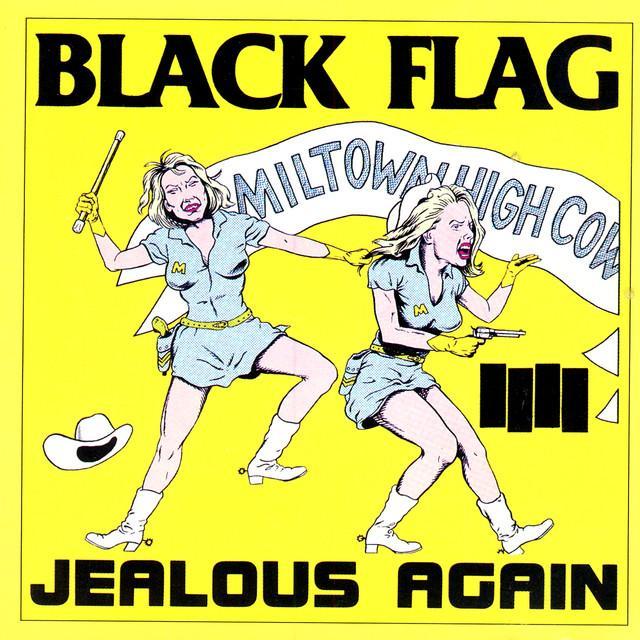
Jealous Again by Black Flag
In less than two minutes, Black Flag turn a jealous argument into a raw portrait of control, resentment, and punk-era frustration.
"Jealous Again" - Black Flag
Provided by LyricFindYou're jealous again
No, she's just a friend
Why can't I do anything without being yelled at?Loading...Loading lyrics...
Unable to load lyrics
We're unable to display the lyrics at this time. Please try again later.
Why the meaning of Jealous Again Black Flag still hits
The meaning of Jealous Again Black Flag starts with a relationship that feels crowded and hostile. The speaker sounds trapped by suspicion. He keeps insisting that the other person is overreacting, but the song never becomes calm enough to feel trustworthy or settled.
That tension is the point. Rather than offering a love song or a breakup song, Black Flag present an ugly argument in motion. Jealousy is shown as a cycle of accusation, denial, and emotional exhaustion.
Factually, “Jealous Again” is the title track of Black Flag’s 1980 EP Jealous Again, the band’s second EP and the only non-compilation Black Flag release to feature Ron Reyes on lead vocals, according to Wikipedia. It was released on SST and produced by Spot and Black Flag.
Watch the official Jealous Again
music video
A fight, not a romance
At the lyric level, the song reads like a direct confrontation. The speaker answers accusations with lines like just a friend
and complains about being always on the phone
. Paraphrased, the message is clear: he feels watched, nagged, and cornered.
But the song is not simply saying, “The other person is wrong.” It also captures how defensive and immature both sides may be. The speaker does not sound reflective. He sounds angry that his freedom is being challenged.
That is why the central conflict feels bigger than jealousy alone. It is also about autonomy. When he asks who gets to decide his friends or movements, the song frames jealousy as a way of policing another person’s life.
Who is speaking, and can they be trusted?
The song uses a first-person voice, but that does not mean listeners have to accept everything the speaker says as fact. Interpretation: one of the smartest ways to hear “Jealous Again” is as a self-portrait of someone who feels trapped but is also unreliable.
He promises never leave ya
, then lashes out a moment later. He also claims I won't push you around
, but the line is followed by a legal consequence, not a moral one. In plain terms, he avoids violence because the police would punish him, not because he has reached emotional maturity.
That detail matters. It gives the song an ugly honesty. Black Flag let the speaker expose himself.
How the chorus traps the song in a loop
The repeated title phrase, You're jealous again
, is blunt and almost childish. That simplicity works because repetition becomes structure. Every time the hook returns, it suggests this argument has happened before and will happen again.
There is also a sharp contrast between reassurance and collapse. The speaker says it is not the end
, but the music and delivery make the relationship sound unstable anyway.
You're jealous again
And again and again
This is the song’s emotional center. Jealousy is not a one-time event here. It is a repeating condition that drains both people.
Hardcore sound, hardcore meaning
Black Flag were central to early American hardcore, and this track shows why. The recording is fast, tense, and stripped down. Greg Ginn’s guitar sounds jagged rather than melodic, while the rhythm section keeps everything moving like a fight that cannot cool off.
That style fits a review by Robert Christgau, who described Black Flag’s approach as committed to rage as a musical principle in The Village Voice, quoted on Wikipedia. Whether or not a listener agrees with him, the description suits “Jealous Again.” The band do not soften the scene with warmth or polish.
The production also matters. The EP was recorded in sessions at Media Art in Hermosa Beach and produced by Spot with the band, according to Wikipedia. Spot’s early hardcore recordings often kept a live, abrasive feel, and here that roughness helps the song feel immediate, like a private argument turned into public noise.
Artist context sharpens the song
Context adds another layer to the meaning of Jealous Again. The EP came during a volatile stretch for Black Flag, with lineup changes and aborted sessions before Ron Reyes completed these vocals, according to Wikipedia. That instability does not prove the song is autobiographical, but it does place it inside a band culture full of confrontation, pressure, and distrust.
Interpretation: because of that context, the song can be heard as more than a lovers’ quarrel. It also sounds like a punk statement against being controlled by anyone. In that reading, the jealous partner becomes a symbol of outside pressure—someone demanding access, obedience, and explanation.
That broader reading fits Black Flag’s early identity. Their music often pushed against authority, expectation, and social rules. “Jealous Again” shrinks that rebellion down to a domestic argument, which makes it feel more claustrophobic.
The clearest takeaway
The meaning of Jealous Again Black Flag is not subtle, but it is sharper than it first appears. On the surface, it is about a partner’s jealousy. Underneath, it is about control, defensiveness, and the exhausting loop of a relationship that has lost trust.
What makes the song memorable is that Black Flag do not clean up the emotions. They let them stay messy, loud, and uncomfortable. That honesty is why the track still lands.
Disclaimer: This interpretation mixes documented context with critical reading of the lyrics and performance. As with most songs, individual listeners may hear different meanings in “Jealous Again.”








