What “Moody Blue” Really Means
In “Moody Blue,” Elvis Presley turns romantic confusion into a catchy, polished country-pop single about loving someone who never seems emotionally still.
"Moody Blue" - Elvis Presley
Provided by LyricFindWell, it's hard to be a gambler
Bettin' on the number
That changes every timeLoading...Loading lyrics...
Unable to load lyrics
We're unable to display the lyrics at this time. Please try again later.
The Heart of the Song
The meaning of Moody Blue Elvis Presley comes down to uncertainty. The narrator is involved with a woman who feels impossible to read. One day she seems close, and the next she feels distant, changed, or hidden behind another mood.
That idea shows up right away in the song’s gambling image. When the singer compares love to betting on a number that keeps changing, they frame romance as a risk with shifting rules. The relationship is not stable. It is exciting, but it is also exhausting.
The chorus sharpens that tension. When Elvis sings moody blue
and asks am I gettin' through
, the song stops being just a description of her behavior. It becomes a plea for connection. The real pain is not simply that she changes. It is that he cannot tell whether his feelings are reaching her at all.

Watch the official Moody Blue
music video
A Narrator Chasing a Moving Target
Who is speaking here?
The song uses a first-person voice, but its emotional focus is on the woman being observed. The narrator studies her, questions her, and tries to make sense of her patterns. They do not sound angry so much as baffled.
That is why lines like night and day
matter. The song presents her as a person of extremes. She can seem like two opposites at once, which leaves the narrator wondering who I'm talkin' to
. In plain terms, they feel like they are meeting a different version of the same person every time.
What happens across the verses?
The story moves in a simple arc:
- The singer says love feels like gambling.
- They admit they keep hoping to understand her.
- They notice her moods change day by day.
- They realize certainty never arrives.
That structure is important. The song does not build toward a solution. Instead, it circles around repeated confusion, which mirrors the relationship itself.
Why the Chorus Hits So Hard
The chorus is catchy, but it is also the emotional center of the song. The phrase try to learn the song
suggests that understanding this woman is like trying to master a tune that keeps slipping away.
Interpretation: This may be the song’s smartest metaphor. Music usually stands for order, pattern, and repetition. Here, even the “song” cannot be learned. That means the narrator cannot find any dependable rhythm in the relationship.
There is also a gentle sadness in Elvis’s delivery. He does not push the lyric with bitterness. Instead, he sounds patient, puzzled, and still emotionally invested. That choice keeps “Moody Blue” from becoming a complaint song. It stays human and vulnerable.
Symbols, Color, and Emotional Weather
The title does a lot of work. “Blue” can mean sadness, but it also suggests coolness, distance, and style. Calling her moody blue
turns her changing emotions into a vivid image.
The weekday sequence in the second verse adds another layer. When the song says one day turns into another and her personality keeps unwinding, it makes her seem impossible to pin down in time. She is always becoming someone new.
Interpretation: The song is not really diagnosing her personality. It is showing how she feels from the narrator’s side of the relationship. In other words, “moody” may reflect his confusion as much as her behavior.
How Elvis’s Sound Shapes the Meaning
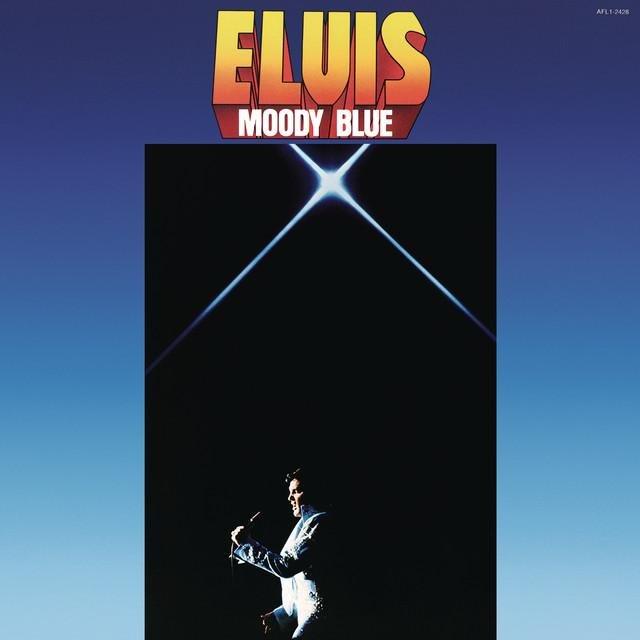
“Moody Blue” was written by Mark James, who also wrote “Suspicious Minds,” and Elvis recorded it on February 4, 1976, in the Jungle Room at Graceland, with Felton Jarvis producing. It was released as a single on November 29, 1976, and later appeared on the Moody Blue album in June 1977, according to the research data summarized from Wikipedia’s entry on the song.
The arrangement helps explain why the song connected. It blends country, pop, and smooth adult contemporary touches. The tempo is steady, the groove is light, and the backing feels clean rather than heavy. That polished sound gives the song motion without turning the emotional conflict into drama.
Elvis’s vocal is the key instrument. He sounds relaxed, but there is a hint of strain under the surface, which fits a singer trying to stay calm while feeling confused. The production never overwhelms that feeling.
Commercially, the song mattered too. It reached No. 1 on Billboard’s Hot Country Singles and became Elvis Presley’s last No. 1 hit during his lifetime, again based on the supplied research summary. That success makes sense: the song is easy to hear as both a relationship story and a showcase for late-period Elvis control and charm.
A Few Plausible Readings
There is more than one valid way to hear the song:
- Straight relationship reading: It is about loving someone emotionally unpredictable.
- Projection reading: The woman may be less unstable than the narrator thinks; they may simply be insecure.
- Performance reading: The song turns romantic confusion into a stylish persona piece, where mystery itself is part of the attraction.
All three readings fit the lyric. The song never fully solves the mystery, and that is part of its appeal.
Why “Moody Blue” Still Works
The meaning of Moody Blue Elvis Presley lasts because it captures a common feeling: wanting closeness with someone who stays hard to read. The song is catchy, but underneath the hook is a small ache. Love here is not a grand tragedy. It is the quieter frustration of never quite knowing where one stands.
That emotional realism, paired with Elvis’s smooth delivery, is what gives the song its staying power.
Disclaimer: This interpretation mixes documented song facts with informed reading of the lyrics and performance. Meaning can vary from listener to listener.








