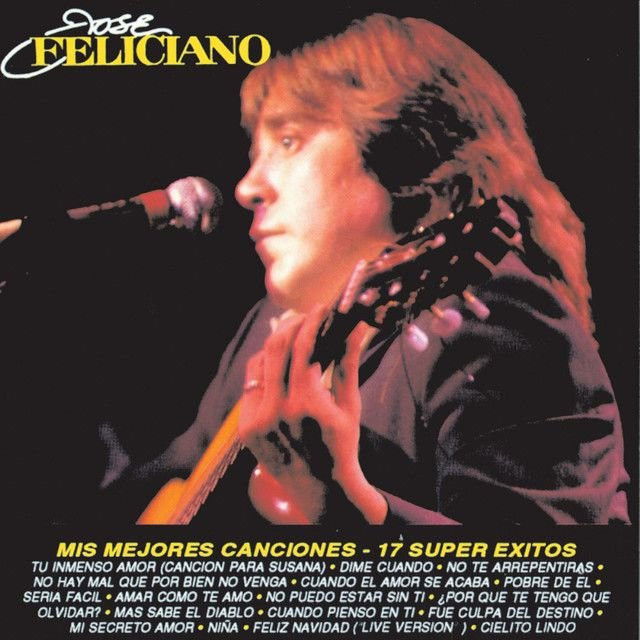
Por Qué Te Tengo Que Olvidar? by José Feliciano
A breakup ballad built on one impossible question
The meaning of Por Qué Te Tengo Que Olvidar? José Feliciano comes down to a painful contradiction: they know a relationship is over, but their heart refuses to accept what their mind seems to understand. That is why the song feels so immediate. It is not just about sadness. It is about being stuck between love and the duty to let go.
"Por Qué Te Tengo Que Olvidar?" - José Feliciano
Extraño el calor, en nuestros rincones
No puedo fingir si tu no estas aquí
Loading lyrics...
Unable to load lyrics
We're unable to display the lyrics at this time. Please try again later.
Released in 1990 as the lead single from Niña, the track became José Feliciano’s first No. 1 on Billboard’s Top Latin Songs chart, according to Wikipedia. It also won the Grammy for Best Latin Pop Performance at the 33rd Annual Grammy Awards. Those facts matter because they show how widely this emotional conflict connected with listeners.

Watch the official Por Qué Te Tengo Que Olvidar?
music video
What the song is really saying
At the center of the lyric is a person haunted by memory. They still hear a voice, still feel the absence, and cannot pretend life is normal. Early lines about hearing and missing the loved one set up a world where the relationship is physically over but emotionally alive.
The title question, echoed in the chorus, gives the song its whole emotional engine. When they ask por qué te tengo que olvidar
, the issue is not simple heartbreak. It is resistance. They are not asking how to heal. They are challenging the idea that forgetting is even possible.
That makes the song more than a standard love lament. It is about emotional logic failing in real time. They know they should move on, yet every memory pulls them back.
Verse by verse, the pain gets deeper
The first verse introduces absence as something physical. They miss warmth, shared places, and closeness. A phrase like no puedo fingir
shows they cannot act as if everything is fine. The loss has changed their whole emotional balance.
The second verse pushes that further. They admit openly that they are not the same person anymore. The line about trying to forget but failing turns memory into an active force, not a passive one. In other words, the past is not fading. It is growing stronger.
That is why one of the song’s most striking ideas is mi fórmula de amor
. It sounds almost scientific, but the feeling is the opposite of controlled. Interpretation: they may see this person as the key that once made life make sense. Without them, there is no solution, only confusion.
The chorus turns longing into argument
The chorus is short, direct, and devastating because it repeats the same question instead of answering it. The singer is not building toward closure. They are circling the wound.
Porque te tengo que olvidar
Si yo te amo
Those lines capture the core conflict in its plainest form. They still love this person, so forgetting feels unnatural, even cruel. The repetition matters because it sounds like someone trying to convince themselves and failing each time.
For listeners, this is where the song becomes universal. Many breakup songs say love hurts. This one says letting go can feel more painful than holding on.
Loneliness becomes a character
One of the song’s strongest images comes when solitude seems to sit down at the table. That move gives loneliness a body and a voice. It is no longer just a mood. It is company, and bad company at that.
This person is not only sad; they are living with sadness every day. The song suggests routine heartbreak, the kind that appears at dinner, in silence, and in memory. When they imply that life without the loved one feels unbearable, the song reaches its most dramatic emotional point.
Interpretation: the lyric uses intense language not to describe literal danger, but to show how total the emotional dependence feels. The missing person has become the center of the singer’s identity.
How José Feliciano’s voice and the production carry the meaning
This song works because the arrangement does not overpower the emotion. It is a Latin pop ballad with a soft, romantic structure, shaped by melody, measured tempo, and a polished early-1990s production style. According to the song’s credits, it was produced by Rudy Pérez and co-produced by Ricardo Eddy Martínez, both key figures in mainstream Latin ballad production of that era.
Feliciano’s vocal performance is what seals the meaning. They sing with tenderness first, then rising ache. Instead of sounding theatrical, the delivery feels intimate, as if they are thinking aloud. That makes phrases like sin ver la solución
hit harder. The problem is not only the breakup; it is the lack of emotional exit.
Their long history as a genre-crossing artist also adds context. Known globally for both pop and guitar-driven performances, Feliciano brought deep warmth and credibility to a song that could have felt overly sentimental in weaker hands. On Spanish Wikipedia, the song is also framed as part of a strong commercial return in Latin pop.
Why the song endured
The song became a hit because it names a feeling many people hide: sometimes they do not want to forget, even when they know they should. Its writing, credited to Luis Ángel, Edwin Apolinaris, and Tommy Villarini, keeps the message simple enough to sing along with but emotionally sharp enough to linger.
That balance explains its staying power. It is romantic, but not naive. It is dramatic, but emotionally clear. The meaning of Por Qué Te Tengo Que Olvidar? José Feliciano is ultimately about the gap between what life demands and what love allows.
Final takeaway
This ballad is about a person who cannot separate memory from identity. Love remains present long after the relationship is gone, and the song’s question never fully resolves because that is the point.
Their pain lives in repetition, in solitude, and in the stubborn truth that love does not disappear on command. Interpretation disclaimer: song meanings can vary by listener, and this reading is based on the lyrics, performance, and documented release context.







