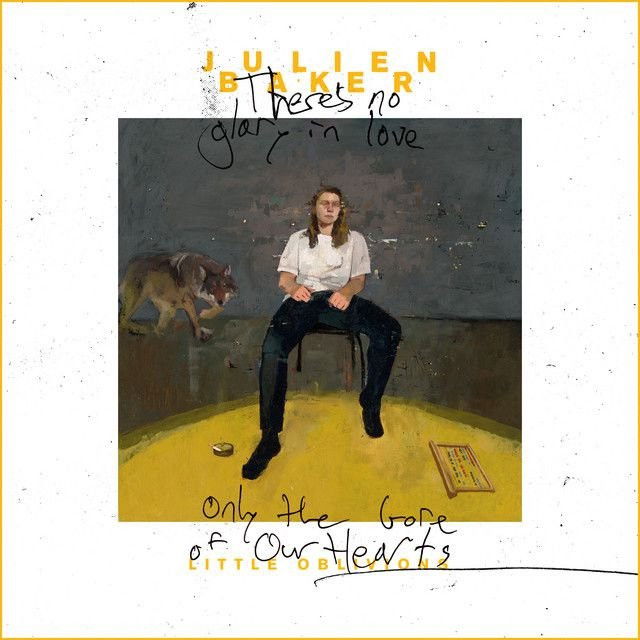
Why ‘Hardline’ Feels Like a Confession on Fire
Julien Baker opens Little Oblivions with a jolt. Hardline is both an admission and an explosion, a song where a private spiral becomes public. For listeners searching for the meaning of Hardline Julien Baker, the track frames relapse, shame, and boundary-testing against a suddenly massive, full-band sound. The contrast is the point: a quiet voice carried on a wave that could level a room.
"Hardline" - Julien Baker
Still, something that I'm trying to avoid
Start asking for forgiveness in advance
Loading lyrics...
Unable to load lyrics
We're unable to display the lyrics at this time. Please try again later.
The Line Between Care and Collapse
At its core, Hardline is about self-sabotage. The narrator anticipates hurting someone and heads it off by seeking forgiveness in advance
. They imagine controlling the fallout by naming it early, but that’s a form of control that still harms. The title itself hints at a strict code the narrator once claimed and then broke, turning principles into painful irony.
Interpretation: The song suggests how recovery isn’t tidy. The character tries to manage damage with warnings, but warnings don’t spare anyone. They show awareness without the ability to stop.
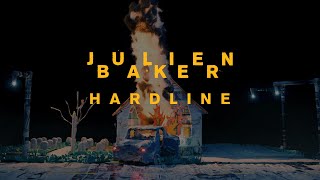
Watch the official Hardline
music video
The Voice Behind the Wreckage
Baker writes in first person to a second person who matters. The narrator draws a boundary and undermines it in the same breath: you could leave at any time
. It’s a dare and a plea. Offering an exit can feel like kindness; here, it’s also a shield against accountability.
Interpretation: The “you” can be a partner, a friend, or even the listener. The song asks how we love people who keep testing the limits we set for survival.
From Weekday Blackouts to Weekend Knockouts
Hardline moves in beats. First comes the weekday blackout—ordinary time turned dangerous. Then comes the weekend, the escalation, and the narrator’s admission that they can’t find the brake
. Throughout, they see the pattern and still repeat it. Baker has connected these themes to real experiences around 2019 and to the idea that recovery is non-linear. That context clarifies the song’s urgency: the voice is not looking back from a safe distance. It’s in the mess.
When Grey Turns to ‘All Black’
The chorus questions whether nuance even exists when you’re deep in compulsion and shame. It’s the turning point from rationalization to nihilism:
You say it’s not so cut and dry Oh, it isn’t black and white What if it’s all black, baby? All the time
Interpretation: Those lines reject hope and moderation. The narrator argues the world isn’t grey—it’s void. That isn’t truth so much as a feeling that arrives when you’ve hurt yourself and others enough times that absolutes seem easier than nuance.
Symbols That Do the Damage
Baker leans on visceral images. The split between medicine and poison
shows how the same substance can soothe or destroy. Fortune-telling shows up as self-fulfilling doom: the narrator predicts the crash and steers into it. The mirror scene—say my own name
—captures dissociation, a test to see if anyone, even the self, is still there.
There’s also a flash of gendered self-interrogation: the narrator wonders whether they’d be treated differently if they were a boy, then immediately refuses protection, saying they “enjoy” the hurt. Interpretation: it’s not pleasure; it’s punishment. The voice owns harm to maintain control over it, even when that ownership costs them.
How the Arrangement Punches Through
Hardline’s sound makes its thesis audible. The track blooms from murmured confession into pounding drums, towering guitars, and churchy organ swells. Listeners have noted the “Sicko Mode”–style organ blast at the start, and the song quickly scales into a post-rock rush with a subtle electronic pulse. As the narrator loses control, the mix fills with bright, tearing textures—Baker’s voice stays human-sized while the band becomes the storm.
The stop-motion video by Joe Baughman mirrors this scrapbooked chaos, turning travel ephemera and fire into a portrait of memory reshaped by damage. Onstage, full-band performances underline how Baker retooled her sound on Little Oblivions, stepping far beyond her earlier sparse settings to match the lyrics’ magnitude.
Two Honest Readings—Both True
- Interpretation 1: A relapse narrative. The “hard line” is a vow of sobriety broken, and the song documents the self-awareness and helplessness of that break.
- Interpretation 2: A relationship boundary. The “line” is a partner’s limit, crossed repeatedly until the narrator argues that the world is “all black.” Either way, the result is the same—trust erodes, and the narrator wears despair like armor.
Both readings meet in the final refrain: all-or-nothing thinking tries to make chaos feel simpler. It’s a lie the song exposes by letting the music show the scale of what’s at stake.
Takeaway
For anyone asking the meaning of Hardline Julien Baker, it’s this: a painfully honest admission that knowing better doesn’t always mean doing better. The song refuses easy redemption arcs and instead offers candor, craft, and a sound large enough to hold the truth.
Disclaimer: This interpretation draws on the lyrics, public statements, and production context and may differ from each listener’s experience.









