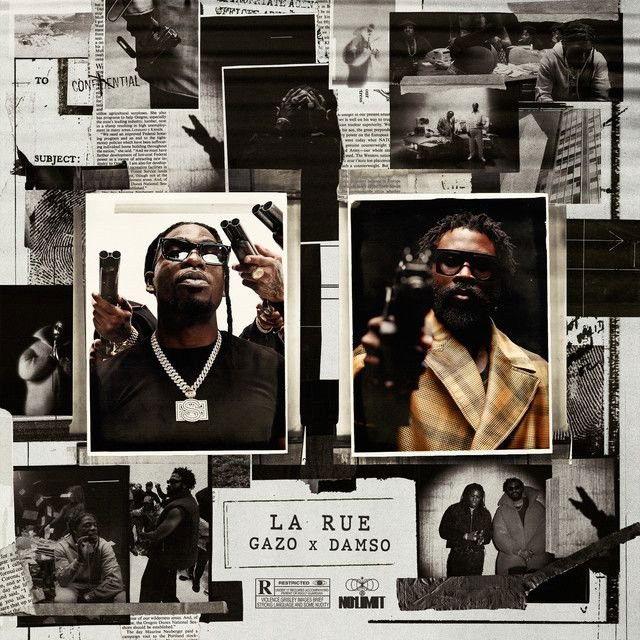
LA RUE by No Limit, Gazo, Damso
They build a street sermon from a single dare: if others claim war, what are we really about? The meaning of LA RUE No Limit, Gazo, Damso hinges on that test. It’s less a boast than a filter—separating performance from proof, talkers from those who carry the weight and risk of the block.
"LA RUE" - No Limit, Gazo, Damso
(Hey)
(Si eux, c'est la-, bah, dis-moi, nous, on est-)
Loading lyrics...
Unable to load lyrics
We're unable to display the lyrics at this time. Please try again later.
A Hook That Judges, Not Just Jumps
The refrain circles a razor-edged idea. When they say si eux, c’est la ue‑r
—war—Gazo answers with nous, on est quoi?
The split word “ue‑r” (short for “guerre”) sounds like a censored siren and a cadence trick. More importantly, it frames the song’s morality: action defines identity.
Across the track, posturing is exposed. They see people “talking war” but not showing up. The chorus becomes a street lie detector, a way to check if claims match scars.
Voices From The Block, Tight Circle First
The verses speak in first person and sometimes “we,” addressing a tight crew and a doubtful crowd. When one voice says j’ai vendu la pure
and j’ai pas eu le choix
, it casts dealing as survival, not glamour. That stance recurs: necessity, not fantasy.
They also lean on loyalty—if you’re in, you’re in. The threats are blunt because, in their world, hesitation invites loss. The language is clipped, the grammar jagged by design, mirroring the stress. This isn’t an open confession; it’s a boundary line.
From Hustle To War Footing: The Story Beats
- Hustle as origin: selling “pure” is framed as compulsion, not ambition.
- Community pressure: references to cuffs and surveillance suggest a cycle that swallows generations.
- Code of silence: names are muted, details obscured—safety first.
- Escalation: retaliation talk turns the street into a zone where the next step is always risk.
- Emotional armor: they claim a
le cœur en kevlar
, which signals numbness as protection.
Each beat loops back to the hook. If others claim war, their answer is simple: we endure it, and if pushed, we return fire.
Symbols That Sharpen The Lens
- Pure: shorthand for narcotics and the economics of the block—quick cash with fatal interest.
- Kevlar heart: trauma hardened into policy. Feel less, survive more.
- Sawn‑off barrel and street names: hardware and geography ground the claims in specifics.
- Purple soda: codeine in a soft drink points to self‑medication and hazy nights.
Plata ou plomo
: the cartel ultimatum—silver or lead—captures the no‑win choices.
Together, the images create a ledger: profits on one side, casualties on the other. The tone is cold, not celebratory, which keeps the bravado tethered to consequence.
How The Sound Pushes The Message
Sonically, the record sits in French drill: sliding 808s, minor‑key pads, and skittering hats that leave space for barked ad‑libs. Gun‑on‑beat imitations and start‑stop flows make the verses feel like corners turned at speed.
Gazo’s grainy delivery drives the menace; Damso threads in polished, writerly pivots and moral friction. Their contrasts sell the theme: different textures, same code. The mix keeps vocals forward, like direct eye contact—no refuge in reverb.
A Culture Check On Authenticity
Interpretation: the song doubles as a critique of rap’s optics economy. Long albums that “just stream,” empty gang talk, and timelines that confuse virality with pedigree are all under fire. If “they’re at war,” the artists argue, it isn’t on a screen; it’s where bills, police, and rivals intersect.
There’s also a social undertow. When they hint at community anger born from handcuffs and raids, the rage reads as learned behavior. The street becomes both shield and trap, making the hook’s question more tragic: what are we, if the only proof allowed is pain?
Wordplay, Censorship, And Edge
Breaking “guerre” into ue‑r
does double duty. It side‑steps moderation while turning the syllables into percussion. That fragmentation mirrors the fractured choices in the lyrics—nothing whole, everything cut down to what survives the edit.
Damso’s penchant for layered references meets Gazo’s blunt force, and No Limit frames it with a militant hook. The result is narrower than a manifesto but wider than a street skit—an x‑ray of reputation under pressure.
Takeaway
The meaning of LA RUE No Limit, Gazo, Damso is a pressure test: don’t tell them who you are—prove it. The chorus isn’t a slogan; it’s a summons. In this world, identity is verified by cost, not captions.
Disclaimer: This analysis is an interpretation based on publicly available lyrics and artist personas. Listeners may reasonably read the song in other ways.







