
jealousy, jealousy by Olivia Rodrigo
They don’t need a diary entry to feel this one. The meaning of jealousy, jealousy Olivia Rodrigo fans hear is simple and sharp: it’s a portrait of how social media comparison twists self-worth. The song turns envy into a character that tags along, comments on everything, and won’t log off.
"jealousy, jealousy" - Olivia Rodrigo
'Cause all I see are girls too good to be true
With paper-white teeth and perfect bodies
Loading lyrics...
Unable to load lyrics
We're unable to display the lyrics at this time. Please try again later.
Scroll-pressure, distilled into a pop rush
The opening images—wanting to throw my phone
and staring at idealized feeds—set the stage. Rodrigo names the cycle clearly: curated perfection makes real life look small. Even when they know comparison isn’t fair, the brain still tallies points.
As an idea, the song treats envy like a parasite. The hook’s admission—comparison is killin' me slowly
—reads like a diagnosis. She isn’t glamorizing jealousy; she’s mapping how it moves through a person, from a glance to a fixation.
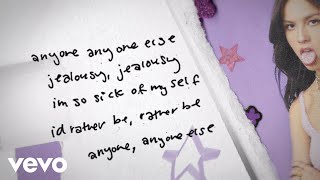
Watch the official jealousy, jealousy
music video
Who’s speaking, and who’s being watched
This is a first-person confession. The narrator watches kids who don't know me
and projects meaning onto them. They recognize the logic—their win is not my loss
—but can’t make the feeling obey. That tension is the heart of the song: knowledge vs. emotion.
Importantly, the “you” isn’t a single rival. It’s a composite of influencers, classmates, and strangers who seem to be living “right.” The jealousy has no face, which makes it harder to fight.
A quick timeline of the spiral
- It starts with innocent scrolling and a spike of envy.
- The narrator compares outfits, trips, bodies, relationships—every metric.
- The feeling personifies: jealousy has
started followin' me
. - They ping-pong between being happy for others and resenting them.
- They try a gentler mantra—your success isn’t my failure—then the cycle restarts.
The chorus as diagnosis
Com-comparison is killin' me slowly
I think I think too much
Interpretation: The chorus reframes the verses as a mental loop, not a moral lapse. It’s about compulsive thought, not cruelty. By naming the pattern, the narrator inches toward control.
Symbols and motifs that do the heavy lifting
- Followers: The phrase “follow” becomes a ghost. When envy has
started followin' me
, it flips platform language into a haunting. - Mirror metrics: Lines like
all I see is what I should be
show how outside images become a personal checklist. - Status props: Cars, parties, and vintage clothes stand in for a “perfect” life script. They’re not evil; they’re shorthand for approval.
- Mantras vs. feelings: The lyric about wins and losses shows cognitive behavioral self-talk crashing into raw emotion.
How the sound carries the meaning
Dan Nigro’s production drives the anxiety. The bass is gritty and forward, like a thought you can’t mute. Drums hit in clipped patterns, creating stop-start momentum that mirrors scrolling. The vocals stack into near-chant moments, suggesting a crowd in the narrator’s head. It’s pop built for motion, but the edges are rough—catchy enough to sing, tense enough to sting.
Rodrigo’s delivery matters, too. She swings from tight, almost whispered lines to punchy, half-snarled hooks. That dynamic feels like holding it together in public, then letting the frustration out in private.
What the meaning of jealousy, jealousy Olivia Rodrigo explains about now
Interpretation: The song articulates a modern, gendered pressure without turning it into a lecture. It validates the ugly feeling and then exposes the machinery—algorithms, highlights, and the myth that there’s one right way to grow up. It suggests that recognizing the pattern is step one; step two is opting out, even for a minute.
For listeners, the power lies in the phrasing. Saying the quiet part out loud—“I’d rather be anyone else”—turns shame into a shared experience. That’s why this track can feel cathartic rather than petty.
Alternate angles worth considering
- Interpretation: It can be read as a critique of consumer culture. The envy points toward things money buys; the deeper lack is identity and time.
- Interpretation: It doubles as an artist’s diary. As Rodrigo’s profile rises, the comparison flips—others compare to her. The song captures both sides of that equation.
Why it sticks after the hook fades
- It’s specific (friends, cars, parties) yet universal (envy, self-doubt).
- The writing balances confession with insight, never excusing the feeling but not shaming it either.
- The production makes the theme legible without words: restless, loud, sticky.
Takeaway
Jealousy here is not a villain to defeat in one fight. It’s a background process that needs naming, slowing, and sometimes muting. The song gives listeners language—and a beat—to do exactly that.
Disclaimer: Song meanings are subjective. This analysis reflects one informed interpretation based on lyrics, performance, and public context.







