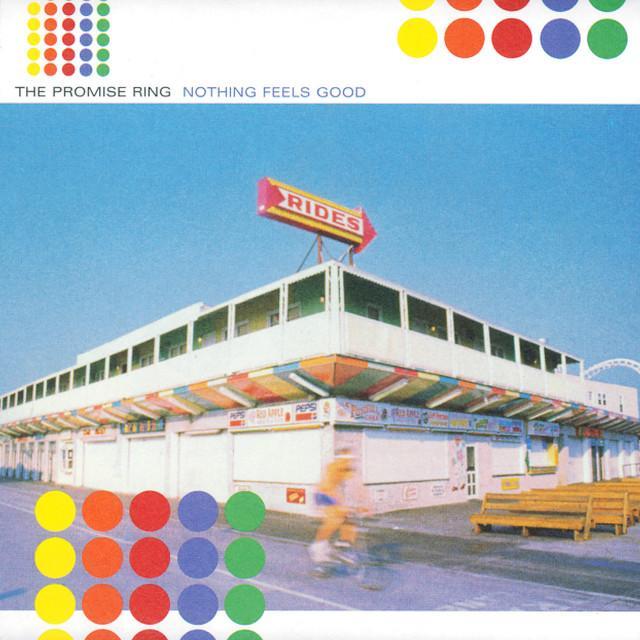
Raspberry Rush by The Promise Ring
Why this song feels vivid and slippery
The meaning of Raspberry Rush The Promise Ring is less about a clear story and more about a burst of sensation. The lyrics move through quick images of travel, nationality, watching, and noise. Instead of explaining themselves, they create a mood: excited, off-balance, and a little lost.
"Raspberry Rush" - The Promise Ring
Down the ferry with wild Irish you never know where you are.
And you never know our eyes, eager for Indians.
Loading lyrics...
Unable to load lyrics
We're unable to display the lyrics at this time. Please try again later.
That approach fits Nothing Feels Good, the band's 1997 album, which marked a cleaner, more pop-shaped turn in their sound while keeping emo intensity intact. The record was released on October 14, 1997, produced by J. Robbins, and is widely seen as a key second-wave emo album (Wikipedia).

Watch the official Raspberry Rush
music video
The core meaning: a rush without a map
At its center, the song seems to capture what it feels like to move fast through a scene without fully understanding it. The repeated setting Down the ferry
suggests motion and crossing. A ferry is not a final destination; it is a transition point. That matters because the whole lyric feels stuck in between places, identities, and meanings.
Interpretation: the song is about youthful disorientation that still feels thrilling. The line about being eager for Indians
is especially cryptic, and it should be handled carefully. Rather than reading it as a literal statement, it makes more sense as part of Bohlen's collage-like method, where phrases act like emotional flashes instead of fixed arguments.
The same thing happens with wild Irish
and the repeated idea that you never know where you are
. The song keeps naming groups and places, but it refuses to settle into one stable viewpoint. That makes the listener feel the confusion rather than simply hear about it.
A shared voice, not a private diary
One of the most striking choices is the use of plural perspective. The song says our eyes
, not just "my eyes." That small shift makes the track feel communal. They are not hearing one person confess; they are hearing a group move through an unstable world together.
This is important in The Promise Ring's broader style. On Nothing Feels Good, Davey von Bohlen often used fragments, repeated phrases, and color symbolism instead of traditional narrative detail (Wikipedia). Critics noticed that style too: AllMusic praised the album's "beautifully odd" lyrics alongside its catchy music, while PopMatters noted Bohlen's habit of capturing moments through repetition and wordplay.
So in "Raspberry Rush," the "we" matters. It suggests shared youth culture, shared uncertainty, or even a band-on-the-move feeling. The speaker is inside a scene, not standing outside it and explaining it.
The images that carry the song
Travel, identity, and unstable ground
The ferry image does a lot of work. Ferries connect two shores, but they also leave people suspended between them. That fits a song where identity feels mobile and hard to name.
The references to nationality or ethnicity seem less like description and more like flashes of perception. They pass by quickly, almost like faces seen from a moving window. Interpretation: the song may be showing how young people absorb the world in fragments, with desire and curiosity mixing with confusion.
Sound as something they wear
The song's last image is its clearest and strongest: dirty coat of sound
. Even without a direct explanation, the metaphor suggests music, noise, or atmosphere becoming physical.
And you never know our eyes,
eager for Indians.
That brief pair shows how the lyric links seeing with wanting. By the ending, sound itself becomes wearable. Interpretation: they are so immersed in emotion or music that it covers them like clothing. The word "dirty" adds grit, suggesting this is not a polished pop fantasy. It is messy, lived-in, and a little grimy.
How the music sharpens the meaning
The Promise Ring built Nothing Feels Good out of emo energy and power-pop melody, with melodic bass, varied drumming, and strong hooks (Wikipedia). That matters for "Raspberry Rush" because the song's emotional effect likely comes from contrast.
The lyrics are abstract, but the music around them is direct and immediate. J. Robbins' production on the album helped shape that cleaner, more melodic sound. So even when the words feel elusive, the band delivers them with momentum and brightness. The result is a classic Promise Ring tension: confusion in the language, clarity in the feeling.
That tension may be the real point. Davey von Bohlen said of the album's title idea that life is bizarre, but it can feel good not to know everything (Wikipedia). That quote gives useful context here. "Raspberry Rush" sounds like a song that accepts uncertainty instead of solving it.
A few strong ways to read it
There is no single confirmed explanation for this track in the available published sources, so the best reading is interpretive rather than definitive.
Three plausible readings stand out:
- Youthful motion: the song captures travel, scene life, and emotional speed.
- Perception overload: its fragmented images mirror the way memory and sensation blur together.
- Music as identity: the closing metaphor suggests sound is not just heard; it becomes part of who they are.
These readings can all be true at once. In fact, that overlap is part of the song's charm.
Why "Raspberry Rush" still works
The meaning of Raspberry Rush The Promise Ring lies in how it turns confusion into feeling. It does not offer neat answers. Instead, it creates a quick, bright, strange emotional world where movement, watching, and noise all blur together.
That is also why the song fits Nothing Feels Good so well. The album remains influential because it made emo sound tuneful and immediate without giving up mystery. "Raspberry Rush" is one of its smaller, stranger gems.
Disclaimer: This article offers interpretation based on the lyrics, album context, and available sources. Because the band has not widely published a line-by-line explanation, some meanings remain open to listeners.







