
Why "Bin da" by Veysel Hits Like a Victory Lap
The meaning of Bin da Veysel starts with a very simple phrase: being present. But in this track, “being here” does not mean quietly showing up. It means arriving with force, status, money, and proof that the hustle worked.
"Bin da" - Veysel
Bin da, bin da, bin da
Brudi, bin da, bin da, bin da, bin da, bin da, bin da, bin da
Loading lyrics...
Unable to load lyrics
We're unable to display the lyrics at this time. Please try again later.
Veysel is a German rapper with Turkish roots, known for a hard-edged style shaped by street rap and performance-heavy delivery. Public discographies and credits list Veysel Gelin among the writers of “Bin da,” along with Jonas Nikolaus Lang, Martin Peter Willumeit, Joachim Piehl, and Moritz Smolnig. Those credits matter because the song feels carefully built as a swagger anthem, not a casual freestyle.
More Than “I’m Here”
At the center of the song is the repeated hook, bin da
. In plain terms, it means “I’m here.” The phrase becomes larger than its literal meaning through repetition. It sounds like a roll call, a warning, and a brand slogan all at once.
Interpretation: The hook suggests more than physical presence. It signals relevance. Veysel is saying they are not watching success from a distance; they are inside it, moving through major cities, major rooms, and major stages.
That idea is reinforced when the song contrasts ordinary life with his own. One person is stuck somewhere anonymous, while he sends a location from New York, Broadway
. The line is not just about travel. It creates a gap between local limitation and global visibility.
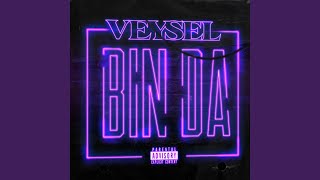
Watch the official Bin da
music video
A Flex Song With a Flash of Self-Awareness
Most of the verses are built from luxury images: first-class flights, private jets, Dubai convoys, Rolls-Royces, designer jeans, and cash. These details are familiar in rap, but here they come one after another with almost no pause. That stacking effect is important.
Rather than telling a deep plot, the song creates an environment. Every image says the same thing in a new way: they made it, and everyone around them should see it.
Still, one line adds a crack in the armor. Veysel says being a star is an erschaffene Lüge
, or a created lie. That does not cancel the flexing. Instead, it makes the song more interesting.
Interpretation: They seem to know celebrity is partly performance. The image is real enough to enjoy, but it is still built, staged, and sold. That fits a song where the narrator keeps announcing their presence as if presence itself needs to be constantly maintained.
The Chorus Turns Presence Into Power
The chorus does not develop the story. It does something more effective: it drills the identity claim into the listener’s head. By repeating Brudi, bin da
, the song sounds conversational and confrontational at the same time.
“Brudi” gives the phrase street-level familiarity, like talking to a friend, rival, or wider circle. The result is a hook that feels communal but also territorial. They are not asking for attention. They are declaring ownership of the moment.
This is a big part of the meaning of Bin da Veysel. The song treats visibility as power. To be seen, heard, and recognized is its own kind of victory.
Cities, Cars, and Constant Motion
A major motif in the song is nonstop movement. They go from Broadway to Dubai to Milan to beaches every few days. Cars change, places change, and scenes change. That motion gives the track its pulse.
On one level, it signals wealth. If someone is always flying, landing, and spending, then success looks endless. On another level, the movement suggests that stasis is dangerous. Slowing down could mean losing momentum, losing status, or losing the image.
That helps explain why the song rarely pauses for reflection. Even celebration is presented as transit: another flight, another stage, another convoy, another city.
Toughness and Image Control
The lyrics also mix glamour with menace. Alongside designer brands and applause, there are references to weapons, crisis-solving through force, and a hooligan-like attitude. That blend matters because Veysel’s persona is not polished pop stardom. It is hard power.
Even lighter moments are controlled carefully. He jokes about being a little self-obsessed, then balances it with gratitude for a gute Fam
. That brief family nod softens the track without changing its center. It suggests they still want to be seen as grounded beneath the excess.
Why the Sound Fits the Message
Production-wise, “Bin da” works because it leaves room for the chant. The beat is direct, repetitive, and heavy enough to support blunt statements. Instead of chasing melody, the track leans into rhythm and emphasis.
That matters for meaning. A more emotional or detailed production might have pushed the song toward confession. This beat pushes it toward assertion. The repeated vocal pattern makes the hook feel like something built for crowds, cars, and live energy.
Interpretation: The sound turns “I’m here” into an event. It is less about inner feeling than outer impact.
Final Take on the Meaning of Bin da Veysel
The meaning of Bin da Veysel is about arrival, status, and staying visible in a world that respects power. It celebrates luxury and movement, but it also hints that fame is a role someone has to keep performing.
That is why the song lands. It is not subtle, and it does not need to be. “Bin da” turns presence into proof: they made it, they know people are watching, and they intend to keep the spotlight.
Disclaimer: This article offers an informed interpretation based on the released lyrics and publicly available credits. Song meaning can remain open to multiple readings.








