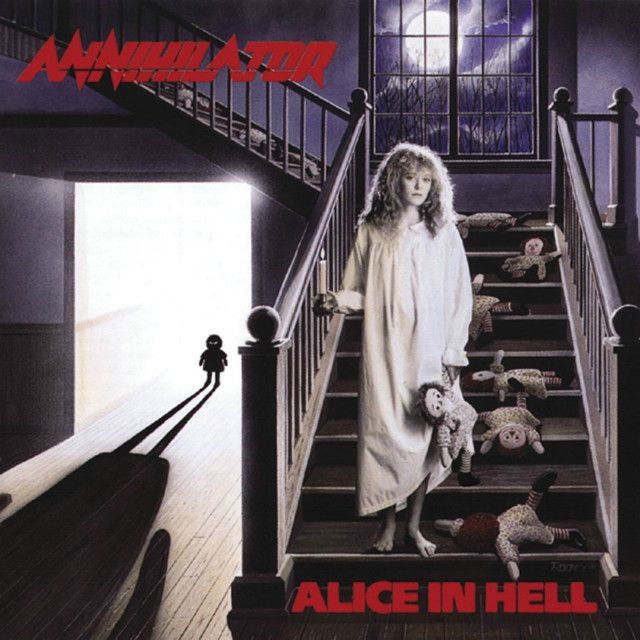
Alison Hell by Annihilator
A thrash song with a mind in free fall
The meaning of Alison Hell Annihilator is less about a simple horror tale than a portrait of fear turning inward. On the surface, the song sounds like a story about a girl haunted by a presence in her room. Under that surface, it becomes a darker study of what happens when terror is ignored until it reshapes reality.
"Alison Hell" - Annihilator
Alice aren't you scared
Alice isn't is wonderful
Loading lyrics...
Unable to load lyrics
We're unable to display the lyrics at this time. Please try again later.
Annihilator released the song on their 1989 debut Alice in Hell, produced by Jeff Waters. The album is widely recognized as a key technical thrash release, and it helped establish the Canadian band’s reputation for speed, precision, and sharp songwriting. Research on the album’s release, credits, and reception consistently places it among respected late-1980s thrash debuts.

Watch the official Alison Hell
music video
What the lyrics are really describing
The song keeps returning to childhood fear: corners, beds, basements, and long nights. Those images matter because they are ordinary places made threatening by panic. When the lyrics suggest something is under the bed
or hidden nearby, the point is not just that Alison is scared. It is that her whole environment has become unsafe.
Interpretation: the “evil spirit” can be heard in two ways.
- It may be a literal horror figure inside the song’s story.
- It may be a voice of madness, trauma, or paranoia growing stronger.
The second reading fits the song especially well. The repeated idea that her mind begins to fold
shifts the focus from an outside monster to an inside collapse. By the chorus, Alison is no longer just afraid of something. She is trapped inside fear itself.
The turning point: being unheard
One of the song’s most important details is that nobody believes her. The line about no one listening to her fears turns the track from spooky to tragic. If the song were only about a threat, it would be a thriller. Because her fear is dismissed, it becomes a story about abandonment.
That is why the most chilling idea in the lyric is not the boogeyman image. It is the suggestion that neglect helps create the nightmare. When the song says you've created me
, the “me” sounds like the thing haunting her, but it can also mean the broken mental state that grows from isolation.
Interpretation: this is the emotional core of the song. Alison may not be battling a demon at all. She may be battling what happens when fear gets denied until it becomes its own reality.
Why the title hits so hard
The title is clever and cruel at the same time. “Alison Hell” echoes “Alice in Hell,” linking the track directly to the album title while giving the character her own private inferno. It sounds almost like a name and a sentence at once.
That wordplay matters because the song is about identity slipping. Alison is still a person, but the title suggests she is also becoming a place of torment. By the end, the phrase Alice in hell
feels less like a pun and more like a diagnosis.
Artist context and the debate around its origin
There is real background around the song, but it comes with some uncertainty. Jeff Waters has said the song was inspired by a troubling story he heard about a young girl whose fears were mishandled, while John Bates later disputed that and said the lyrics came from a painful relationship and used metaphor heavily. Since those accounts conflict, the fairest conclusion is that the song’s exact origin is contested.
That uncertainty does not weaken the song. If anything, it strengthens it. A track about terror and unstable perception makes sense as either a horror narrative or a metaphor for emotional damage. The song can hold both meanings at once.
How the music tells the same story
Even listeners who never study the lyrics can feel what the song is doing. Waters’ guitar work is fast and highly controlled, but it never feels cold. The riffs push forward like racing thoughts, and the sudden shifts feel like panic spikes.
Randy Rampage’s vocal performance adds another layer. He does not sound calm, reflective, or detached. He sounds like the song is happening in real time. That raw delivery helps blur the line between narration and breakdown.
A short multi-line moment captures the trap at the center of the song:
You're in the basement
You're trapped insanity
Those words are blunt, and that is why they work. The image of the basement suggests repression, secrecy, and being locked away. Musically, the band turns that claustrophobic idea into speed and pressure, which is one reason the track became a standout from Alice in Hell.
Why the song still lasts
Part of the reason “Alison Hell” has endured is that it offers more than shock value. Yes, it has the darkness thrash fans expect. But it also has structure, atmosphere, and a central idea people can connect with: the fear of not being believed.
That theme travels well beyond metal. Many listeners hear the song as a warning about what happens when inner suffering is dismissed. Others hear it as a pure horror piece with a psychological twist. Both readings are supported by the song’s imagery.
In that sense, the meaning of Alison Hell Annihilator is not just about a haunted girl. It is about the thin line between fear and identity. Once that line breaks, the song suggests, the real prison is no longer the room. It is the mind.
Final takeaway
“Alison Hell” remains one of Annihilator’s signature songs because it fuses technical thrash energy with a genuinely unsettling story. Whether listeners hear a monster, a breakdown, or a metaphor for emotional damage, the song keeps pointing to the same truth: ignored fear can become its own kind of hell.
Disclaimer: This interpretation separates verified facts from reasonable analysis. Because songwriter accounts differ, some meaning discussed here is interpretive rather than definitive.







