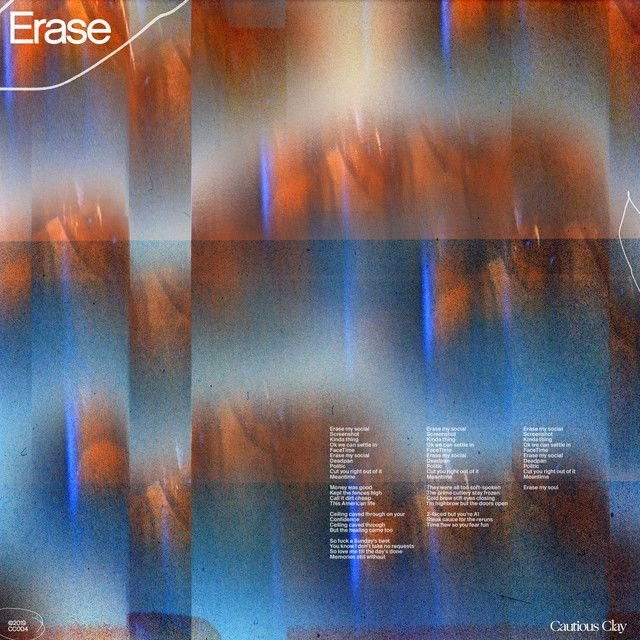
Erase by Cautious Clay
Why This Song Hits a Nerve
The meaning of Erase Cautious Clay comes into focus fast: this is a song about wanting distance from the digital version of the self. Rather than celebrating online visibility, it questions what gets lost when screens, snapshots, and image management start shaping everyday life.
"Erase" - Cautious Clay
Screenshot kinda thing
Okay, we can settle in FaceTime
Loading lyrics...
Unable to load lyrics
We're unable to display the lyrics at this time. Please try again later.
Released on September 13, 2019, “Erase” arrived during a busy stretch for Cautious Clay, the project of Josh Karpeh, an Ohio-born artist with a jazz background and a style that blends R&B, pop, and alternative textures. In an interview with NME, Karpeh called the track “a little more hard-hitting” and said it is about living truthfully without letting social media control every part of life. That comment gives the clearest factual frame for the song.

Watch the official Erase
music video
A Hook About Deleting More Than an App
The chorus centers on the phrase Erase my social
. On the surface, that sounds like deleting accounts or stepping away from public platforms. But the song is deeper than a simple “log off” message.
Interpretation: the hook suggests a wish to erase a public mask. They seem tired of being documented, interpreted, and reduced to a feed. When the lyrics mention Screenshot kinda thing
and FaceTime, the song points to a world where intimacy is filtered through devices. Even contact that looks personal can still feel staged, saved, and replayed.
That tension matters. The song does not say connection is bad. It says connection becomes thin when every moment can be captured, judged, and turned into content.
The Verses Turn Private Stress Into Social Critique
One of the strongest lines in the song is Call it dirt cheap, this is American life
. They use that line to widen the scope. This is not just one person having a bad day online. It hints at a larger culture where value feels shallow, fences stay high, and appearances are managed like property.
The next images deepen the pressure. A line about the ceiling caving in on confidence suggests emotional collapse. Then the song quickly adds that healing also comes. That shift is important: “Erase” is not hopeless. It acknowledges damage, but it also looks for recovery after overload.
Ceilin' caved through on your confidenceCeilin' caved through, but the healing came too
That small passage captures the song’s emotional center. Pressure breaks something open, but the break can also make change possible.
Who They Seem to Be Talking To
The song’s voice feels split between self-talk and direct address. At times, they sound like they are speaking to another person who makes demands, keeps score, or stays emotionally slippery. The line don't take your request
suggests resistance. They are no longer willing to perform on command.
Interpretation: this could describe a romantic relationship shaped by technology, where screenshots, reruns, and remote contact replace trust. It could also describe a broader audience, including followers, viewers, or even the pressure of public life itself.
That ambiguity helps the song. Many listeners know what it feels like when personal identity starts bending to outside expectations, whether from one person or from a whole online crowd.
Strange Images, Clear Feeling
“Erase” uses cool, fragmented details: frozen cutlery, cold brew, steak sauce, reruns, fear of fun. These are not narrative clues in a neat story. They work more like flashes from a stressed mind.
The phrase Time flew so you fear fun
is especially revealing. It suggests burnout. When life moves too fast, even pleasure starts to feel suspicious or hard to access. That idea matches the song’s larger concern with overexposure and emotional fatigue.
Cautious Clay often writes in a way that leaves room between the images. Their songs can feel conversational, but they also trust mood and texture. Here, the unusual details make the listener feel disoriented in the same way the narrator does.
How the Production Carries the Message
Karpeh told NME that “Erase” was meant to sound more forceful, and the production reflects that. The beat has a clipped, tense pulse. The groove is still smooth enough to fit his R&B-adjacent style, but it has a firmer edge than some of his softer, more airy songs.
That matters for meaning. The cooler sound palette supports the emotional withdrawal in the lyrics. The vocal delivery feels measured rather than explosive, which makes the song sound controlled even when the words suggest frustration. Instead of a dramatic breakdown, they give listeners a contained pushback.
That restraint fits Cautious Clay’s wider musical identity. As covered by NME, Karpeh studied jazz at George Washington University and has spoken about influences that range from jazz to pop. In “Erase,” that background shows up less as flashy technique and more as control: rhythm, space, and tone do a lot of storytelling.
Artist Context Makes the Song More Personal
The meaning of Erase Cautious Clay becomes richer when placed next to Karpeh’s public comments from the same period. He said he was still figuring out how much of his personal life to share with fans. That makes a line like Erase my soul
feel especially striking. It sounds like the fear that too much exposure can hollow a person out.
Importantly, he did not frame social media as purely evil. He said those platforms have value, but people should also invest in those around them. That balance is key. The song is not preaching a total retreat. It is asking for healthier boundaries.
Final Take: A Song About Boundaries in Public Life
“Erase” works because it turns a very current problem into something emotional and human. It is about social media, but also about self-protection, intimacy, and the cost of being too visible. The song’s fractured images and firmer production make that stress feel immediate.
Interpretation: the best way to hear it is as a boundary-setting anthem disguised as a moody alt-R&B track. They are not just trying to disappear. They are trying to keep something real from being flattened into a public version of themselves.
Disclaimer: This article offers interpretation based on the lyrics, released recordings, and artist comments. Songs can support more than one valid reading.








