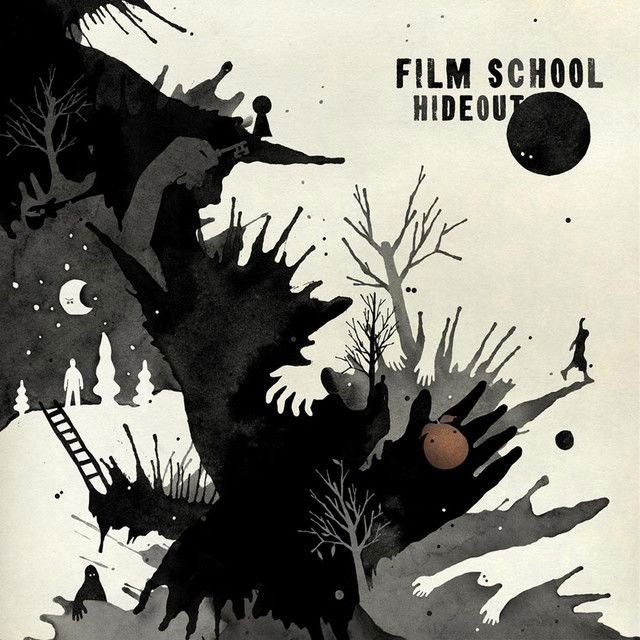
Two Kinds by Film School
The meaning of Two Kinds Film School centers on uncertainty in love. In a few lines, the band sketches a relationship that feels intimate but unstable, abstract but wounded. The song does not tell a full story with clear events. Instead, they build a mood: two people are talking, one asks a strange question, and the answer reveals how fragile their connection has become.
"Two Kinds" - Film School
If all strangers turned to stone
I'll tell you what might happen
Loading lyrics...
Unable to load lyrics
We're unable to display the lyrics at this time. Please try again later.
Because the lyrics are brief and repetitive, the meaning comes from tension rather than plot. The song keeps returning to one core idea: love may not be one simple thing. It may split into forms, and only one of them feels familiar.
A Small Song With a Big Emotional Split
At the center of the track is the repeated claim that there's two kinds of love
. That line does most of the song's heavy lifting. It suggests contrast, but it never fully defines the two categories.
Interpretation: one kind of love may be mutual, grounded, and lived in the present. The other may be distant, imagined, fading, or harder to trust. When the lyric adds one we used to know
, it introduces loss. They are not just naming two kinds of love; they are admitting that one version now belongs to the past.
That is why the song feels sad without becoming dramatic. It does not shout. It quietly notices that something once clear is no longer available in the same way.

Watch the official Two Kinds
music video
The Opening Question Turns Love Into a Thought Experiment
The first lines begin with a surreal image: all strangers turned to stone
. The song then pairs that image with the wish that we could always be alone
. In plain terms, the speaker is responding to a hypothetical question about isolation.
This matters because the song links romance with separation from the outside world. If strangers become stone, then other people are present but lifeless. If the couple is always alone, then intimacy becomes sealed off from ordinary life.
Interpretation: the song may be asking whether love can survive when it turns inward too completely. Total closeness sounds appealing, but it can also become static, airless, or unreal. The opening image hints that private love can feel safe while also cutting people off from the living world.
A Speaker Who Hesitates in Real Time
The most revealing part of the verse may be the small, nervous language around decision-making. The line I'll take my best guess
makes the speaker sound unsure, as if they are improvising an answer rather than speaking from confidence.
That uncertainty deepens with I'm out if I'm in doubt
. Even without much detail, the phrase suggests self-protection. This is someone who may leave rather than remain inside confusion.
What that hesitation adds
The song's emotional power comes from this contrast:
- they are close enough to discuss love directly
- they are not secure enough to define it clearly
- they want connection, but they fear ambiguity
That tension gives the track its cool, drifting sadness. The speaker does not sound angry. They sound unconvinced.
Why the Chorus Feels Like a Loop
Film School repeat the central refrain again and again, and that repetition shapes the meaning. Rather than moving the story forward, the chorus circles the same unresolved idea. The effect is almost hypnotic.
Interpretation: this loop can represent obsessive thinking after a change in a relationship. When people lose confidence in love, they often repeat the same question in different forms: What changed? What did this used to be? Can it still return?
The repeated I know, I know, I know
is especially interesting because it sounds certain on the surface. Yet inside the song, it feels less like confidence and more like self-reassurance. They may be trying to convince themselves that they understand what has happened.
How the Sound Supports the Meaning
Film School are associated with alternative rock and dreamy, textured production, a style noted across coverage of the band and their catalog on sources like AllMusic and Discogs. That backdrop matters for the meaning of Two Kinds Film School because the song's likely emotional effect depends on atmosphere as much as words.
In this kind of arrangement, repetition can feel immersive rather than repetitive in a negative sense. Layered guitars, steady rhythm, and soft-edged vocals often create emotional blur. That blur matches the lyric's uncertainty. The words are simple, but the mood around them makes them feel haunted.
Factual note: the songwriters listed for the track are Greg Bertens, Jason Ruck, Justin Labo, and Nyles T. Lannon, as provided in the song context.
Two Plausible Readings of the Song
Reading one: a relationship that has changed
This is the clearest reading. Two people once shared a recognizable kind of love, and now they are stuck comparing the past with the present. The familiar version may be gone, leaving only doubt, memory, and analysis.
Reading two: love versus fantasy
A second reading is more philosophical. The song may separate lived love from imagined love. One kind exists in real life, with uncertainty and other people around it. The other kind wants perfect isolation and total unity, but that perfection turns lifeless.
That is where the opening stone image becomes important. It may suggest that fantasy can freeze the world instead of deepening it.
Why the Song Still Lingers
What makes "Two Kinds" memorable is its restraint. Film School do not overexplain the breakup, the fear, or the emotional divide. They let one strange image and one repeated idea carry the whole track.
For listeners, that openness is the point. The song gives them just enough to recognize a familiar feeling: the moment when love stops feeling singular and starts feeling split between what is real now and what used to be.
That is the best way to understand the meaning of Two Kinds Film School. It is a song about love under pressure from doubt, memory, and distance.
Disclaimer: This interpretation is based on the available lyrics and general artist context. As with many concise, atmospheric songs, other readings are possible.







