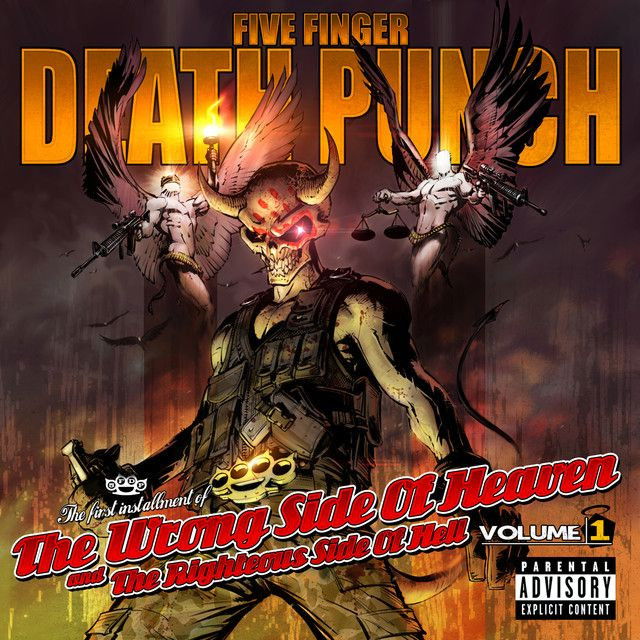
Why "M.I.N.E (End This Way)" Hits So Hard
Five Finger Death Punch often write songs that turn pain into something blunt, loud, and easy to feel. That is exactly why the meaning of M.I.N.E (End This Way) Five Finger Death Punch stands out. Instead of sounding angry for the sake of it, this song feels like a painful confession from someone who knows they damaged a relationship and cannot fix it.
"M.I.N.E (End This Way)" - Five Finger Death Punch
Everybody bleeds
Everybody bends to fill a need
Loading lyrics...
Unable to load lyrics
We're unable to display the lyrics at this time. Please try again later.
Written by Ivan Moody, Jason Hook, Jeremy Spencer, Kane Churko, Kevin Churko, and Zoltan Bathory, the track fits the band’s hard rock style while leaning into emotional self-examination rather than pure aggression. The songwriting credits provided with the song point to a collaborative piece built around regret, inevitability, and the sense that two people saw the ending coming.
A Breakup Song Framed as a Shared Human Wound
At its core, the song presents heartbreak as both personal and universal. The opening idea repeats that everyone suffers, everyone breaks, and everyone wants relief. By stressing common pain, the narrator is not asking for pity. They are placing their own failed relationship inside a larger truth: suffering is part of being human.
That is why brief phrases like Everybody hurts
and not alone
matter so much. They widen the song beyond one couple. The speaker may be dealing with guilt, but they also seem to be reminding themselves that pain is not unique and isolation is not total.
Interpretation: this opening works almost like emotional self-defense. If everyone bleeds and everyone grieves, then this breakup is tragic, but not meaningless. It becomes one more example of how people hurt each other while still wanting love.

Watch the official M.I.N.E (End This Way)
music video
The Real Conflict Is Guilt Without Repair
The most revealing part of the lyric is not just that the speaker caused harm. It is that they admit it while also insisting there is no path back. They confess to having hurt you
and deserted you
, but the song does not move toward apology in the usual way.
Instead, it stops at recognition. The narrator sees the damage clearly, yet says they cannot compromise or apologize in a way that would change the outcome. That makes the song heavier than a simple regret anthem. It is about moral clarity arriving too late.
Why the Chorus Feels So Final
The emotional center lands in the repeated idea that end this way
was always waiting in the background. The line does not sound shocked. It sounds resigned.
We both knew
It would always end this way
This is the song’s only real thesis statement. It suggests the relationship was troubled from deep inside, not ruined by one single event. The speaker’s actions still matter, but the chorus frames the collapse as something both people sensed long before the final break.
Pulling Someone Close Out of Fear
One of the sharpest ideas in the song is that the narrator held on tighter because they feared abandonment. In plain terms, they clung to someone because they expected that person to leave. That creates a painful contradiction: the need for closeness may have helped cause the loss.
Interpretation: this is one of the strongest meanings in the track. It suggests anxious attachment, possessiveness, or emotional overcorrection. The speaker does not present themselves as a villain in a cartoon sense. They sound like someone whose fear made them controlling, and whose control pushed love closer to collapse.
That detail deepens the meaning of M.I.N.E (End This Way) Five Finger Death Punch. The song is not only about a breakup. It is about how fear of loss can shape behavior that makes loss more likely.
The Sound Mirrors the Lyrics
Musically, the track’s rock foundation supports that cycle of pressure and release. Five Finger Death Punch are known for pairing thick guitars, forceful drumming, and melodic choruses, a style widely documented across the band’s catalog and releases. In a song like this, that contrast matters.
The verses carry a reflective tone, almost as if the speaker is taking inventory of damage. Then the chorus opens up emotionally, making the confession sound larger and more fatalistic. That shift gives the song its punch: private guilt becomes public, an inner wound becomes a shouted truth.
Heavy But Not Empty
The production style associated with Kane and Kevin Churko often emphasizes clear vocal presence inside dense hard rock arrangements. That matters here because the song needs both force and clarity. If the vocal were buried, the regret would feel vague. Instead, the emotional message stays front and center.
Interpretation: the instrumentation does not just make the song dramatic. It helps stage the conflict between control and collapse. Tight riffing suggests tension, while the larger chorus suggests surrender.
Two Strong Ways to Read the Song
There are at least two useful readings of the track:
- A direct relationship breakup: The most obvious reading is romantic collapse, with mutual awareness that the bond could not survive.
- A broader self-destructive pattern: The song can also describe someone trapped in habits that damage every close connection they touch.
Both readings fit because the language stays broad. The repeated universal lines about pain and grief make the song feel larger than one argument or one betrayal.
Why the Song Connects
Part of the appeal is its honesty. The narrator does not pretend innocence, but they also do not offer a clean redemption arc. Many breakup songs choose blame or apology. This one sits in a harsher middle space: they understand what they did, they understand what was broken, and they believe the ending was built in.
That is why the song resonates with listeners who have lived through messy endings. It captures the moment when clarity arrives after the damage, not before it.
The Last Word on Its Meaning
The meaning of M.I.N.E (End This Way) Five Finger Death Punch is rooted in regret, fear, and inevitability. It shows a speaker facing the truth that love can be real, harm can be real, and sometimes both people know a relationship is headed toward collapse long before it ends.
In that sense, the song is less about one breakup than about a painful human pattern: people want connection, fear losing it, and sometimes help destroy the very thing they wanted to keep.
Disclaimer: This interpretation is based on the lyrics provided and publicly known songwriting context. Like many songs, its meaning can remain open to different listener readings.






