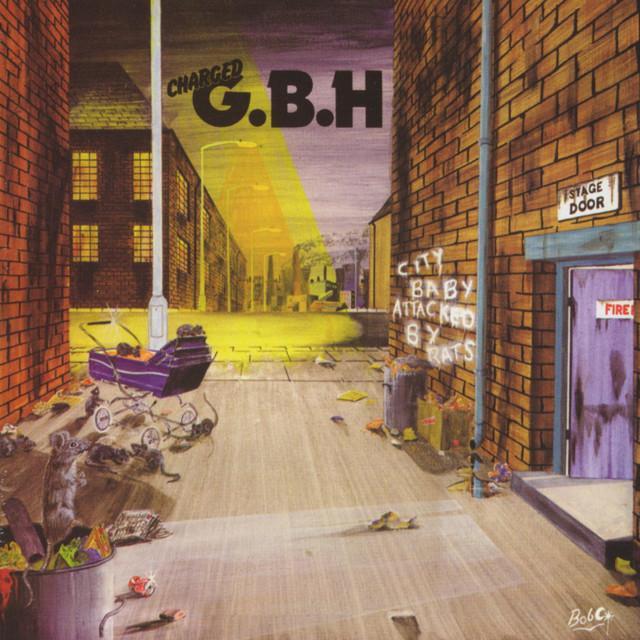
Sick Boy by GBH
GBH turn sickness into a punk badge of honor, then ask whether the real problem is the person—or the system watching them.
"Sick Boy" - GBH
Provided by LyricFindI'm strapped into my bed, I've got electrodes in my head.
My nerves are really bad, it's the best time I've ever had.
I'm a sick boy and there's no cure.Loading...Loading lyrics...
Unable to load lyrics
We're unable to display the lyrics at this time. Please try again later.
Why the meaning of Sick Boy GBH still hits hard
The meaning of Sick Boy GBH starts with contradiction. The song describes a person in what sounds like a medical or psychiatric setting, but instead of sounding scared, they sound thrilled. That mismatch is the whole point. GBH use dark humor to make the listener uneasy, then they push that discomfort toward a bigger question about control, deviance, and identity.
Factually, GBH were one of the key early UK street punk bands, formed in Birmingham in 1978, and they became part of the scene often called UK82. Their early work was known for speed, aggression, morbidity, and black comedy, which gives important context for this song's tone. "Sick Boy" was released as a 1982 single on Clay Records, right in the band's breakthrough era.[1]

Watch the official Sick Boy
music video
A narrator who enjoys the cage
The first verse places the speaker in confinement. They describe being restrained and wired up, using images like strapped into my bed
and electrodes in my head
. The song does not linger on pain in a realistic way. Instead, it turns the scene into something absurd and almost celebratory.
That matters because the narrator says this is the best time
they have ever had. In plain terms, the song flips what listeners expect. A place of treatment becomes a place of pleasure. Interpretation: GBH may be mocking the idea that institutions can define sanity in any simple way. If the patient likes the system designed to fix them, the system starts to look ridiculous.
The chorus turns diagnosis into identity
The hook is blunt: I'm a sick boy
. Then the song adds there's no cure
, which sounds final and confrontational rather than tragic. The chorus does not beg for help. It claims the label.
Interpretation: This can be heard as a punk refusal of respectability. Instead of trying to appear normal, the speaker wears abnormality like a uniform. In that sense, the chorus works almost like a mission statement: society can diagnose them, but it cannot shame them.
There is another layer too. Punk often turned insults into badges. By repeating the diagnosis, GBH strip it of some power. The song becomes less about recovery and more about resistance.
White coats, clipboards, and social control
One of the sharpest details comes when the narrator describes people in white coats
and others taking notes. That is a simple image, but it opens up the song's wider theme. The problem may not just be illness. It may be observation.
In other words, the track is full of authority figures who watch, classify, and record. That fits GBH's broader early style, which often attacked social norms and institutions through exaggeration and ugly humor.[1] Interpretation: the hospital setting can stand in for any system that decides who is acceptable and who is not.
This is where the song feels more clever than it first appears. It sounds chaotic and juvenile on the surface, but its images keep returning to power: beds, electrodes, coats, notes, diagnoses. The speaker may be unstable, yet everyone around them is busy managing that instability.
Desire, taboo, and provocation as punk strategy
The final verse shifts toward sexualized imagery with school uniforms and adolescent desire. The narrator notices school girls everywhere
and calls themselves a gym slip lover
. It is meant to jar.
That does not mean the song should be read as endorsement. GBH's early lyrics often used shock to test the listener's limits. Interpretation: Here, the disturbing attraction deepens the portrait of a narrator who is socially unacceptable in every possible way. They are not only medically labeled; they are morally transgressive too.
In punk, that kind of provocation often serves two functions:
- It creates outrage fast.
- It exposes how culture reacts to deviance.
The song offers no moral lesson, which is exactly why it remains abrasive. It throws the listener into discomfort and refuses to clean it up.
How the sound sells the idea
Musically, "Sick Boy" works because GBH keep everything fast, compact, and raw. Their early recordings were loud, short, and aggressive, and many songs from that era stay under three minutes.[1] That economy matters here. The band do not build a careful psychological study; they hit the listener with a compressed blast of mania.
The guitar tone is jagged, the rhythm section pushes hard, and the vocal delivery sounds sneering rather than emotional. That combination supports the lyric's perspective. If the narrator is trapped, the music does not sound trapped. It sounds energized, even exhilarated.
Interpretation: That is why the song feels less like a cry for help and more like a refusal to be corrected. The sonic attack makes sickness sound active, not passive.
Where the song sits in GBH's story
GBH's influence reached far beyond punk. Their early work helped shape hardcore and even fed into thrash metal's development, with later admiration noted from artists in heavier scenes.[1] "Sick Boy" belongs to that crucial early period when the band were defining their identity through speed, menace, and dark wit.
The credited writers are Andrew Paul Williams, Colin Derek Abrahall, Colin Robert Blyth, and Ross Andrew Lomas, reflecting the classic early-unit chemistry behind the song. While there is no widely sourced band statement giving a definitive explanation of "Sick Boy," the available historical context strongly supports reading it through GBH's known mix of nihilism, morbidity, and humor.
The simplest reading—and the best one
So what is the meaning of Sick Boy GBH? At its core, the song is about a person turned into a diagnosis who then embraces that role so completely that the whole idea of normality starts to look absurd. It is ugly, funny, and hostile on purpose.
The song shocks because it refuses redemption. It does not ask listeners to sympathize fully with the narrator, but it does make them question the world around that narrator. In classic punk fashion, GBH turn disgust into a weapon.
Disclaimer: This interpretation is based on the lyrics, GBH's documented era and style, and the song's musical context. Because no definitive sourced band explanation appears to be widely available, some points above are informed interpretation rather than confirmed author intent.
[1] GBH band history and release context: https://en.wikipedia.org/wiki/GBH_(band)







