
Why 'Watcher of the Skies' Feels So Unhuman
The meaning of Watcher of the Skies Genesis starts with distance. This is not a love song, a diary entry, or a simple sci-fi story. It imagines Earth from far away, as if an outsider has arrived too late and found the human story already over.
"Watcher of the Skies" - Genesis
His is a world alone no world is his own,
He whom life can no longer surprise,
Loading lyrics...
Unable to load lyrics
We're unable to display the lyrics at this time. Please try again later.
Genesis released the song on Foxtrot in 1972, and it later came out as the album's only single in 1973. It was written by Tony Banks, Mike Rutherford, Peter Gabriel, Phil Collins, and Steve Hackett, and produced by David Hitchcock. Factually, it is one of the clearest early examples of the band's progressive-rock style, with Mellotron, odd meters, and a cosmic theme all working together. These details are widely documented in reference histories of the song and album.
An Alien View of Human Absence
At its core, the song presents a witness looking at Earth after humanity has fallen or moved on. The lyric opens with the image of a watcher of the skies
, which immediately places the point of view above the planet, not inside ordinary human life.
Interpretation: The power of the song comes from that cold angle. Instead of asking how people feel, it asks what humanity looks like when seen from outside. That shift makes the song feel eerie, almost like a judgment delivered by silence.
The early lines describe a world where life has ended, changed, or slipped somewhere else. When the lyric says planet unknown
, the idea is not that Earth is literally new. It is that the world has become unrecognizable because the people who gave it meaning are gone.
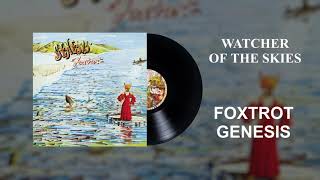
Watch the official Watcher of the Skies
music video
The Story Unfolds in Ruins
The song moves like a short science-fiction scene:
- A distant observer arrives.
- The planet shows signs of past life.
- Humanity seems absent or destroyed.
- A warning is given to those still traveling onward.
- The ending circles back to fate and isolation.
That structure helps explain why the lyrics feel both narrative and philosophical. They are not just describing disaster. They are also asking what remains after a civilization disappears.
One of the key images is empty remains
. The song cautions against judging a whole race only by ruins. In plain terms, it suggests that dead monuments, wreckage, and leftovers cannot fully explain the living people who once made them.
Judge not this raceby empty remains
That is the article's only multi-line quote, and even here the point matters more than the wording. The song argues that evidence after collapse can be misleading. A dead world invites harsh conclusions, but the lyric pushes back against easy judgment.
A Warning Hidden Inside the Cosmic Scale
The middle section changes from observation to counsel. The song starts speaking more directly, almost like a departing elder addressing younger travelers. The phrase ocean of being
turns existence into a dangerous sea, something vast, beautiful, and merciless.
Interpretation: This section may be about human evolution, exile, or leaving Earth behind. It can be heard as a warning that survival is not guaranteed just because a journey has begun. In that reading, the song is less about one apocalypse than about the risk built into progress itself.
Another striking image is the lizard's shed its tail
. On one level, it suggests an old form being cast off. On another, it hints that humanity's bond with Earth has snapped. The line is strange on purpose. Genesis often used surreal imagery to keep meanings open rather than fixed.
The Keats Link and the Sci-Fi Context
The title comes from John Keats's 1817 poem On First Looking into Chapman's Homer, which includes the phrase about a watcher seeing a new planet. That literary source adds wonder to the song's bleakness. The observer is not only horrified; they are also stunned by what they see.
Song histories also note that Tony Banks and Mike Rutherford shaped the lyric idea during a soundcheck in Naples, imagining how an alien might react to an empty Earth. Commentators have also connected the concept to Arthur C. Clarke's Childhood's End, which fits the song's concern with humanity, transformation, and departure.
Why the Music Makes the Meaning Bigger
The song's famous Mellotron introduction is a huge part of its meaning. Tony Banks later explained that the opening was meant to sound enormous and melodramatic, using the Mellotron's unstable character to create atmosphere. That choice matters.
Before a word is sung, the keyboard chords already suggest scale, space, and unease. Then the band shifts into a tense rhythmic pattern, with progressive-rock complexity that never feels random. The unusual meter and later polyrhythmic layers make the ground feel unstable, as if the song itself is looking at Earth from an unfamiliar logic.
This is why the meaning of Watcher of the Skies Genesis cannot be separated from sound. Peter Gabriel's voice delivers the lines like a report from another realm, while Phil Collins's drums and the organ textures keep pushing the song forward with controlled force.
Why It Endures in Genesis History
The song opened Genesis concerts from 1972 to 1974 and remained part of their live world after that in instrumental form. It was ideal for that role because it announced the band's ambition right away: literary, theatrical, and musically massive.
It also captured the Peter Gabriel-era Genesis identity. Onstage, the band's visual style and the song's apocalyptic grandeur worked together, turning the performance into a kind of cosmic theater.
The Last Look
In the end, the song is about what humanity looks like after it can no longer explain itself. It imagines a witness, a ruined planet, and a future that may continue without comfort or mercy.
Interpretation: The song does not offer a single neat lesson. It can be heard as a warning about self-destruction, a meditation on evolution, or a study of loneliness on a civilizational scale.
That is part of why it still feels so powerful. It leaves listeners with awe, not closure.
Disclaimer: This interpretation blends documented context with critical reading of the lyrics and music. As with many Genesis songs, some meanings remain intentionally open.








