
More by Halsey
The meaning of More Halsey comes through with unusual clarity: it is a song about wanting a child, suffering loss, and still choosing love. Rather than hiding behind vague language, they build the track from intimate images of waiting rooms, empty space at home, and a future they can almost picture.
"More" - Halsey
When a house ain't a home
Is it true, honestly
Loading lyrics...
Unable to load lyrics
We're unable to display the lyrics at this time. Please try again later.
Halsey released “More” on Manic in 2020, an album they described as one of their most personal projects. In interviews around that era, they also spoke openly about endometriosis and pregnancy loss, which gives the song real-life context without reducing it to biography alone. The writing credits provided for the song include Ashley Frangipane, Ammar Malik, Andrew Wells, Benjamin Joseph Levin, David M. Lubben, Kevin Michael Snevely, Magnus Høiberg, and Peder Losnegård.
The Heart of the Song Is Love After Loss
At its core, “More” is about parental love that exists before birth and survives disappointment. The opening lines place the listener in a painful emotional space: a home that feels unfinished, a body that feels tied to the crisis, and years marked by medical spaces and spiritual doubt.
When the lyric mentions waiting rooms
, it turns a broad feeling into a concrete scene. This is not abstract sadness. It is the routine, draining kind of heartbreak that comes from trying, hoping, and hearing bad news again.
Interpretation: The song suggests that grief and desire are not opposites. The more they hurt, the more intense the love becomes. That is why the refrain matters so much: the word more
is not about having more pain instead of love, but more love because pain has revealed how deep that desire runs.
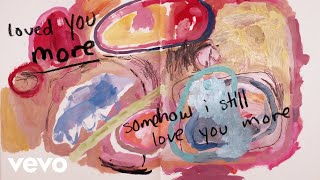
Watch the official More
music video
A Future Imagined in Small Household Details
One of the song’s smartest choices is how it imagines parenthood through ordinary objects. They picture little feet
, clothes in a drawer, and a sonogram-like image through a little screen
. These are not grand symbols. They are domestic, tactile, and close to everyday life.
That approach makes the song more devastating. The narrator is not mourning an idea alone; they are mourning routines and moments they have already started to love in their mind. The phrase flower bud in concrete
captures that tension well. It suggests fragile hope growing in a hard place.
How the Story Moves From Despair to Promise
The song unfolds in a clear emotional arc:
- It begins with doubt, exhaustion, and the fear that hope may be pointless.
- It shifts into longing, where wanting becomes stronger instead of weaker.
- It turns to imagined scenes of family life and recognition.
- It ends in a promise of enduring love.
That final movement is especially striking. Instead of closing on a medical outcome, the song closes on commitment. The message is not, “Everything worked out.” It is closer to, “Love is already here.”
I've loved you for all of my lifeSomehow I'll still love you more
Those lines are simple, but they carry the song’s emotional thesis. They recast parenthood not as a status achieved, but as a bond felt long before certainty arrives.
The Chorus Turns Pain Into Devotion
The chorus is repetitive by design, and that repetition mirrors obsessive thought. In many songs, a hook offers release. Here, it works more like a return to the same ache. Yet each repetition also sounds like resolve.
Interpretation: The repeated idea of wanting “more” may reflect the cycle of grief itself. A person revisits the same questions, rooms, and hopes, but each pass changes the emotional weight. The chorus becomes both a lament and a vow.
This is why the song resonates with listeners beyond one exact life experience. Even for people who have not gone through infertility or miscarriage, the structure feels familiar: when something matters deeply, setbacks can intensify attachment instead of ending it.
Why the Production Feels So Bare
“More” uses restrained production, with soft piano and a gentle, spacious arrangement that leaves room around the vocal. That quietness matters. A louder or busier track could have made the message feel overstated. Instead, the near-fragile sound keeps attention on breath, pauses, and emotional detail.
Halsey’s vocal delivery is also crucial. They sing with control, but not distance. There is pain in the phrasing, especially when lines stretch toward the end of a thought, as if the singer is trying to hold themselves together. The effect is confessional without becoming melodramatic.
From a songcraft point of view, this balance is a big reason the track lands. The writing is specific, but the arrangement never crowds it.
Artist Context Sharpens the Meaning
Knowing Halsey’s broader history adds depth to the track. They have publicly discussed reproductive health struggles, including endometriosis and miscarriage, in interviews and public statements. That context helps explain why “More” feels so lived-in and precise.
Still, the best reading stays inside the song first. The lyrics themselves provide enough evidence: medical imagery, imagined parenthood, spiritual conflict, and a promise to a child not yet met. Biography supports the interpretation, but the song earns it on the page and in the performance.
Why “More” Still Hits So Hard
The lasting power of the meaning of More Halsey is that it refuses easy closure. It does not offer a neat lesson or a triumphant ending. Instead, it captures something harder to express: how love can fully exist even in uncertainty.
That honesty is what makes the track memorable. They turn private grief into a quiet, durable song about hope, absence, and the fierce instinct to keep loving anyway.
Disclaimer: This interpretation is based on the lyrics, performance, and publicly discussed context. As with any song, listeners may hear meanings that differ from this reading.








