Why ‘Family Tradition’ Still Defines Hank Jr.
When people ask about the meaning of Family Tradition Hank Williams, Jr., the short answer is this: it is a proud, funny, and defensive statement about living under a famous last name while refusing to please everyone. Hank Williams Jr. turns criticism into a chorus and makes his own image part of the song’s message.
"Family Tradition" - Hank Williams, Jr.
But lately, some of my kinfolks have disowned a few others and me
I guess it's because I kind of changed my direction
Loading lyrics...
Unable to load lyrics
We're unable to display the lyrics at this time. Please try again later.
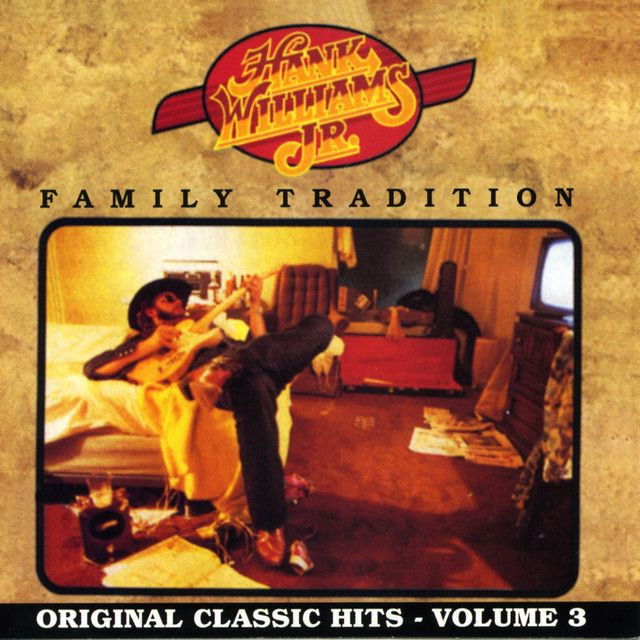
Released on May 28, 1979, as the title track from Family Tradition, the song was written by Williams Jr. and produced by Jimmy Bowen. It reached No. 4 on Billboard’s Hot Country Songs chart and remains one of his best-known recordings. It was also later certified 3× Platinum by the RIAA, showing how long its appeal has lasted.
A Rebellion Hidden Inside a Sing-Along
At its core, the song is about two kinds of pressure. One comes from country music insiders, the people in the first verse who act like a close family until someone changes the rules. The other comes from bloodline pressure: being the son of Hank Williams means the public expects a certain sound, a certain sadness, and a certain kind of myth.
Williams Jr. answers that pressure with sarcasm. He repeats the questions people ask him—why he drinks, why he smokes, why he seems to live like the songs he sings—then flips those attacks into a shrug: family tradition
. That phrase is both a joke and a shield.
Interpretation: the song does not truly excuse self-destruction. Instead, it shows how public judgment can flatten a person into a stereotype, and how they may lean into that stereotype just to keep control of the story.

Watch the official Family Tradition
music video
The Shadow of Hank Sr. Never Leaves
One of the song’s most important ideas is that Williams Jr. is not rejecting his father. In fact, he says he is very proud
of his father’s name. That matters because the song is often mistaken for a simple outlaw anthem.
It is more complicated than that. He admits that his father’s music and his own ain't exactly the same
. That single idea explains the whole track. He wants the legacy, but not the cage.
According to American Songwriter, the song works as a tongue-in-cheek answer to critics and to the long shadow of Hank Williams Sr. That framing helps explain why the tone feels so loose even when the subject is heavy.
How the Verses Build the Message
The song moves in clear steps:
- It opens with rejection from the country “family.”
- It shifts to public accusations about drinking and smoking.
- It declares pride in his father while claiming musical difference.
- It ends by turning personal trouble into legend and defiance.
That structure matters. Each verse gives a different source of pressure, and each chorus answers with the same refrain. By the time he calls his situation my unique position
, the song has widened from autobiography into a statement about fame itself.
There is also a sharp line about loving women and Jim Beam
, followed by a reference to 1973. He uses that moment to admit real damage without dropping the song’s rough grin. The honesty keeps the track from becoming pure bragging.
Why the Chorus Hits So Hard
The chorus is memorable because it sounds like a trial and a party at the same time. The questions come from critics, but the crowd can sing them too. That turns judgment into participation.
Why do you drink?Why do you roll smoke?Why must you live outthe songs that you wrote?
After that, the answer lands with a mix of humor and stubborn pride. In live performance, the song often becomes call-and-response, which fits its meaning perfectly. A crowd repeats the accusations, and the singer owns them anyway.
Interpretation: that is why the song has lasted. It lets listeners join the argument, not just hear it.
The Sound Makes the Meaning Bigger
The production also helps explain the meaning of Family Tradition Hank Williams, Jr. This is not polished countrypolitan. It has a barroom feel, a sturdy rhythm, and a vocal delivery that sounds conversational, rowdy, and fully in control.
That matters because the song itself is about changing direction. Research on the track notes that Williams Jr. had moved away from a more traditional, father-linked presentation and toward a Southern rock and honky-tonk blend. The arrangement sells that move. It sounds grounded in country, but looser and tougher around the edges.
A key detail is the fiddle-led bridge performed by Charlie Daniels, which adds extra fire and roots the song in a live-wire Southern spirit. The music does not just support the lyrics; it proves the point that Hank Jr. had found his own lane.
More Than a Party Song
It is easy to hear “Family Tradition” as a celebration of outlaw behavior. That is part of its appeal, but it is not the whole story. The song is also about inheritance, performance, and the burden of being watched.
Rolling Stone described it as an open-letter kind of song, aimed at purists who questioned both his lifestyle and his sound. That reading fits. He is speaking to critics, to fans, and maybe to himself all at once.
So the deeper meaning is not “rules do not matter.” It is closer to this: people will write a role for someone before they get to speak, and sometimes the only way to answer is to turn that role into a song they cannot ignore.
The Last Word on Its Meaning
The meaning of Family Tradition Hank Williams, Jr. comes from its double stance: loyalty to family myth and refusal to be trapped by it. It is rebellious, but also wounded. It is funny, but also defensive. That mix is what makes it feel human.
This article offers an interpretation based on the lyrics, performance, and documented context; like any song, “Family Tradition” can support more than one reasonable reading.








