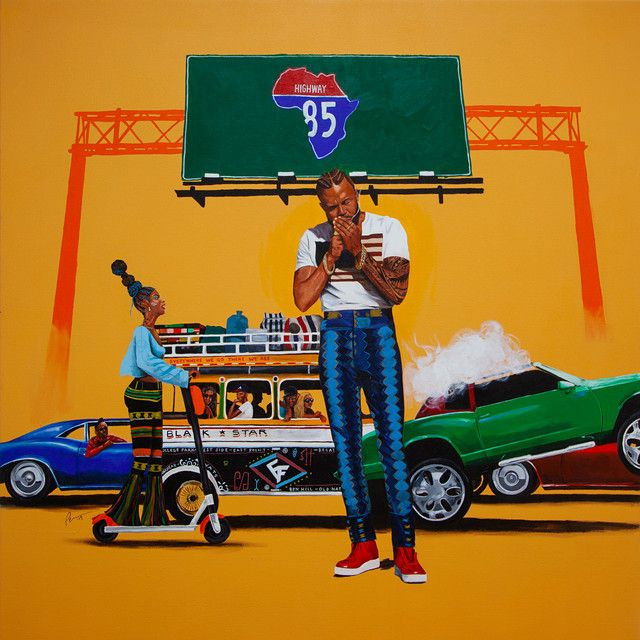
85 to Africa by Jidenna
A Highway Turned Into a Homecoming
The meaning of 85 to Africa Jidenna starts with a striking image: a U.S. interstate becoming a road back to ancestry. Jidenna is not saying someone can literally drive from Atlanta to Africa. Instead, they turn Interstate 85 into a metaphor for cultural return, Black self-definition, and movement beyond the limits of American racial politics.
"85 to Africa" - Jidenna
I need a new conversation
I need a new obligation
Loading lyrics...
Unable to load lyrics
We're unable to display the lyrics at this time. Please try again later.
The song appears on Jidenna’s second album, 85 to Africa, released in 2019 through Wondaland and Epic. The album blended hip-hop, highlife, afrobeats, and Afro-fusion, and critics often noticed its wide musical scope and big concept. In a Billboard interview, Jidenna described the project as the soundtrack for traveling from Atlanta’s I-85 toward Africa, a bridge between places and sounds.
Watch the official 85 to Africa
music video
What the Song Is Really Saying
On the surface, the track feels loose and confident. But under that swagger, Jidenna is challenging how Black identity gets narrowed in the United States. Early lines ask for a new conversation
, which signals frustration with stale debates about race, blame, and belonging.
They then point toward Africa not as an abstract symbol, but as a real network of cities, memories, and histories. References to Accra, Abuja, Lagos, Haiti, and spiritual traditions widen the map. The song pushes back against the idea that Black identity in America must be cut off from the continent.
Interpretation: The title phrase works like a shortcut to liberation. When Jidenna repeats 85 to Africa
, they are imagining a route out of confusion and into connection.
Diaspora, Memory, and Reclaiming Origin
One of the song’s strongest ideas is that many people in the African diaspora have been taught to look away from Africa, or to treat it as distant. Jidenna flips that attitude. They mention people suddenly wanting DNA tests and hoping they come from Lagos, which sounds both funny and pointed.
That moment is about reclaimed curiosity. What was once ignored is now desired. The song notices that change, but it also teases it. Jidenna seems to ask: why did it take so long for some people to value African roots?
They also connect Black Atlantic identities rather than treating them as separate. Haitian, Jamaican, Nigerian, Brazilian, and Afro-spiritual references sit side by side. This matters because the song is not just about one nation. It is about a larger diaspora finding links across oceans.
I'll just take the 85 to Africawhen I gotta vanish
Those lines suggest escape, but not cowardice. They frame Africa as refuge, source, and alternate center.
The Verse Themes: Frustration Meets Pride
Jidenna’s writing moves fast, but several themes repeat:
- dissatisfaction with empty public arguments
- pride in African heritage
- anger at racial pressure and policing
- interest in spiritual traditions outside narrow Western frames
- a desire to travel, reconnect, and redefine home
When they refer to the matrix
, the idea is clear even without long quotation: many people are trapped in fake systems, received opinions, and racial scripts. The song rejects that trap.
Another sharp section brings up religion and spiritual practice. Jidenna references juju, Santería, Candomblé, and Umbanda. These mentions matter because the song refuses the old story that African-derived belief systems are backward or evil. Instead, they are treated as living parts of culture and history.
Interpretation: This makes the track more than a travel song. It becomes a defense of African and diasporic knowledge that has often been mocked or misunderstood.
Why Atlanta Matters So Much
Atlanta is not a random setting. It is one of the most important Black cultural capitals in the United States, especially in rap. By starting from Atlanta, Jidenna grounds the song in present-day Black America before opening the route outward.
That choice also shapes the album concept. According to Billboard, Jidenna imagined the music beginning with Atlanta trap and then moving sonically across the Atlantic. That helps explain why the song feels both Southern and transnational at once.
So the road in the chorus does two jobs:
- It is a real American highway.
- It is a symbolic passage to African consciousness.
How the Sound Carries the Message
The production, credited to Nana Kwabena, J-Kits, and Dom, is key to the song’s meaning. It does not sit fully in one genre. The beat hits with rap energy, but its rhythm and bounce hint at Afro-fusion movement.
That blend supports the song’s argument. Jidenna does not want Africa and America to sound sealed off from each other. They want the listener to hear a route between them.
Critics noticed that larger approach on the album. Pitchfork praised the project’s cinematic and expansive
production, while AllMusic highlighted its tighter sonic ties to Africa. Even when reviews were mixed on some lyrics, many agreed the record’s world-spanning sound was one of its strengths.
A Bold Chorus With Two Possible Readings
The hook is catchy, but it can be read in at least two ways.
Interpretation 1: It is a fantasy of escape. When American life becomes hostile or draining, Jidenna imagines leaving and finding freedom elsewhere.
Interpretation 2: It is not about leaving forever. It is about mental and cultural alignment. In that reading, “Africa” means a reclaimed center of identity, even while someone remains in the U.S.
Both readings fit the song. That tension is part of what makes it memorable.
Why the Song Still Connects
The meaning of 85 to Africa Jidenna lasts because it turns a complex subject into a simple image. A highway becomes history, and travel becomes identity work. The song is playful, but it also has weight. It speaks to listeners who feel boxed in by American labels and want a larger map of Black life.
Jidenna’s title track is not subtle, and it is not meant to be. It is a statement piece about origin, motion, and choosing a wider cultural horizon.
Disclaimer: This interpretation blends documented context with critical reading of the lyrics and sound. As with any song, listeners may hear different meanings.








