
Why LDA's 'Quello che fa male' Hurts
The meaning of Quello che fa male LDA comes down to one sharp idea: people can become attached to the very love that wounds them. In this song, LDA frames romance as something both healing and destructive. The narrator feels overwhelmed, breathless, and emotionally exposed, yet they still reach toward that same person.
"Quello che fa male" - LDA
Noi che balliamo intorno a bordo di un cratere
Che con te accanto tutto il mondo non si vede
Loading lyrics...
Unable to load lyrics
We're unable to display the lyrics at this time. Please try again later.
LDA is the stage name of Luca D'Alessio, an Italian artist who emerged to wider attention through Amici di Maria De Filippi and later developed a melodic pop style of his own. The songwriting credit provided here lists Alessandro Caiazza and Luca D'Alessio. Those facts help place the song in LDA's usual lane: emotional pop built on youthful vulnerability rather than distance or irony.
The real emotional center
At its core, the song is about contradiction. The narrator knows this bond is painful, but they also present it as essential. That tension appears most clearly in the refrain about loving what hurts and letting go of what helps. In plain terms, they are describing a pattern many listeners recognize: mistaking emotional intensity for emotional truth.
This is why the hook lands so hard. When the singer says quello che fa male
, they are not just talking about one bad moment. They are naming a habit of the heart. The song suggests that pain can start to feel familiar, and familiarity can be confused with love.
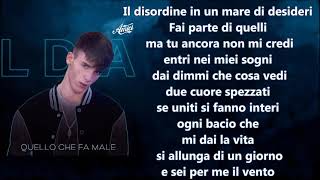
Watch the official Quello che fa male
music video
A speaker caught between longing and self-awareness
The verses show someone who is not fully blind to the situation. They look inward, notice they have changed, and feel the absence of the other person in almost physical terms. The mirror image in the lyric points to a loss of identity after separation.
That matters because the song is not only saying, "I miss you." It is also saying, "I am not the same without you." When the narrator describes being unable to breathe well, the feeling is dramatic, but it also fits the style of young romantic pop: emotion is felt in the body before it is explained by the mind.
The addressee stays partly out of reach
The loved person is drawn in tender, idealized images. Their touch is soothing, their presence changes the whole world, and their gaze has almost mythic power. Even so, the relationship feels unstable. The line tu non lo sai
gives the song one of its saddest turns: the deepest feeling may not even be fully known by the person receiving it.
That creates a gap between inner truth and spoken truth. The narrator feels everything intensely but struggles to communicate it clearly.
How the chorus reframes the verses
The chorus takes private longing and turns it into a wider statement about human behavior. Instead of saying only that this one romance is difficult, the song broadens the point: people often reject what is healthy and chase what is damaging.
That is why the storm image matters. When the singer compares their crying to a storm, they are showing love as weather—sudden, overpowering, and larger than control. The promise to keep that pain far away sounds noble, but it also sounds fragile. They want to protect the other person from their sadness, yet the whole song proves that sadness is already everywhere.
Ti prego amore non devi cambiare
Le tue carezze fanno bene al cuore
This brief moment captures the paradox. They beg the other person not to change because the relationship still contains comfort. Even inside a painful bond, there are real moments of relief.
Images of craters, oceans, and broken hearts
The imagery gives the song much of its meaning. Early on, the lovers are imagined dancing near a crater. That is a striking picture: joy taking place beside danger. Love here is never fully safe; it is beautiful because it stands so close to collapse.
Later, disorder becomes a sea of desires. That image suggests emotional chaos, but not emptiness. The narrator's inner life is crowded, restless, and full of wants they cannot easily organize. The dream imagery pushes this further, showing that the relationship follows them even into sleep.
One of the strongest ideas appears when the lyrics suggest due cuori spezzati
can become whole together. Interpretation: this could mean love offers repair. But it could also be a warning. Two hurt people do not always heal each other; sometimes they simply make pain feel mutual, and therefore easier to accept.
How the sound likely supports the message
Even without diving into full production notes, the writing strongly points toward contemporary Italian pop: a clean melodic structure, emotional vocal emphasis, and a chorus designed to feel immediate. Songs like this often rely on soft verse space and a fuller, more open chorus so that private pain turns into collective release.
That sonic shape fits the meaning of Quello che fa male LDA very well. The verses feel confessional, while the refrain feels universal. If the arrangement includes airy synths, piano, or restrained percussion, that would reinforce the push-pull mood: intimate but dramatic, wounded but still warm.
LDA's vocal style also matters. They tend to sing with directness rather than detachment, which helps a lyric like ti amo da morire
sound raw instead of theatrical. The phrase is extreme, but the emotional setting makes it believable.
Why the song connects
The song works because it does not pretend love is logical. It understands that people can recognize a harmful pattern and still want it. For younger listeners especially, that honesty may feel familiar. The track captures the stage of heartbreak where insight has arrived, but freedom has not.
Interpretation: the song is less a celebration of toxic love than a confession about how hard it is to leave it behind. That distinction matters. The narrator sounds trapped, not proud.
Final takeaway
The meaning of Quello che fa male LDA lies in its portrait of emotional self-contradiction. Love is shown as comfort, addiction, storm, and shelter all at once. That blend is what gives the song its sting.
This reading is an interpretation based on the lyrics provided and general artist context, so listeners may hear different shades of meaning in the song.








