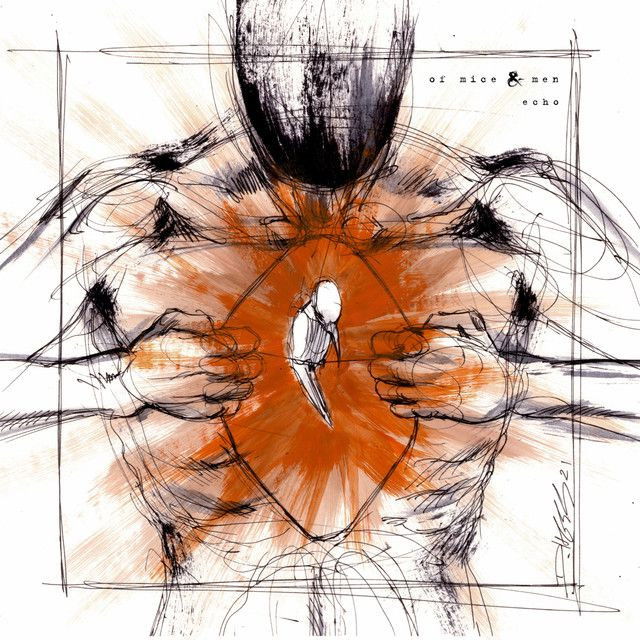
Echo by Of Mice & Men
The meaning of Echo Of Mice & Men centers on a big question: if life is short and fragile, what remains after people are gone? Their answer is not simple comfort. Instead, the song suggests that human beings fade physically, but their presence keeps moving through memory, influence, and time like a sound wave that never fully disappears.
"Echo" - Of Mice & Men
I can see history repeating
Time breaks down
Loading lyrics...
Unable to load lyrics
We're unable to display the lyrics at this time. Please try again later.
That idea fits the larger context around Echo, the band’s seventh studio album, released on December 3, 2021 through SharpTone Records. The record was self-produced during the pandemic, with the band working remotely, and Aaron Pauley handling mixing and mastering. That isolated process matters because the album itself was described by Pauley as a snapshot of a difficult period shaped by loss, growth, love, impermanence, and the infinite.
The Song’s Core Idea Lives Between Time and Memory
At the lyric level, the song opens in a state of déjà vu. The speaker feels history repeating and senses patterns returning, even in places that should feel new. When they mention history repeating
and later say they have seen it all before, the song frames life as a loop rather than a straight line.
This is where the writing gets philosophical. The lyrics do not just describe memory; they blur memory, destiny, and recurrence. The speaker walks a familiar path in an unfamiliar place, which creates the feeling that human experience may be part of something older and larger than one lifetime.
Interpretation: the song suggests that people are not fully separate individuals moving through isolated moments. They may be part of one ongoing pattern, where past and present constantly reflect each other.

Watch the official Echo
music video
Why the Chorus Feels So Huge
The chorus gives the song its clearest image. People are compared to a cry sent into darkness: We echo
and move into the ether
. In plain terms, the band is saying that human life sends something outward, even after the body fades.
That is why the next image matters too. The line about fading like a spark
admits weakness and brevity. A spark is bright, but short-lived. The song never pretends otherwise. Yet the chorus balances that sadness with endurance, because the echo keeps traveling into forever
.
Interpretation: this is the emotional center of the track. It holds two truths at once:
- Human life is temporary.
- Human impact may outlast the moment.
That mix of fragility and persistence is what gives the song its power.
The Band Uses Philosophy Without Losing Emotion
One striking part of “Echo” is how openly it borrows from philosophical language. The spoken lines echo T. S. Eliot’s Four Quartets, especially ideas about all time being present and memory carrying footsteps and words forward. The song does not use those references as decoration. It uses them to deepen its main theme: time may not be as cleanly divided as people think.
One ancient melody repeating
Ad infinitum
We were once the same note
This brief passage reframes identity itself. Instead of presenting people as fully separate, it imagines them as pieces of one older sound. They were once the same note, and now they continue as echoes.
Interpretation: the song leans toward a spiritual or cosmic reading of human connection. Whether listeners hear that as religion, metaphysics, ancestry, or collective memory, the point is the same: separation may be less real than it feels.
How the Sound Carries the Meaning
Because Of Mice & Men work in metalcore, the song’s meaning is not only in the words. The sound matters just as much. On Echo, the band combined heavy riffing with atmospheric texture, and that balance suits a song about weight and vastness. The guitars give the track physical force, while the open space in the arrangement suggests distance, ether, and the unknown.
That approach also makes sense in context. According to album coverage, the band recorded remotely during 2020 and built the record through a self-produced process. Pauley told Loudwire that the EP rollout let them “tell a story in chapters,” which fits an album preoccupied with continuity across breaks and fragments.
Even the pacing supports the theme. The song pushes forward, but it also feels suspended, as if it is moving through a large empty space. That tension mirrors the lyric idea that life is both active and fleeting.
How “Echo” Fits the Album Around It
The meaning of Echo Of Mice & Men becomes even clearer when placed beside Pauley’s description of the album as covering “loss and growth, life and impermanence, love, and the infinite.” “Echo” sounds like a distilled version of that statement.
Other songs from the era, especially “Fighting Gravity,” also wrestle with control, mortality, and letting go. So “Echo” does not stand alone as a random philosophical detour. It acts like a thesis statement for the project’s worldview: people cannot control time, but they can create resonance.
Critics generally responded well to the album, with positive notices from outlets like Distorted Sound and others. That reception reflects how the record connected personal feeling to larger existential themes without losing heaviness or intensity.
The Most Useful Reading for Listeners
The best way to hear “Echo” is not as a puzzle to solve, but as a meditation on what remains. The song accepts that people vanish, relationships change, and time moves beyond anyone’s control. Still, it argues that voices, memories, and emotional traces keep going.
So the track is both bleak and comforting. It says people are sparks, yes, but also echoes. They do not last forever in one form, yet something of them may continue in others.
That is likely why the song feels so moving. It gives listeners a way to think about mortality without reducing life to nothing.
Disclaimer: This interpretation is based on the lyrics, artist context, and available reporting. As with any song, individual listeners may hear different meanings in “Echo.”
Sources
- https://en.wikipedia.org/wiki/Echo_(Of_Mice_%26_Men_album)
- https://loudwire.com/of-mice-and-men-fighting-gravity-song-lyrics-echo-album-aaron-pauley-interview/
- https://distortedsoundmag.com/album-review-echo-of-mice-men/
- https://www.rocksound.tv/news/read/this-is-everything-you-need-to-know-about-of-mice-mens-new-album-echo








