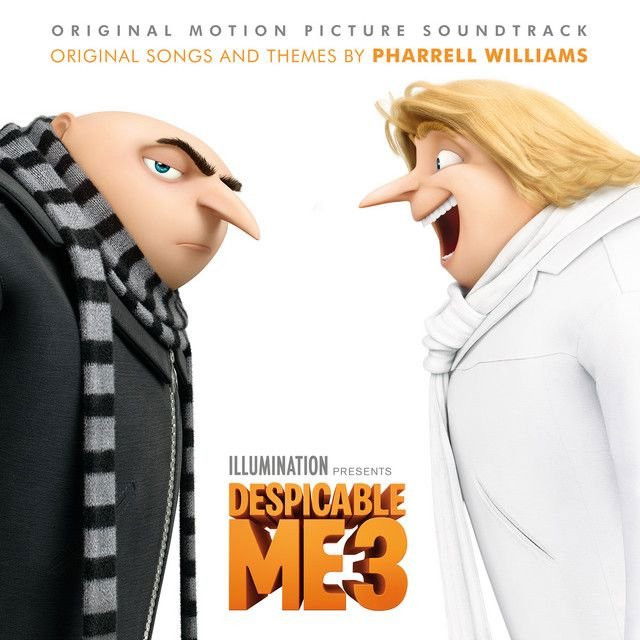
Why Pharrell Makes Gru Sound So Fun
The meaning of Despicable Me Pharrell Williams becomes clear the moment the song starts: it is not trying to make villainy deep, tragic, or scary. It makes it funny. Pharrell Williams and composer Heitor Pereira use a bright, punchy pop track to put listeners inside Gru’s oversized ego, turning bad behavior into a cartoon performance.
"Despicable Me" - Pharrell Williams
It's about time that I get my way
Steam rolling whatever I see, huh
Loading lyrics...
Unable to load lyrics
We're unable to display the lyrics at this time. Please try again later.
Created for Despicable Me (2010), the song works as character introduction as much as soundtrack. Pharrell was heavily involved in the film’s music, while Heitor Pereira composed the score for the movie, according to studio and film-credit records from Universal Pictures and IMDb. That context matters because the track is built to sound like Gru himself: dramatic, silly, boastful, and always moving.
A Villain Anthem With a Wink
At its core, the song is about a person who treats selfishness like style. The hook centers on a mood swing, with the speaker declaring a bad bad day
and using that as a reason to bulldoze everyone else. In plain terms, the song frames cruelty as childish entitlement.
That is why the title phrase lands so well. When the song repeats Despicable me
, it sounds less like a confession and more like branding. They are not ashamed. They are selling the image of being the biggest menace in the room.
Interpretation: the joke is that Gru sees himself as grand and fearsome, but the song keeps exposing how petty he really is. He is dramatic about wanting control, yet the track presents that drama with a grin.
Watch the official Despicable Me
music video
How the Verses Build Gru’s Personality
The verses race through questions, gadgets, and wild plans. Instead of calmly explaining motives, the narrator jumps from one chaotic idea to another. That writing style matters. It creates the feeling of a brain that is always searching for the fastest, loudest, most theatrical option.
A short line like why not
becomes the song’s hidden philosophy. Rather than asking whether something is right, smart, or kind, the speaker asks why they should hold back at all. That tells listeners this is a world of impulse and spectacle.
Another telling phrase is freeze gun
. It points to the movie’s cartoon-science world, where criminal plans are exaggerated and absurd instead of realistic. The song is not interested in real violence. It is interested in comic villain props, the kind that make destruction feel mischievous rather than brutal.
Rivalry, Ego, and Old Frustrations
The lyrics also hint at insecurity under the swagger. The jab at Vector and the mention of family frustrations suggest that Gru’s need to dominate may come from feeling challenged, mocked, or overlooked.
Interpretation: beneath the bravado, the song hints at someone who wants control because they do not feel secure without it. Even the dream of having everything in hand sounds less calm than desperate.
Why the Chorus Is So Effective
The chorus is simple on purpose. It reduces Gru’s whole worldview to a tantrum: they feel wronged, they want power, and anyone hurt along the way can deal with it. The line get my way
captures that mindset perfectly.
This is where the meaning of Despicable Me Pharrell Williams becomes especially sharp. The song is funny because it treats villain logic like playground logic. If the speaker is upset, then the world must bend.
I'm having a bad bad day
It's about time that I get my way
Those two lines are enough to frame the rest of the song. The emotion is small, but the response is huge. That mismatch is the comedy.
The Sound: Bright, Busy, and Proud
Pharrell’s production style often leans rhythmic, clean, and hook-heavy, and that approach fits here. The beat has bounce. The vocal delivery is clipped and playful. The repeated chants push the song forward like a marching cartoon machine.
That brightness matters because a darker arrangement would change the meaning. If the track were ominous, Gru might sound dangerous. Instead, the music makes him sound entertaining. The groove turns his bad mood into a show.
There is also a neat contrast in the bridge, where the song invites people to bounce
. For a moment, the villain is not just threatening people; they are performing for them. That turns the track into part boast, part dance record, and part comedy sketch.
A Character Song More Than a Confession
This song is best understood as a role-playing track. Pharrell is not delivering a personal manifesto. They are helping an animated film define its lead character in under three minutes. The lyrics exaggerate Gru’s attitude so the audience instantly understands him.
That is why the song still works outside the film. Even without the movie, listeners can hear a comic portrait of ego run wild. But with the movie in mind, every gadget reference and arrogant line feels more precise.
Final Take on the Song’s Meaning
So, what is the meaning of Despicable Me Pharrell Williams? It is a playful portrait of villainy as performance. The song shows Gru as selfish, flashy, and destructive, but never in a way that asks listeners to fear him too deeply. Instead, it invites them to laugh at how seriously he takes his own chaos.
In the end, that balance is the song’s real trick. It celebrates the fun of a larger-than-life bad guy while quietly showing how immature that pose really is.
Disclaimer: This interpretation is based on the lyrics, the film context, and publicly available credits. As with any song, meaning can vary from listener to listener.








