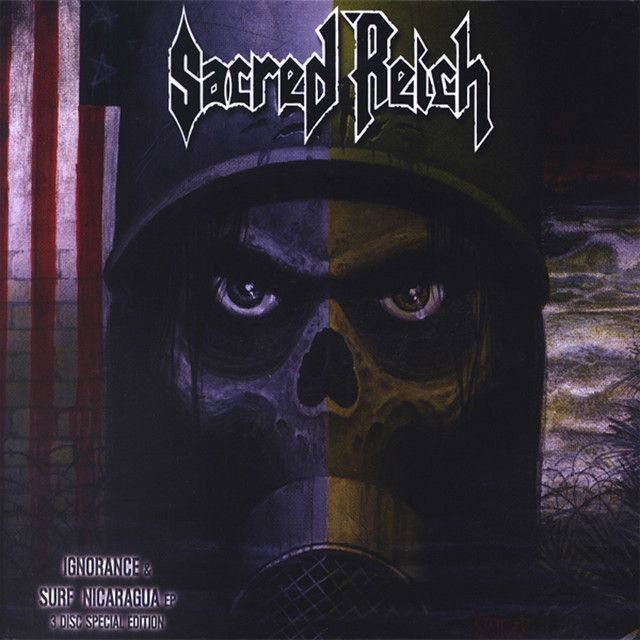
Surf Nicaragua by Sacred Reich
The meaning of Surf Nicaragua Sacred Reich starts with a blunt question: how does a government convince young people to fight in a war that feels far away and hard to justify? Sacred Reich answers with sarcasm, speed, and anger.
"Surf Nicaragua" - Sacred Reich
Where you're all going to go
They'll pay you to kill
Loading lyrics...
Unable to load lyrics
We're unable to display the lyrics at this time. Please try again later.
Released on the 1988 EP Surf Nicaragua through Metal Blade, the track came after the band’s debut Ignorance and was produced by Bill Metoyer with the band, according to the release details documented by Wikipedia’s summary of the EP. The song is widely understood as a protest against U.S. intervention in Central America, especially Nicaragua during the 1980s.
A Thrash Song Aimed at Foreign Policy
At its core, the song is anti-war and anti-intervention. It imagines a young American being recruited, reshaped, and sent into a conflict that is sold as noble but feels hollow once they arrive.
Very early, the lyrics describe the system almost like a machine. The recruit is told they will be paid, cleaned up, and turned into a soldier. The phrase play G.I. Joe
is especially sharp because it reduces war propaganda to a toy-box fantasy. Sacred Reich suggests that military service is being packaged as adventure, while the real result is violence and confusion.
This is where the meaning of Surf Nicaragua Sacred Reich becomes clear: the song is not just about one battlefield. It is about the political language that makes intervention sound righteous.
Watch the official Surf Nicaragua
music video
The Chorus Turns Patriotism Into Irony
The chorus is the song’s most memorable piece because it takes official slogans and exposes the gap between words and reality. When the lyrics mention democracy
and the American Way
, the band is not praising those ideas. They are questioning how those phrases are used to justify action overseas.
The key emotional turn comes when the soldier realizes, in effect, that this is not home and asks why they are there. The line about Managua narrows the song from broad politics to a specific place, which makes the critique more concrete.
Then comes the bitter joke: surf Nicaragua
. That phrase is absurd on purpose. Interpretation: the title compares war rhetoric to a travel ad or beach fantasy, showing how easily serious violence can be dressed up in catchy language. The humor makes the message hit harder, not softer.
A Story About Escalation, Not Heroism
The verses move in a simple timeline:
- A young person is recruited.
- They are sent abroad under patriotic language.
- They begin to question the mission.
- The conflict grows deeper anyway.
That structure matters. The song does not focus on battlefield glory. Instead, it focuses on political momentum. Once the process starts, the individual inside it has little control.
Later lines ask what the war is really for and accuse the United States of forcing its ideas on others. That gives the song its moral center. It is not merely saying war is scary. It is saying intervention can be arrogant.
Nicaragua, Managua, and 1980s Fear
The historical setting is important. In the 1980s, U.S. involvement in Nicaragua was a major political issue, tied to Cold War struggles in Latin America. The song directly names Managua, the capital, and outside commentary has connected the track to that moment. Wikipedia cites guitarist Wiley Arnett recalling that Phil Rind said the song was about the Sandanistas
and what was happening in Managua.
Even with that context, the lyrics stay broad enough to speak beyond one event. They present intervention as a pattern: powerful nations tell themselves they are defending freedom, but the people sent to fight may not fully understand the mission.
Vietnam Is the Warning in the Background
One of the song’s strongest ideas is its reference to forgetting past mistakes. When it brings up Vietnam, it is drawing a line between one controversial war and the possibility of another.
First we send advisers
then the troops follow.
That brief sequence captures the band’s fear of escalation. A limited role becomes a deeper conflict. A political promise becomes a military trap.
Interpretation: by invoking Vietnam, Sacred Reich is arguing that public memory is short. They suggest that leaders repeat the same pattern because the language changes, but the structure stays familiar.
How the Music Carries the Message
The track’s thrash-metal sound is a big part of its meaning. Fast drums, cutting riffs, and Phil Rind’s hard-edged vocal delivery create urgency. There is no dreamy distance in the arrangement. It feels immediate, almost like an alarm.
That matters because the song is about pressure and momentum. The speed mirrors how quickly recruitment, ideology, and escalation can move. The guitars sound aggressive rather than triumphant, which keeps the focus on anger instead of celebration.
Producer Bill Metoyer, who worked on many metal records of the era, helps give the song a tight and forceful attack. That clean-but-heavy style lets the political message stay understandable while the band still sounds intense.
Why the Song Still Lands
What keeps this song relevant is its plain language. Sacred Reich does not hide behind abstract poetry. They ask what a war is for, who benefits, and what happens when patriotism stops people from asking harder questions.
For listeners in the United States, that directness still works. The song speaks to any moment when foreign policy is sold as simple, moral, and necessary before the full human cost is faced.
In the end, the meaning of Surf Nicaragua Sacred Reich is a warning. It warns about recruitment wrapped in image, war wrapped in slogans, and history wrapped in forgetfulness. Its title may sound playful, but the point is deadly serious.
Disclaimer: This interpretation is based on the lyrics, the song’s historical context, and publicly available commentary. As with any song, listeners may hear additional meanings.








