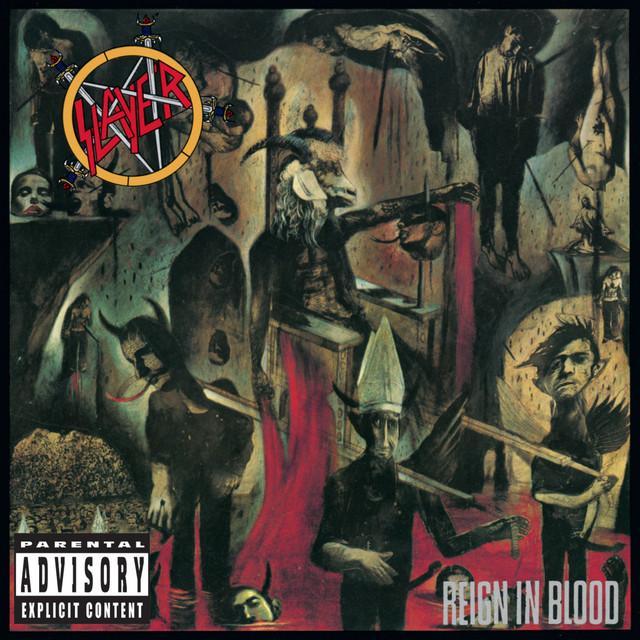
Why "Altar Of Sacrifice" Feels So Unholy
The meaning of Altar Of Sacrifice Slayer comes through fast: this is a horror narrative about ritual killing, spiritual corruption, and a brutal rebirth into evil. Rather than sounding reflective or symbolic in a soft way, Slayer make the song feel immediate and physical. It throws the listener into a scene of terror and never lets up.
"Altar Of Sacrifice" - Slayer
Here on the table of hell
A figure in white unknown by man
Loading lyrics...
Unable to load lyrics
We're unable to display the lyrics at this time. Please try again later.
Factually, "Altar of Sacrifice" appears on Slayer's debut album Show No Mercy from 1983, and the song is credited to Jeff Hanneman and Kerry King. Those details are widely documented in standard discographies and album references. In context, that matters because early Slayer were building a style that pushed thrash metal toward darker and more extreme imagery than many of their peers.
A Nightmare Told Like a Ritual
At the story level, the song begins with someone facing death on an altar. The opening image places them in a helpless position, and phrases like destined to die
and table of hell
frame the sacrifice as both physical and spiritual.
This is not just murder. The lyrics present a ceremony, led by a priest-like figure, where bloodshed becomes a gateway into damnation. That is why the song feels more unsettling than a simple slasher tale. It is organized evil.
Interpretation: The victim is not only losing life. They are being stripped of human identity and prepared for a new, cursed form of existence.
Watch the official Altar Of Sacrifice
music video
How the Chorus Defines the Song
The repeated title phrase, altar of sacrifice
, works like the song's central symbol. It is the place where innocence ends and corruption begins.
When the chorus adds curse of the damned
, Slayer connect the act of sacrifice to a larger fate. The altar is not just a location. It is a point of no return.
That is the core of the meaning of Altar Of Sacrifice Slayer: once the ritual starts, the victim does not simply die. They are absorbed into a world of evil power, fear, and undeath.
From Victim to Creature
One of the most striking parts of the lyric is the transformation sequence. After death is introduced almost gently, with the sinister assurance close your eyes
, the song turns graphic. Blood changes color, flesh deforms, and the body becomes something no longer human.
This section gives the song a second phase. First comes sacrifice; then comes mutation. In plain terms, Slayer are describing a conversion into a demonic being.
That movement matters because it shifts the song from fear of death to fear of what comes after death. The horror is not that life ends. The horror is that consciousness continues in a twisted form.
The Devil Imagery Has a Job
Slayer became famous for satanic imagery, but in this song it serves a clear dramatic purpose. The references to Satan, the priest, and commands from hell create a power structure. Someone is in charge, and the victim is being remade to serve that power.
Interpretation: The satanic language can be read less as theology and more as a symbol of total domination. Evil here is organized, ritualized, and seductive. The song shows how terror can come packaged as initiation and empowerment.
That idea becomes clearer late in the track, when the victim seems to receive dark abilities. What began as helplessness turns into a kind of cursed empowerment. Slayer suggest that power gained through evil is never freedom. It is another form of control.
Why the Music Feels Like Panic
The production on Show No Mercy is raw compared with later Slayer records, but that roughness helps. The guitars slash forward with rapid, tightly picked riffs. The drums push the song with little sense of relief. Tom Araya's vocal delivery sounds less like storytelling from a distance and more like a witness yelling from inside the scene.
That musical attack supports the lyric perfectly. There is no warm space, no emotional comfort, and no pause for mourning. Everything races toward violation and transformation.
In other words, the sound makes the ritual feel unstoppable. Even if a listener misses some of the words, they still feel the pressure.
Artist Context Matters Here
In the early 1980s, American thrash metal was becoming faster, harsher, and more confrontational. Slayer stood out by pushing occult and violent imagery hard on songs like this one and throughout Show No Mercy. Hanneman and King wrote with a taste for provocation, and the band's early identity depended on sounding more dangerous than almost anyone else in the scene.
That does not mean every lyric is a personal confession. In heavy metal, especially extreme metal, shock imagery often works like horror cinema. It creates a world, tests boundaries, and gives the music a stronger emotional charge.
So when listeners ask about the meaning of Altar Of Sacrifice Slayer, the best answer is not that the song argues a belief system. It stages a dark fantasy where sacrifice becomes transformation, and transformation becomes eternal imprisonment.
A Small but Interesting Side Note
There is also a real place called Altar of Sacrifice in Zion National Park, a sandstone peak named for red iron-oxide staining that looked like spilled blood, according to historical naming accounts. That mountain has nothing to do with Slayer's song, but it is a strange coincidence that shows how naturally the phrase evokes blood, ritual, and dread.
Final Reading: Horror With a Point
At its simplest, the song tells a satanic horror story. At a deeper level, it is about what happens when a person is reduced to a body, a soul, and a tool for someone else's power.
That is why the track still hits so hard. It is fast, cruel, vivid, and built around the fear that death may not be the end of suffering.
Disclaimer: This interpretation is based on the lyrics, musical context, and Slayer's broader style. As with most songs, meaning can vary from listener to listener.







