Why Slayer’s “Blood Red” Still Feels Alarming
Slayer turn political fear into something brutally simple: a song about power that spills real blood.
"Blood Red" - Slayer
Provided by LyricFindPeaceful confrontation meet war machine
Seizing all civil liberties
Honest ballotation among bansheeLoading...Loading lyrics...
Unable to load lyrics
We're unable to display the lyrics at this time. Please try again later.
The Core Meaning Hiding in Plain Sight
The meaning of Blood Red Slayer is not hard to hear once the song’s images line up. This is a protest song in thrash-metal form. It describes a world where governments or violent systems take away rights, spread lies, and use force to make their version of truth seem unavoidable.
The lyrics move fast, but their message is direct. They point to crushed liberty, manipulated public life, and mass suffering. When the song mentions civil liberties
and then places that idea next to violence, it shows a society where freedom is not debated away but beaten down.
Interpretation: The song is less about one single battlefield and more about a recurring pattern in history: power speaks in the language of order while creating fear and death.

Watch the official Blood Red
music video
A Political Song Without a Lecture
One reason the track works so well is that Slayer do not write it like a speech. They use stark phrases and images instead. The line about words as ammunition
suggests that propaganda matters almost as much as bullets. Language becomes a weapon. Public messaging becomes part of the machinery of control.
That idea connects to another key phrase, enforcing their truth
. The song’s target is not just violence. It is violence backed by official certainty. In other words, the problem is a system that claims moral authority while acting brutally.
This has made the song feel durable. Listeners can hear it as a warning about war, authoritarian rule, or any regime that hides cruelty behind slogans.
How the Verses Build the Threat
From freedom to massacre
The first verse begins with political tension and quickly escalates into bloodshed. That jump matters. Slayer suggest that when civil rights are seized, mass violence is not far behind. The image of the face of death
pushes the point further: the consequences are visible, even if leaders try to hide them.
The song keeps exposing that gap between appearance and reality. It says evil cannot be covered up forever. It may wear uniforms, flags, or official language, but it still leaves bodies behind.
Why the crowd matters
Later, the lyrics mention growing opposition. That detail is easy to miss, but it is important. The song is not only about domination. It is also about resistance.
Interpretation: Slayer seem to show that once repression becomes obvious, people answer back with speech, protest, and collective anger. The system has guns, but the public still has a voice.
The Chorus Turns Everything Red
The title phrase, Blood red
, is blunt on purpose. It works like a summary of the whole track. Instead of offering a detailed slogan, the chorus leaves listeners with a color and a stain.
That image can suggest several things at once:
- literal bloodshed
- moral corruption
- the visual mark violence leaves on a nation
- the idea that oppression eventually colors everything around it
Because the hook is so stripped down, it hits harder. It does not explain. It accuses.
Sound and Structure: Why It Feels So Crushing
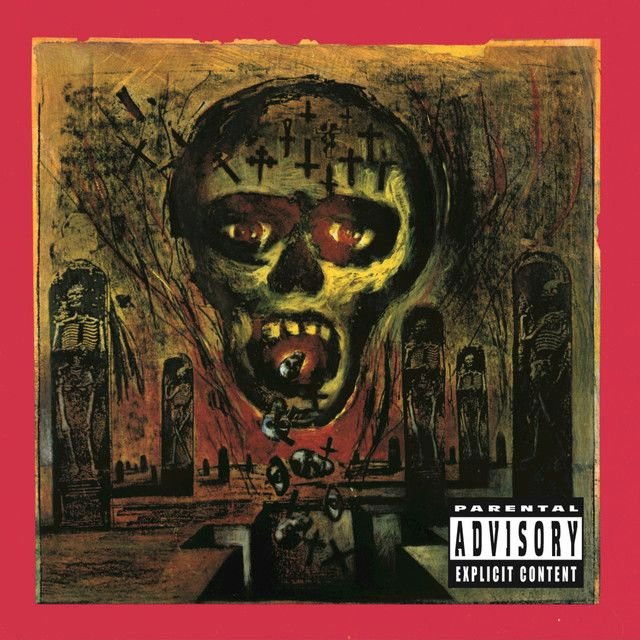
“Blood Red” appears on Seasons in the Abyss, the 1990 Slayer album that mixed the speed of their earlier work with heavier groove and atmosphere, as noted in standard album references such as Wikipedia’s album entry. That balance matters for meaning.
The song is not pure chaos. It has a pounding, deliberate motion that feels almost military. The guitars lock into a stern groove, the drums keep pressure high, and Tom Araya’s vocal delivery sounds more like a witness issuing warnings than a character telling a story.
That heaviness is one reason the song translates well even outside thrash. A 2024 Metal Injection piece on the Slower cover quoted guitarist Bob Balch saying the song’s groove is undeniably heavy
and that its arrangement is straightforward enough to survive a doom-metal transformation (Metal Injection). That observation helps explain the original too: the song’s core menace is structural, not just fast.
Artist Context Helps the Reading
Slayer were never a simple political band, but they often used extreme imagery to confront violence, war, death, and institutional cruelty. “Blood Red” fits that pattern while sounding more openly civic than many of their shock-based songs.
The available song credits list Jeff Hanneman and Tom Araya as the writers. That pairing makes sense here. Hanneman often brought sharp, confrontational ideas, while Araya’s delivery gives the lyrics urgency and plainspoken force.
The song is also widely listed as part of Seasons in the Abyss, including the “Blood Red” disambiguation page on Wikipedia. Even that basic catalog fact matters, because the album is often seen as a bridge between Slayer’s fastest work and their more atmospheric songwriting.
A Reasonable Alternate Reading
There is another way to hear the track. Interpretation: Instead of focusing on one government, listeners might read it as a general map of how fear works. Lies distort vision, violence normalizes itself, and ordinary people become numb to horror.
Under that reading, the song is about political psychology as much as politics itself. The real enemy is a culture that accepts cruelty once it is packaged as necessity.
Why the Song Endures
The meaning of Blood Red Slayer still lands because the song refuses to soften its picture of power. It says oppression is not abstract. It bleeds. It stains. It leaves proof.
For American listeners especially, the track can feel current without needing any update. Debates about rights, truth, force, and public manipulation have not gone away. Slayer’s language is extreme, but the warning is recognizable.
In the end, “Blood Red” is one of Slayer’s clearest political statements: when authority strips freedom and sells violence as order, the result is visible in the title itself.
Disclaimer: This interpretation is based on the released lyrics, song credits, and documented context. As with most songs, some meanings remain open to listener interpretation.








