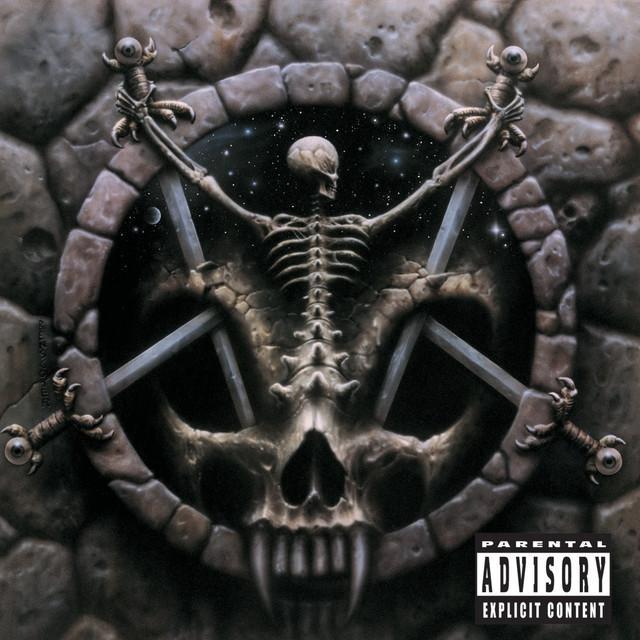
Dittohead by Slayer
Why This Song Still Hits Like a Warning
The meaning of Dittohead Slayer starts with panic and disgust. This is not a subtle song. It throws listeners into a world where public systems feel broken, crime feels emboldened, and violence becomes part of daily life.
"Dittohead" - Slayer
Subconscious hold begins to slip
The scales of justice tend to tip
Loading lyrics...
Unable to load lyrics
We're unable to display the lyrics at this time. Please try again later.
Factually, "Dittohead" appears on Divine Intervention (1994), runs just 2:31, and is credited solely to Kerry King for both lyrics and music, according to Songfacts: Songfacts. That short runtime matters. Slayer pack a huge political and emotional charge into a tiny space.
Watch the official Dittohead
music video
A Protest Song Disguised as a Threat
On the surface, the lyrics attack a legal system the speaker sees as weak and collapsing. Early lines describe a country that has lost its grip
, with justice no longer balanced and authority unable to act. The song keeps returning to the idea that rules exist, but enforcement does not.
That idea becomes clearer in phrases like no spine
and do no time
. They suggest a justice system that punishes lightly, if at all. In plain terms, the speaker believes criminals can escape real consequences, and that this failure encourages even more violence.
Interpretation: The song is not just saying laws are flawed. It is saying institutional weakness creates a culture where brutality grows. The lyrics treat social collapse almost like a chain reaction.
The Speaker Shifts From Witness to Monster
One of the smartest things in the song is how the voice changes. At first, the speaker sounds like an angry observer talking about courts, policy, and national decline. Later, the voice becomes more personal and more dangerous.
When the lyrics move toward ideas like Violence is my passion
, the song stops sounding like outside commentary. It begins to sound like the very force that society has unleashed. That shift gives the song its menace.
Interpretation: Slayer may be showing how violent people justify themselves when they think the system is weak. In that reading, the song becomes a warning delivered through the mindset of aggression itself. Instead of simply saying society is broken, it dramatizes what brokenness sounds like.
1994 Matters More Than It First Seems
The lyrics directly name Here in 1994
, grounding the song in a specific American moment. That was a period of intense public debate around crime, punishment, media influence, and political frustration. The song captures that climate in a raw, exaggerated form.
Songfacts also notes that the title "Dittohead" was associated with Rush Limbaugh’s fan culture, where agreeing listeners would say “ditto” rather than repeat praise: Songfacts. That gives the title another layer. It may hint at political echo chambers, repeated slogans, or unthinking agreement.
Interpretation: If that title is intentional commentary, then Slayer are not only attacking crime and weak punishment. They may also be mocking how political anger gets repeated and amplified by media culture.
Violence, Fame, and the American Feedback Loop
A key section links weapons, entertainment, and attention. The song suggests that violence is not only committed; it is also watched, discussed, and rewarded with notoriety. In other words, public culture becomes part of the problem.
That is why the song’s anger feels wider than a simple anti-crime message. It targets:
- legal loopholes
- passive government
- media fascination with violence
- a public numbed by repetition
The phrase mentalities under sedation
captures that numbness well. People are not only scared; they are dulled, distracted, and no longer shocked.
How the Sound Carries the Meaning
The music is essential to understanding the meaning of Dittohead Slayer. Songfacts calls it one of Slayer’s fastest songs and quotes Kerry King saying, “That’s probably our fastest song”: Songfacts. That speed is not decoration. It is the message in sonic form.
The guitars feel like a sprint, the drums hit with near-chaotic force, and the vocal delivery sounds urgent rather than reflective. There is almost no room to breathe. That creates the sense of a society rushing downhill.
In practical terms, the arrangement mirrors the lyrics:
- rapid tempo suggests panic and escalation
- sharp riffing suggests conflict and pressure
- shouted vocals suggest outrage overpowering reason
Because the song is so short, it also feels compressed, like a news cycle of fear condensed into two and a half minutes.
Is Slayer Endorsing the Voice?
This is where careful reading matters. Songfacts observes that the song critiques leniency but does not simply reduce the issue to a neat moral statement: Songfacts. That complexity fits Slayer’s style.
They often write from extreme viewpoints without clearly endorsing them. Here, the lyric voice is so intense that it can sound like both a complaint and a symptom. The song may be expressing real frustration while also exposing how fear can turn into obsession.
Nothing to regretYou can do to me
In context, those short lines sound less like wisdom than the logic of a person who feels untouchable. That makes the song darker. It is not merely about policy failure; it is about the psychology that grows in that failure.
The Real Takeaway From “Dittohead”
At its core, "Dittohead" portrays a nation where justice, media, and public thinking have all started to fail at once. The result is a vicious cycle: weak systems feed aggression, aggression gains attention, and society grows more numb.
That is why the song still lands. The meaning of Dittohead Slayer is not just anger at crime. It is fear that a broken culture can train people to accept violence as normal.
Disclaimer: This interpretation is based on the lyrics, documented song facts, and Slayer’s broader style. As with many metal songs, meaning can remain open to multiple readings.







