Why 'In Christ Alone' Still Stands Strong
The meaning of In Christ Alone Stuart Townend starts with its unusual balance: it is deeply personal, but it also works like a short statement of belief. Written in 2001 by lyricist Stuart Townend and composer Keith Getty, it was the first hymn the pair created together, and Getty later described the tune as a “strong very Irish melody” (Wikipedia). That mix of clear doctrine and memorable melody helps explain why the song spread so quickly in churches in the UK, Ireland, and the United States.
"In Christ Alone" - Stuart Townend
He is my light, my strength, my song
This Cornerstone, this solid Ground
Loading lyrics...
Unable to load lyrics
We're unable to display the lyrics at this time. Please try again later.
A Modern Hymn With an Old-School Purpose
At its core, the song is about total dependence on Jesus. It opens by stacking images of support and stability, including my hope is found
and solid Ground
. Those phrases are simple, but they do a lot of work. They frame Christ as the one steady thing in a world marked by fear, stress, and loss.
This is why the hymn feels bigger than a private worship song. It is not mainly about a passing emotion. Instead, it presents a full Christian claim: Christ is the foundation of faith, the center of salvation, and the source of endurance.
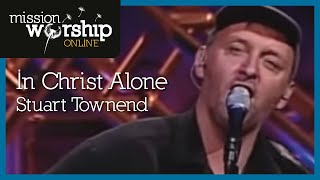
Watch the official In Christ Alone
music video
How the Verses Move Through the Gospel Story
One reason the song connects with so many listeners is its structure. Each verse covers a major part of the Christian story, almost like a timeline.
From comfort to incarnation
The first verse focuses on peace and refuge. It speaks to fear and striving, then answers them with rest in Christ. The second verse shifts to the incarnation, using the striking phrase took on flesh
. In plain terms, the song says that God entered human life in vulnerability, not in distant power.
That shift matters. The hymn does not present Jesus as only an inspiring teacher. It presents Him as fully divine and fully human, which is central to historic Christian belief.
The cross and resurrection at the center
The middle of the song places the cross and resurrection at the center of its message. It describes Jesus’ death as more than tragedy. It is presented as the turning point where sin is dealt with and where life becomes possible for believers.
Then the third verse pivots from burial to triumph. The phrase Up from the grave
gives the song its surge of movement. After that, the lyric turns from what happened to Jesus to what that means for the believer: evil no longer has the final word.
The Most Debated Line in the Hymn
Any article on the meaning of In Christ Alone Stuart Townend has to address the line about God’s wrath being satisfied. Factually, this lyric became the center of a major debate in 2013, when a Presbyterian Church (USA) committee excluded the hymn from a denominational hymnal after the authors refused permission to change the wording (Wikipedia).
Interpretation: That line shows that the hymn is not trying to be vague or broadly spiritual. It takes a specific theological position, often linked to satisfaction or penal substitution views of atonement. In other words, the song says the cross does not only show love; it also deals with sin in a decisive, costly way.
For some Christians, that precision is exactly why the hymn is powerful. For others, it is the reason the hymn is difficult. Either way, the line explains why this song has had such lasting impact: it is singable, but it is also doctrinally bold.
Why the Hook Feels So Secure
The repeated idea of standing “in Christ alone” gives the hymn its emotional force. The song keeps returning to one point: human security is not found in personal strength, social approval, or good circumstances. It is found in Christ.
That message reaches its clearest form in the last verse, especially with phrases like no fear in death
and Christ I'll stand
. The wording is direct enough for a congregation, but strong enough to carry grief, anxiety, and uncertainty. That is part of why the hymn is often used at funerals, church services, and moments of public worship.
How the Music Supports the Message
The production and arrangement also shape the meaning. Even when performed in different styles, the song usually keeps a firm, rising melodic line and a steady hymn-like pace. Getty’s folk-influenced melody gives it warmth, while the regular meter makes it easy for groups to sing together (Wikipedia).
Interpretation: The music mirrors the text’s promise of stability. It does not sound restless or fragmented. Instead, it feels grounded, which supports lyrics about refuge, victory, and confidence.
That may help explain its broad reach. The song ranked highly in BBC Songs of Praise polls and appeared on major CCLI church music charts, including in the U.S. market (Wikipedia). Its success is not just about popularity. It is about usefulness: churches can sing it, remember it, and teach from it.
Why It Endures Across Denominations
The hymn has been recorded by many artists and used in major Christian settings. It was first released on New Irish Hymns in 2001 and later recorded by Townend himself on Lord of Every Heart (Wikipedia). Over time, it became one of the best-known modern hymns in English.
Its staying power comes from three things:
- a clear gospel narrative
- a memorable melody
- lyrics that offer certainty rather than vagueness
That certainty is the whole point. The song argues that hope, peace, and perseverance are not self-made. They are received.
Final Take on Its Lasting Power
So, what is the meaning of In Christ Alone Stuart Townend? It is a hymn about Christian confidence rooted fully in Jesus’ identity, death, resurrection, and continuing power. It moves from cradle to cross to empty tomb, then ends by applying that story to ordinary human fear.
For listeners who share its theology, the song feels like a full statement of faith in four verses. For listeners outside that tradition, it still offers a useful window into why modern hymns can carry real doctrinal weight.
Disclaimer: This interpretation blends widely accepted background facts with literary and theological reading. Meaning can vary based on a listener’s faith tradition, church background, and personal experience.








