Why 'Mirror Man' Still Feels So Sharp
The meaning of Mirror Man The Human League starts with a contradiction: the song sounds sleek, catchy, and upbeat, yet its words carry suspicion. Beneath the polished pop surface, they sketch a person who seems to survive by reflecting other people’s wants back at them.
"Mirror Man" - The Human League
A pebble skips across the face
A dozen times
Loading lyrics...
Unable to load lyrics
We're unable to display the lyrics at this time. Please try again later.
Released in November 1982, the single arrived after the huge success of Dare and became another major hit, reaching No. 2 in the UK and No. 1 in Ireland, with producer Martin Rushent again shaping the sound. It was written by Philip Oakey, Jo Callis, and Ian Burden, and later became part of the group’s US push through Fascination! These chart and credit details are widely documented in reference sources on the song’s release history.
A Pop Song About Reinvention
At its core, the song describes someone who can adapt instantly. Early lines use water imagery to show how quickly an action can happen and disappear. A pebble skips, leaves ripples, and is gone. In plain terms, the lyric suggests a person who moves on cleanly, leaving others to deal with what remains.
That idea becomes more personal when the speaker says, in effect, they can become whatever another person needs. The short phrase You know I'll change
is the key. It does not sound romantic here. It sounds strategic.
Interpretation: the song is less about sincere devotion than about identity as performance. The central figure is someone who treats personality like a costume.
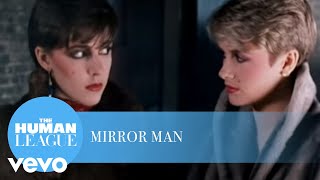
Watch the official Mirror Man
music video
The Chorus Turns the Character Into a Symbol
The refrain gives that figure a name: Here comes the mirror man
. Then comes the cutting description people fan
. On the surface, that could sound friendly or social. But within the song, it feels sly.
A mirror does not create its own image; it reflects what is in front of it. That makes the title character seem hollow, or at least highly adaptive. They are not admired for being genuine. They are watched because they are good at showing people what they already want to see.
Interpretation: the chorus frames the whole song as a critique of charm. “Mirror man” is the kind of person who wins approval by imitation, not honesty.
A Friendship That No Longer Feels Real
The second verse sharpens the emotional cost. The speaker admits they are no longer the same person someone once knew. The phrase our little friendship
sounds almost dismissive, as if a once-close bond has been reduced to something small and expendable.
The song also suggests distance as a tool. Pain will fade, the lyric says, and life is better now, though some doubt remains. That final note matters. Even in a song about moving on, certainty never fully arrives.
Things are much better now
the nagging doubt remains
That small two-line turn gives the narrator a human crack. However polished the persona becomes, something unresolved still lingers.
The Adam Ant Connection Matters—But Only So Much
There is an important piece of outside context. In later interviews around the band’s 1988 Greatest Hits era, Philip Oakey said the song was about Adam Ant, ending years of speculation. That detail has been repeated in major summaries of the track’s background.
Still, listeners do not need that backstory for the song to work. Even without a real-life target, the lyric lands as a study of public image: a charismatic figure, a changed self, and uneasy admiration mixed with distrust.
That is why the meaning of Mirror Man The Human League stays flexible. Factually, there is a known inspiration. Artistically, the song reaches beyond one person.
Why the Sound Feels So Bright and So Cutting
One reason the song lasts is its tension between sound and message. Accounts of its creation often describe it as influenced by Motown and even "electronic northern soul." That description fits. The rhythm pushes forward, the backing vocals add lift, and the arrangement feels built for movement.
That brightness is not a contradiction to the lyric; it is the point. A song about surfaces should have a seductive surface. The clean production, the punchy beat, and Oakey’s controlled vocal delivery all reinforce the idea of image management.
They do not sound messy or wounded. They sound composed. That composure makes the emotional distance stronger.
Another Reading: Is the Speaker Also the Mirror?
There is one more useful angle. The speaker criticizes someone who changes constantly, yet they also say they will change if required. That creates an interesting blur.
Interpretation: the song may not just attack the “mirror man.” It may show how easy it is for anyone to slip into that role. In other words, they may be condemning a fake persona while admitting their own temptation to perform.
That ambiguity keeps the song from becoming simple name-calling. It becomes a reflection on social life itself: people copy, adapt, flatter, and reshape themselves to stay desired.
The Lasting Meaning of “Mirror Man”
So what is the song really saying? The best answer is that it exposes the danger of becoming too reflective—too eager to match every wish, every trend, every audience. A person can become appealing that way, but also hard to trust.
That mix of glamour and doubt is what gives the track its bite. It is catchy enough to dance to, but sharp enough to make listeners question the face being presented to them.
In that sense, the meaning of Mirror Man The Human League is about fame, friendship, and identity all at once. It asks what is left of a person once they become only an image for others.
Disclaimer: This interpretation is based on the lyrics, recorded performance, and widely reported artist context. As with any song, listeners may hear different meanings in it.







