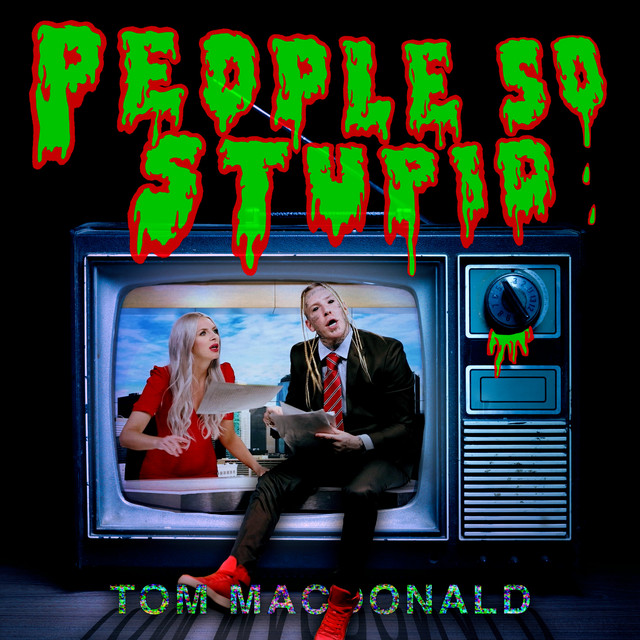
Why Tom MacDonald Made "People So Stupid"
The meaning of People So Stupid Tom MacDonald starts with a very simple idea: they are angry at a culture that seems stuck in outrage, hypocrisy, and online performance. The song is not subtle. It is built to provoke, and that is part of its message.
"People So Stupid" - Tom MacDonald
I'm praying that the world changes soon
Can't get a doobie on a plane but there's Uzis in our schools
Loading lyrics...
Unable to load lyrics
We're unable to display the lyrics at this time. Please try again later.
Rather than tell a story, Tom MacDonald stacks complaints. He jumps from politics to social media to identity debates, making the track feel like a fast-moving rant about modern life. Whether listeners agree with him or not, the song clearly aims to say that public conversation has become louder, thinner, and less useful.
A Protest Song Disguised as a Rant
At its core, the song argues that people focus on symbolic fights while bigger problems go unsolved. MacDonald points at what he sees as contradictions in public life, then turns those contradictions into bars. When he says people so stupid
, he is not diagnosing one group. He is aiming at a whole climate of reaction, complaint, and culture-war fatigue.
Interpretation: the track works less like a policy statement and more like a frustration bomb. It tries to capture the feeling that everybody is offended, everybody is posting, and almost nobody is helping.
That idea becomes clearest near the end, when the song shifts from mockery to a more direct complaint about performative activism. The target is not only public opinion but the habit of mistaking posts and slogans for real change.

Watch the official People So Stupid
music video
How the Verses Build Their Argument
MacDonald structures the verses like a list of grievances. Each line introduces a new flashpoint, which gives the song its aggressive momentum. He moves so quickly that the listener barely sits with one issue before the next arrives.
A few patterns hold the song together:
- They contrast old norms with new ones.
- They frame internet culture as oversensitive.
- They treat contradiction as proof that society has lost perspective.
- They suggest image-based activism is replacing action.
Lines about being triggered and defensive
and claiming victimhood are central to that thesis. He portrays public life as a contest over attention, where outrage becomes identity and disagreement becomes moral theater.
The Chorus Turns Frustration Into a Slogan
The chorus matters because it simplifies the whole song into a chant. Phrases like get better problems
reduce the verses to one hard message: society is wasting energy on the wrong fights.
That hook is catchy, but it also reveals the song's limits. By repeating one insult over and over, MacDonald chooses force over nuance. That is likely intentional. The chorus is made to be memorable, meme-ready, and easy to share, which mirrors the online culture the song attacks.
Interpretation: this is one reason the track connected with fans. It offers emotional release first, analysis second.
The Most Important Theme: Performance vs. Action
The strongest section comes in the final verse. There, MacDonald briefly steps away from pure ridicule and points to something more concrete: serious social problems cannot be solved by hashtags alone. When he references events that seem to happen constantly and says memes are not enough, the song lands on its clearest theme.
That idea can be summed up with one of the verse's key phrases, actions you could be taking
. In other words, the song argues that public concern often stops at display. People show that they care, but they do not always do much after that.
This is the most persuasive part of the song because it identifies a real tension in digital culture. Social media can spread awareness, but it can also reward performance over effort.
Tom MacDonald's Persona Shapes the Meaning
Artist context matters here. MacDonald built his career as an independent rapper whose brand thrives on confrontation and anti-establishment messaging. His releases often challenge media narratives and mainstream political language, and his independence has been widely noted in coverage of his career and chart success (Billboard, Forbes).
That context helps explain the song's style. They are not trying to sound balanced. They are trying to sound fearless, outsider, and unfiltered. "People So Stupid" fits that persona exactly: it is a track designed to trigger reaction while presenting itself as common sense.
The songwriting credit also matters. The song was written by Thomas MacDonald and Nova Paholek, better known publicly as Nova Rockafeller, a frequent creative partner in his catalog and visuals.
Why the Production Sounds So Confrontational
The beat supports the message with blunt force. The production is sparse, heavy, and rhythm-first. Instead of lush melody, the song leans on punchy drums, dark bass, and space for MacDonald's voice to hit hard.
That approach makes every line feel like a challenge. The near-march tempo gives the track a combative mood, while the repeated hook acts like a crowd chant. There is little softness in the arrangement because softness would weaken the song's purpose.
Interpretation: the production turns complaint into certainty. Even when the ideas are messy or debatable, the sound makes them feel decisive.
Why Listeners Split So Strongly on It
Reception to the song was predictably divided. Supporters heard it as blunt honesty about a culture obsessed with offense and online approval. Critics heard it as oversimplified outrage that mocks complex issues more than it explains them.
Both reactions make sense. The song's power comes from saying things many artists avoid, but its weakness comes from treating very different topics as if they all prove the same point. That is why one short phrase like boo-hoo, wah-wah-wah
can feel either funny or dismissive, depending on the listener.
The Bottom Line on the Song's Message
So, what is the meaning of People So Stupid Tom MacDonald? It is a protest against performative outrage, internet tribalism, and shallow activism, delivered through sarcasm, provocation, and culture-war shock lines. Its message is clearest when it argues that posting and complaining are not the same as doing real work.
At the same time, the song is also a performance in its own right. It criticizes outrage while using outrage as fuel. That tension is what makes the track both effective and controversial.
Disclaimer: This article offers interpretation based on the lyrics, artist context, and production choices. Song meaning can vary by listener.








