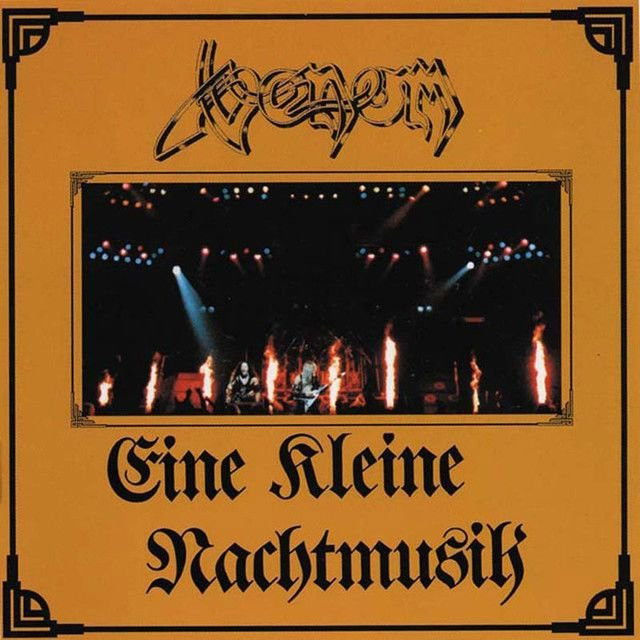
Witching Hour by Venom
The meaning of Witching Hour Venom starts with shock, but it lands on something bigger: a band testing how far metal could push fear, speed, and taboo.
"Witching Hour" - Venom
Provided by LyricFindCome hear the moon is calling,
The witching hour draws near,
Come hear the bell is tolling,Loading...Loading lyrics...
Unable to load lyrics
We're unable to display the lyrics at this time. Please try again later.
A Midnight Ritual Turned Into Metal
Venom’s “Witching Hour” is best understood as a staged descent into chaos. On the surface, the lyrics describe a satanic ritual filled with sacrifice, blasphemy, and apocalyptic imagery. But the song’s real power comes from how it turns those images into a performance of total rebellion.
Interpretation: Rather than asking listeners to believe the scene literally, the song invites them into a world where all moral boundaries are being smashed on purpose. That is central to the meaning of Witching Hour Venom.
The track appears on Welcome to Hell, Venom’s debut album, released in December 1981 through Neat Records. The album was recorded quickly in August 1981 over three days at Impulse Studios in Newcastle, and its raw sound later became hugely influential on extreme metal. Those basic facts are widely documented in reference histories of the album and its legacy.[1]
Watch the official Witching Hour
music video
The Story the Lyrics Tell
From summons to catastrophe
The song unfolds like a short horror film. It begins with a call into the night, using phrases like the moon is calling
and the bell is tolling
. In plain terms, the lyrics announce that an unnatural ceremony is beginning and ordinary people are terrified.
Next, the scene becomes more graphic. The ritual is prepared, the altar is set, and violence becomes unavoidable. When the lyric reaches all hell breaks loose
, it stops sounding like a warning and starts sounding like the whole point.
That refrain matters because it turns the song from narrative into eruption. The verses build the ritual step by step, then the chorus celebrates collapse. Interpretation: Venom are not just describing evil; they are dramatizing the thrill of unleashing it.
Symbols That Drive the Meaning
Occult images as provocation
The song uses familiar symbols—pentagram, altar, Satan, sacrifice—not to build a complex theology, but to create maximum offense and intensity. The line unveil the pentagram
works like a curtain rising. It tells listeners that the show is now fully inside forbidden territory.
That fits Venom’s broader early style. Across Welcome to Hell, the band leaned into Satanism, witchcraft, violence, and excess as core lyrical themes.[1] Their image was part comic-book evil, part underground threat. In “Witching Hour,” that image becomes concentrated into one ritual scene.
Fear, lust, and power
The lyrics also connect evil with appetite. Demons are linked to desire, blood, and domination. The result is not subtle. The song imagines evil as something physical and contagious, something that spreads through bodies and the crowd.
Interpretation: This can be read as a fantasy of absolute freedom through destruction. Every sacred or social rule is violated, and that violation is framed as ecstatic.
Why the Chorus Hits So Hard
The repeated title phrase Witching Hour
does two things at once. First, it names the moment when hidden forces wake up. Second, it freezes the whole song inside a single charged instant, as if midnight itself has become a weapon.
Here, the hook is simple but effective:
All hell breaks loose
Hell's breaking loose
Witching hour
Those words are brief, but they summarize the track’s full emotional goal: panic, spectacle, and release. The song does not ask what evil means in a philosophical sense. It asks what it feels like when order disappears.
The Sound Is Part of the Message
Any explanation of the meaning of Witching Hour Venom has to include the music. Venom’s debut was recorded with a deliberately rough, unpolished attack, and later critics saw that rawness as part of what made the album foundational to thrash, death, and black metal.[1]
In “Witching Hour,” the fast tempo and distorted guitar make the ritual feel unstable and urgent. The drumming pushes forward like a chase scene, while Cronos’s vocal sounds more barked than sung. That matters because the performance strips away distance. Instead of a careful gothic tale, the band deliver a near-riot.
AllMusic later called “Witching Hour” possibly Venom’s most important track because it contains devices that would spread across extreme metal.[1] That legacy helps explain why the song still matters: it sounds like a border being crossed.
Artist Context Makes the Lyrics Clearer
Venom were not polished occult philosophers. They were an English metal trio—Conrad “Cronos” Lant, Jeffrey “Mantas” Dunn, and Tony “Abaddon” Bray—building an exaggerated evil image in the early NWOBHM era.[1] Their stage names alone show how performance and identity mixed together.
That context matters. The lyrics in “Witching Hour” are extreme, but the band’s larger project was also aesthetic: louder, nastier, faster, less respectable. One later critical summary described Welcome to Hell as heavy metal throwing out the rule book and taking on punk’s attitude.[1]
Interpretation: In that light, the ritual in the song stands for artistic rebellion too. The band summon not just demons, but a new metal language.
A Final Reading of the Song’s Meaning
So, what is “Witching Hour” about? At the clearest level, it is a vivid occult horror scene. At a deeper level, it is Venom turning blasphemy and fear into energy. The song treats taboo as fuel, and its raw sound makes that fuel explode.
That is why the meaning of Witching Hour Venom is bigger than its plot. It is about the thrill of crossing lines—religious, musical, and cultural—and hearing what happens when those lines snap.
Disclaimer: This interpretation is based on the song’s lyrics, performance style, and historical context. Like most art, “Witching Hour” can support more than one reading.







