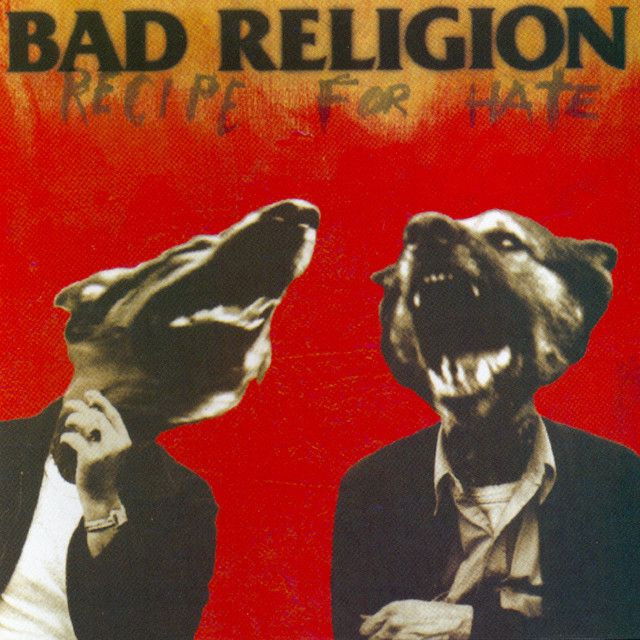
American Jesus by Bad Religion
Why the meaning still hits hard
The meaning of American Jesus Bad Religion comes down to a sharp critique of religious nationalism. Bad Religion are not attacking faith itself in a simple way. They are targeting the habit of using religion to justify national pride, war, exclusion, and moral superiority.
"American Jesus" - Bad Religion
'Cause I'm blessed by nationality
I'm member of a growing populace
Loading lyrics...
Unable to load lyrics
We're unable to display the lyrics at this time. Please try again later.
Released in 1993 as the lead single from Recipe for Hate, the song arrived when the band had signed with Atlantic and were reaching a wider audience. According to the song's widely cited background, Greg Graffin connected its idea to Gulf War-era language about God backing the United States. That context matters because the lyrics keep showing how belief can be turned into political certainty rather than humility.

Watch the official American Jesus
music video
The central idea behind the satire
The verses speak in a proud, almost smug voice. That is the trick. The song opens with lines about being blessed by nationality, then pushes that idea until it sounds ugly and absurd. When the speaker acts sure that the country is chosen, the band are exposing the danger in that confidence.
This is why the chorus matters so much. The phrase American Jesus
is not a devotional statement. It is a satirical image. The song imagines Jesus rebranded as a national symbol, stamped onto highways, wealth, armies, and political power.
Interpretation: the title figure represents a version of religion reshaped to fit American self-interest. In that reading, the song asks what happens when a universal religious figure gets reduced to a mascot for one nation.
How the verses build the argument
The first verse starts with identity. It presents nationality as a kind of spiritual reward. Then the song shifts from private pride to group behavior. Phrases like blessed by nationality
and we enforce our popularity
suggest a culture that confuses dominance with virtue.
In the next section, the lyrics widen the frame. Foreigners are treated as outsiders who may admire America but cannot fully belong. The point is not to endorse that thinking. The point is to reveal how cruel and self-congratulatory it sounds when said out loud.
The chorus then lands like a slogan. That is important. Slogans are easy to repeat, and the song is about ideas that spread through repetition. When they sing about seeing him on the interstate
, they suggest that this nationalized religion is everywhere: in public space, politics, and daily life.
The darkest section of the song
The song's most unsettling passage is the long catalog in the bridge. Instead of showing one clean image of God and country, the band stack up contradictions: farm failure, military force, racism, murder, television preaching, computers, bombs, and broken families. The list argues that this national mythology can be used to bless almost anything.
the force the army wields
the fuel that drives the Klan
That brief moment captures the song's harshest point. If religion is tied too tightly to national identity, it can be invoked by people and institutions across the moral spectrum, including violent and hateful ones.
Then comes one of the smartest turns in the lyric: he's inside me
. Up to that point, the song seems to be mocking other people. Suddenly it becomes more self-aware. The band admit that nobody is fully outside the culture they criticize.
Interpretation: this line suggests complicity. Even critics of nationalism may absorb some of its myths.
Sound, speed, and why the message feels urgent
Musically, "American Jesus" works because Bad Religion package a serious argument inside a fast, hook-heavy punk song. The tempo is brisk, the guitars are bright and aggressive, and the vocals are clear enough to keep the satire intelligible. That mix matters. The band want listeners to catch the words, not just the energy.
The chorus feels chant-like, almost like a rally cry. That is a clever production choice because the song is about mass belief. The music recreates the force of a crowd repeating a simple idea, even while the lyrics question that very impulse.
Factually, the track was written by Brett Gurewitz and Greg Graffin, produced by Bad Religion, and released as a 1993 single from Recipe for Hate. It also features backing vocals from Eddie Vedder, a detail often noted in coverage of the song's release and legacy.
Artist context matters here
Bad Religion have long mixed punk energy with political and philosophical writing. Graffin's academic interests and the band's history of social criticism help explain why this song is so direct without being simplistic. It is not just anti-religion. It is anti-certainty, especially the kind that treats national power as proof of divine approval.
That context also explains the ending chant of one nation under God
. In the song, it does not sound comforting. It sounds eerie and mechanical, as if a civic ritual has become empty repetition.
Why the song still feels current
Part of the staying power of the meaning of American Jesus Bad Religion is that the song never depended on one news cycle. Its target is larger: the fusion of faith, patriotism, and power. That issue remains familiar in American politics, media, and culture.
Listeners may hear different emphases in it. Some hear an anti-war song. Some hear a critique of American exceptionalism. Others hear a warning about consumer religion or televangelism. All of those readings fit the lyric, as long as they connect back to the main idea: religion becomes dangerous when it is used to flatter power instead of challenge it.
Final takeaway
"American Jesus" is a punk song with a very clear argument: when a nation imagines God as its private ally, morality gets distorted. Bad Religion use irony, repetition, and a fast, public-sounding chorus to show how seductive that belief can be.
That is the song's lasting power. It is catchy enough to shout along to, but unsettling enough to make listeners question why the slogan sounds so familiar.
Disclaimer: This interpretation is based on the song's lyrics, known artist comments, and the band's broader context. Like all art, it can support more than one reading.








