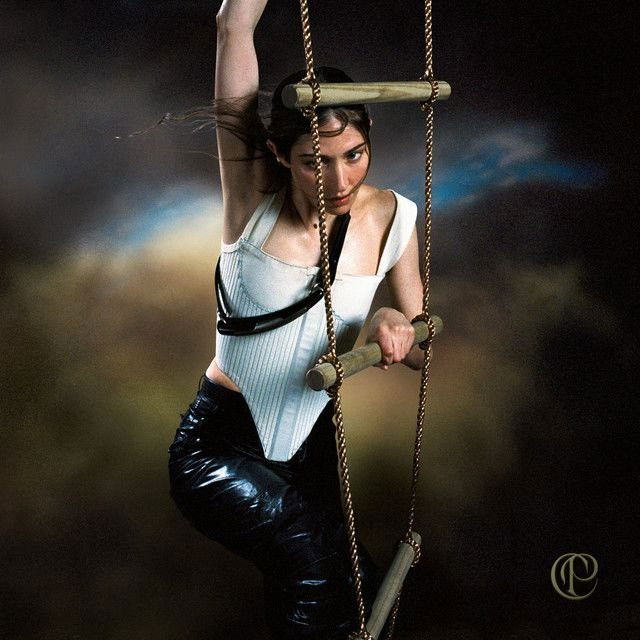
Why 'Hit Me Where It Hurts' Feels So Weightless
The meaning of Hit Me Where It Hurts Caroline Polachek comes down to a strange emotional split: they are in love, but they also feel exhausted, detached, and almost ready for impact. The song turns that contradiction into pop music that sounds light in the air yet bruised at the center.
"Hit Me Where It Hurts" - Caroline Polachek
Maybe there's something going on, I'm not insane
If I'm already out of time, then make it worse
Loading lyrics...
Unable to load lyrics
We're unable to display the lyrics at this time. Please try again later.
Released on Pang in 2019, the track was written and produced by Caroline Polachek and Andrew Wyatt. It is the album’s fourth track, and Polachek later explained in a brief Instagram note that she wrote it during “big life shifts,” while emotionally worn down, vulnerable, and apathetic at the same time. That background matters because the song feels exactly like that: drifting, overwhelmed, and still somehow romantic.
The Heart of the Song Is Vulnerability Without Protection
At its core, this is a song about asking for emotional honesty even when that honesty will hurt. The title phrase is not really about wanting pain for its own sake. It sounds more like a dare: if heartbreak is coming anyway, stop circling and make it real.
That idea is clear in the repeated plea hit me where it hurts
. The line suggests that the speaker would rather face the deepest wound than stay trapped in suspense. In plain terms, uncertainty is becoming worse than pain.
Another key image is butterfly trapped inside a plane
. That surreal line captures the whole song. A butterfly suggests fragility, beauty, and freedom. A plane suggests machinery, pressure, travel, and being sealed inside a system bigger than one person. Put together, the image sounds like a delicate self stuck inside modern life, motion, and emotional turbulence.
Watch the official Hit Me Where It Hurts
music video
A Love Song Set Inside Panic
What makes the song more interesting is that it is not only about breakup fear. It is also about love surviving inside instability. Polachek wrote that she felt insignificant inside the larger systems of life, yet still in love. That statement helps explain why the song never becomes purely bitter.
The push and pull in the verses
The short, clipped phrases in the verses feel like flashes of danger or disorientation: bullseye
, dead end
, moving target
, Achilles' heel
. They do not build a neat story. Instead, they create a pressure map. Everything feels risky, unstable, and easy to lose.
When the lyric turns to ride it out
, the song offers a temporary answer. They cannot fix the relationship, the fear, or the future. They can only endure the moment. That is why the line feels calming and sad at the same time.
What the Chorus Really Means
The chorus gives the song its emotional thesis. First comes confusion and self-doubt, then a sharp request for impact. The line about not being insane suggests the speaker senses danger or change before it is fully visible. They know something is shifting, and they want that feeling validated.
If I'm already out of time, then make it worse
Go on and hit me in the heart
Hit me where it hurts
This is the article’s only longer lyric quote, and it matters because it ties together the song’s fatalism and its honesty. Interpretation: the speaker is not being dramatic for show. They are trying to regain control by naming the worst-case outcome before someone else can.
The Symbols Turn Motion Into Emotional Stress
Many of the song’s images involve travel, motion, or dizziness. There is the plane, a carousel, a magic carpet, London passing below, and later vertigo and popped ears. None of this feels stable. Even the glamorous images seem uneasy.
That pattern suggests a world where everything is moving too fast for real grounding. Love exists, but it exists while the floor is shifting. The song’s recurring travel imagery can also reflect transition: a life in storage, a temporary home, and a future that has not settled yet.
Why the threat imagery feels complicated
The bridge uses alarming language about safety and a gun. It is best read carefully and symbolically, not sensationally. Interpretation: those lines sound like emotional exposure, power, and caretaking getting tangled together. The song imagines intimacy as a risky exchange where one person discovers the other’s weak spot, then both roles blur.
How the Production Carries the Meaning
Part of why the meaning of Hit Me Where It Hurts Caroline Polachek lands so strongly is the contrast between sound and lyric. The production is sleek, airy, and bright, but the words are full of dread, fatigue, and self-exposure.
Polachek and Andrew Wyatt produced the track, with mixing by Geoff Swan and mastering by Mike Bozzi. Sonically, the song has a soft-glow synth-pop feel, but it also moves with a pulsing, compressed pressure that mirrors anxiety. The beat never crashes hard; instead, it hovers. That hovering quality makes the listener feel suspended, like the song never fully lands.
Polachek’s vocal performance is crucial too. They sing with a floating control that keeps the panic from turning messy. That restraint gives the song its emotional power. The voice sounds elegant, but the message underneath is raw.
Two Strong Ways to Read the Song
There are at least two useful interpretations:
- Romantic reading: They sense a relationship may fail and would rather be wounded directly than left in doubt.
- Life-transition reading: The song is about a broader state of burnout, where love is just one part of a bigger feeling of instability and smallness.
Both readings fit the lyrics, and both fit Polachek’s own comments about vulnerability during major life changes.
Why the Song Still Connects
This song lasts because it gives a beautiful shape to a common feeling: being too tired to defend oneself, but still open enough to love. It understands that people can feel numb and overexposed at the same time.
That is the lasting meaning of the song. It turns emotional free fall into something graceful, and it admits that sometimes the bravest thing a person can do is stop pretending they are untouched.
Disclaimer: This interpretation mixes confirmed context with informed reading of the lyrics and sound. As with most songs, listeners may hear different meanings in the same lines.









