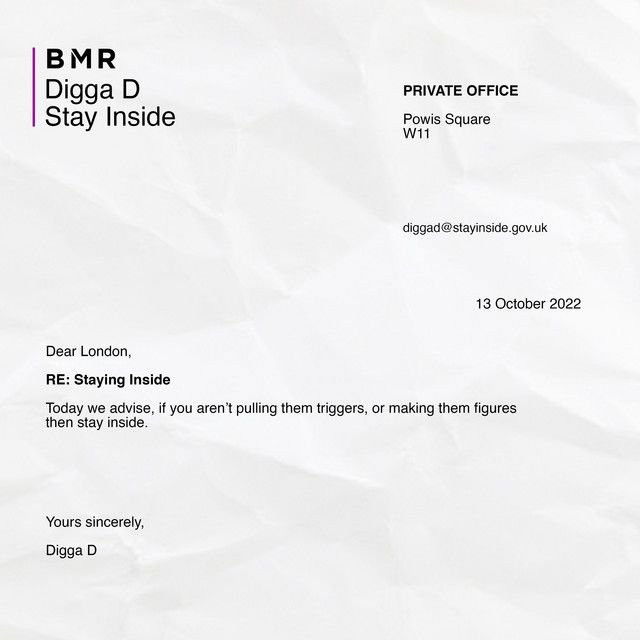
Stay Inside by Digga D
What is the meaning of Stay Inside Digga D? At heart, it’s a warning and a boundary. The narrator lays out the risks of street life and tells anyone who isn’t truly involved to keep their distance. Rather than a simple flex, the song frames the streets like a live battlefield and draws a strict line between those inside and outside that reality.
"Stay Inside" - Digga D
Rest in peace to all the fallen soldiers, man
Fuck the opps
Loading lyrics...
Unable to load lyrics
We're unable to display the lyrics at this time. Please try again later.
A Hook That Draws a Hard Line
If you ain't steppin', you ain't ready for the war, stay inside If you ain't chippin' in for firearms or corn, stay inside
The chorus is direct and repetitive on purpose. It’s a gate that keeps non-participants out. “Steppin’” signals putting in work; “corn” (British slang) means ammunition. The message: if you’re not paying the costs or carrying the risks, do not tag along.
Interpretation: The refrain functions as both public safety notice and social test. It protects bystanders from harm and calls out those who posture without backing it up.

Watch the official Stay Inside
music video
Streets as Battlefield: The Core Idea
The song opens with a grim frame—there’s a war goin' on outside
. That line sets the tone for everything that follows. The city isn’t just a backdrop; it’s a combat zone with shifting rules and constant threat.
From there, the lyrics emphasize consequences over bragging. The narrator points to fatal outcomes, not just scuffles. They present cause-and-effect logic: enter the arena unprepared and the cost can be permanent. The hook’s command, “stay inside,” reads like a curfew rooted in hard experience.
Interpretation: For U.S. listeners, the track resembles drill’s stark realism in cities like Chicago and New York, but filtered through West London slang and references. The mood is cautionary, not celebratory.
Who’s Being Addressed—and Why It Matters
The second-person address gives the record its bite. It’s not abstract storytelling; it’s a pointed talk to peers, friends-of-friends, and clout-chasers. When they say stop rappin'
if you’re not active, it’s a strike at authenticity. The song separates art from image and insists the two must match when violence is on the line.
Interpretation: The hook is also about responsibility within a crew. If someone isn’t ready to carry legal, financial, and moral risks, the group can’t afford them in critical moments.
A Timeline of Threats and Consequences
The verses sketch specific scenes and rules of survival.
- A man leaves home without protection and catches a
bullet in his chest
. The moral is simple: misreading the environment can be fatal. - The community faces
unsolved murders
, heightening fear and distrust. That backdrop justifies the song’s constant edge. - As they get older, they claim to
shoot and we don't cheff
. In UK slang, “cheff” means to stab. The escalation from knives to guns underlines how the stakes have risen. - Gear and logistics matter. A “vest” is a bulletproof vest; “corn” is ammo; “dingers” are stolen cars used to do the job and disappear. These terms show that violence is planned, not random.
Interpretation: The song reads like a code of conduct. It says: if you’re in, accept the rules and contribute; if not, the safest and most honest choice is distance.
How the Sound Pushes the Message Forward
Even without liner notes, the record carries classic UK drill DNA: a cold, minor-key melody, sliding 808 bass, and fast, clicking hi-hats. The tempo keeps listeners alert, while ad-libs—those sharp “grrah” punctuations—hit like percussive shots. That design mirrors the themes: sudden risk, forward motion, little room to breathe.
Digga D’s delivery stays clipped and forceful. There’s not much melodic warmth or catharsis. That restraint reinforces the idea that this is policy, not performance—a set of standing orders.
Two Plausible Readings: Warning or Gatekeeping?
Interpretation 1: Harm-reduction warning. The chorus is tough love, aimed at friends and fans who might drift into dangerous spaces for excitement. Telling them to stay inside is protection.
Interpretation 2: In-group gatekeeping. The same words also police boundaries, deciding who earns access and respect. In this view, the song maintains a harsh hierarchy where only contributors belong.
Both readings can be true at once. The double edge reflects drill’s tension between documentation and bravado.
Takeaway for U.S. Listeners
The meaning of Stay Inside Digga D lands like a street-level PSA. It shines a light on a West London reality through drill’s minimalist lens and demands honesty about roles. If you don’t live this life, don’t cosign it—and definitely don’t follow it into harm.
Disclaimer: This analysis reflects interpretive reading of the lyrics and public context; the final meaning rests with the artist and the listener.









