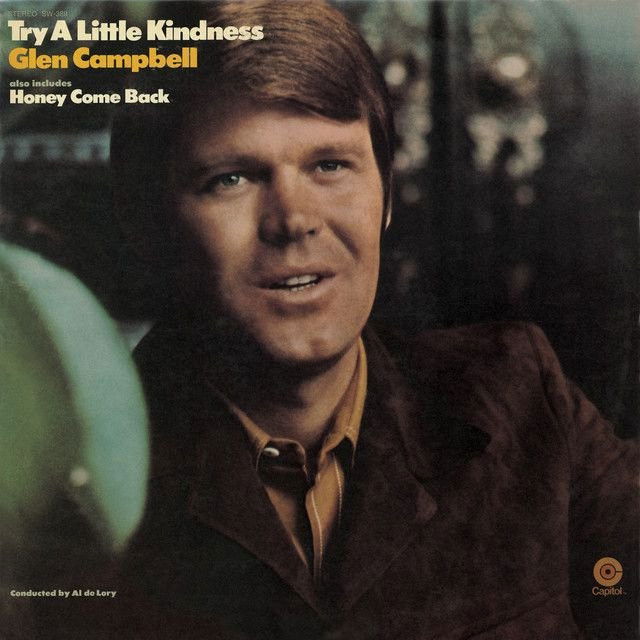
Why 'Try a Little Kindness' Still Matters
The meaning of Try A Little Kindness Glen Campbell is simple on the surface and deeper than it first appears. The song is not just a polite reminder to be nice. It is a moral appeal: when people meet suffering, failure, or social division, they should answer with mercy instead of judgment.
"Try A Little Kindness" - Glen Campbell
With a heavy load from the seeds he's sowed
And if you see your sister falling by the way
Loading lyrics...
Unable to load lyrics
We're unable to display the lyrics at this time. Please try again later.
First recorded by Glen Campbell and released in October 1969, the song was written by Curt Sapaugh and Bobby Austin and became a major crossover hit, reaching No. 2 on Billboard's country chart, No. 1 on the adult contemporary chart, and No. 23 on the Hot 100, according to available chart histories and release details (Wikipedia). That success makes sense. Its message is broad, clear, and timeless.
A Simple Message With a Strong Moral Push
At the center of the song is a direct request: try a little kindness
. But the lyric does more than offer a vague slogan. It gives listeners a series of situations in which someone is struggling, and then asks them to respond with action.
The verses describe people weighed down by their own choices or bad circumstances. One person stands by the road with a burden. Another is slipping off course. The point is not to shame them. The point is to stop, notice, and help.
That is why the line about lend a helping hand
matters so much. The song treats kindness as practical, not sentimental. It is not just a feeling in private. It is something visible, public, and useful.

Watch the official Try A Little Kindness
music video
Who the Song Is Talking To
The lyric speaks in the second person, telling the listener what they can do. That choice makes the song feel personal. It does not describe kindness as a grand political theory or a distant religious lesson. It talks to ordinary people moving through ordinary streets.
There is also a quiet challenge in that approach. The song assumes that everyone will eventually see someone who is struggling. When that moment comes, they can either pass by or step in.
The Listener Becomes Part of the Story
The recurring idea to shine your light
turns the listener into an example for others. Kindness, in the song's logic, spreads outward. One caring act may help one person directly, but it may also change the mood of a wider community.
Interpretation: This is why the song feels bigger than a one-on-one message. It imagines kindness as social influence.
How the Verses Build the Song's Meaning
The song moves in a clear pattern:
- It shows someone in trouble.
- It asks the listener not to judge too quickly.
- It offers kindness as the right response.
- It promises that kindness helps people keep going.
That structure gives the song its force. Each verse takes a common human weakness—indifference, doubt, narrow judgment—and replaces it with compassion.
One of the sharpest phrases is narrow-minded people
. The song is not only about helping the poor or discouraged. It is also about refusing to become hard-hearted. In other words, the real danger is not just another person's suffering. It is the listener's own temptation to look away.
show a little kindness
shine your light
Those short lines capture the song's core idea: goodness should be active and visible.
Glen Campbell's Voice Makes It Land
Glen Campbell was especially good at songs that balanced warmth and polish. By 1969, they were already a major crossover star, moving between country and pop with ease. That matters here because the song needs to sound welcoming, not severe.
Recorded in Hollywood in early 1969 and produced by Al DeLory and Glen Campbell, the track sits between country and easy listening, with a bright, smooth arrangement that supports the lyric's hopeful tone (Wikipedia). The rhythm moves lightly, and the melody feels open rather than heavy.
Why the Production Matters
If this lyric had been sung in a harsher style, it might have sounded scolding. Instead, the record feels encouraging. The clean arrangement, steady beat, and easy melodic rise make the message feel doable.
That is a key reason the song worked so well on multiple charts. It carried a country moral center, but its presentation was soft enough for pop and adult contemporary audiences too.
A Song for Its Time—and Beyond It
Released at the end of the 1960s, the song arrived in a period marked by social conflict, generational tension, and public unrest. Without naming any single issue, it answers that climate with a belief in everyday decency.
Interpretation: The phrase about overlook the blindness
suggests more than private frustration. It hints at a world full of prejudice, coldness, and moral tunnel vision. The song's answer is not revenge or retreat. It is choosing another way to live.
That helps explain why the song still feels relevant in the United States now. Its lesson is small-scale but not small-minded. It says people do not need power or fame to improve the world around them. They need attention, empathy, and follow-through.
The Lasting Meaning of the Song
So what is the meaning of Try A Little Kindness Glen Campbell? It is a call to meet pain with grace, to resist judgment, and to treat kindness as a daily responsibility. The song argues that compassion is not weakness. It is clarity.
Its biggest strength is that it never overcomplicates that idea. They keep the language plain, the melody inviting, and the message open to anyone willing to hear it.
That simplicity is why the song endures. It believes small acts matter.
Disclaimer: This interpretation is based on the song's lyrics, recording context, and public chart history. As with any song, listeners may hear personal meanings that go beyond this reading.







