Why 'I Know It's Today' Hurts and Charms
The meaning of I Know It's Today Leah Greenhaus, Marissa O'Donnell, Sutton Foster starts with a joke and ends with a wound. In Shrek the Musical, this number tracks Fiona across childhood, adolescence, and adulthood as she waits in a tower for the fairy-tale ending she was promised.
"I Know It's Today" - Leah Greenhaus, Marissa O'Donnell, Sutton Foster
There's a princess
In a tower
Loading lyrics...
Unable to load lyrics
We're unable to display the lyrics at this time. Please try again later.
The song was written by Jeanine Tesori and David Lindsay-Abaire for the stage adaptation of Shrek, which opened on Broadway in 2008 and later received cast recordings and a filmed stage version through major theatrical releases and listings from Broadway and Playbill. The three credited performers here—Leah Greenhaus, Marissa O'Donnell, and Sutton Foster—represent Fiona at different ages, and that structure is the key to the song's emotional force.
A Fairy Tale That Ages in Real Time
At first, Fiona sounds like a child play-acting with storybooks. She compares herself to princesses and assumes the pattern will work for her too. When she sings about a white knight
, they are not just hearing romance. They are hearing a script she has memorized.
That is why the song is more than a waiting song. It is about how stories shape expectations. Fiona believes rescue must come because, in her mind, there are rules, happy endings, and proper roles. The humor comes from how bluntly she summarizes old fairy tales, but the deeper point is that those tales have trained her to expect life to move toward reward.
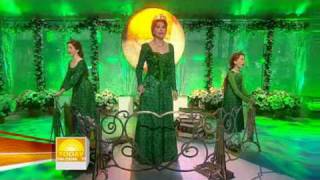
Watch the official I Know It's Today
music video
Three Fionas, One Emotional Arc
Childhood hope
The first section is bright and playful. Young Fiona treats isolation like a temporary delay. Even when the details of the princess stories get dark, she brushes them aside and jumps to the happy ending. Her focus is simple: the prince will come, and it will happen soon.
That innocence is captured in the early count of day number twenty-three
. The number is small enough to feel survivable. Waiting still feels like part of the game.
Teenage impatience
By the middle section, the joke sharpens. Fiona is older, sharper, and more sarcastic. She still believes in the outcome, but now she wants the boring parts removed. She does not want struggle, growth, or uncertainty—just the reward.
That is why her frustration matters so much. She wants to cut the waiting
, which is funny on stage but also revealing. She has been taught to value the ending more than the life in between.
Adult loneliness
The final shift lands hardest. Adult Fiona still says I know it's today
, but now it sounds like a survival tactic. The line has not changed, yet its emotional meaning has. What was once confidence becomes desperation.
When the song reaches day number eight thousand
, the comedy and sadness fully merge. Time has turned a fairy-tale promise into a private ache.
What the Chorus Really Means
The chorus is built around repetition, and repetition is the whole point. Fiona keeps telling herself rescue is imminent because admitting otherwise would be crushing. In plain terms, the hook is not proof of certainty. It is proof of need.
Interpretation: the song suggests that hope can become a cage when it is tied to one fixed dream. Fiona is not only trapped in a tower. She is trapped in a narrative she did not write.
How Humor Carries the Pain
One reason the song works so well is tonal balance. Tesori and Lindsay-Abaire let Fiona mock fairy-tale logic while still longing for it. The jokes about princess plots, rescue scenes, and polished romance make her feel smart rather than naive. That matters because the audience laughs with her before realizing how lonely she is.
There is also a theatrical trick at work. The song keeps moving, so the years pass quickly for the audience. But because the three performers share one emotional thread, the speed makes the loss feel bigger. They watch a life go by inside a comic number.
How the Music Supports the Meaning
Musically, the song mirrors Fiona's changing age and mood. The arrangement begins with a light, storybook bounce. It feels almost like a music-box version of a princess fantasy, matching the innocence of the opening.
As the sections build, the song gains more drive and force. The harmony thickens, the phrasing gets punchier, and the voices overlap in a way that turns personal waiting into accumulated pressure. By the finale, the three Fionas singing together create a layered effect: past hope, present pain, and stubborn belief all exist at once.
That ensemble design is central to the song's meaning. It lets the audience hear how one idea can sound adorable at age seven, restless at age sixteen, and heartbreaking in adulthood.
A Bigger Theme Inside Shrek
Within the musical, this number also sets up the show's broader message. Shrek repeatedly challenges polished fairy-tale ideals in favor of messier, truer connection. Fiona's longing for the perfect prince is part of that setup.
Interpretation: the song is not mocking love itself. It is mocking the false version of love sold by storybooks—the kind that skips fear, time, and real self-knowledge. Fiona has to outgrow that fantasy before she can recognize genuine love when it arrives.
Why the Song Still Connects
Many listeners relate to this song because it is not only about romance. It can also reflect any life delayed by expectation: waiting to be chosen, waiting to become happy, waiting for the real story to start. Fiona's tower becomes a symbol for all the ways people postpone living while they wait for validation.
That is why the meaning of I Know It's Today Leah Greenhaus, Marissa O'Donnell, Sutton Foster remains so resonant. It captures the comedy of hope, the cruelty of time, and the strange courage it takes to keep believing.
Final thought
In the end, the song turns a fairy-tale setup into a very human portrait of longing. It is funny, but its core truth is serious: waiting for life can become life itself.
Disclaimer: This interpretation blends documented musical context with informed reading of the lyrics and performance. Meaning can vary by listener and production.








