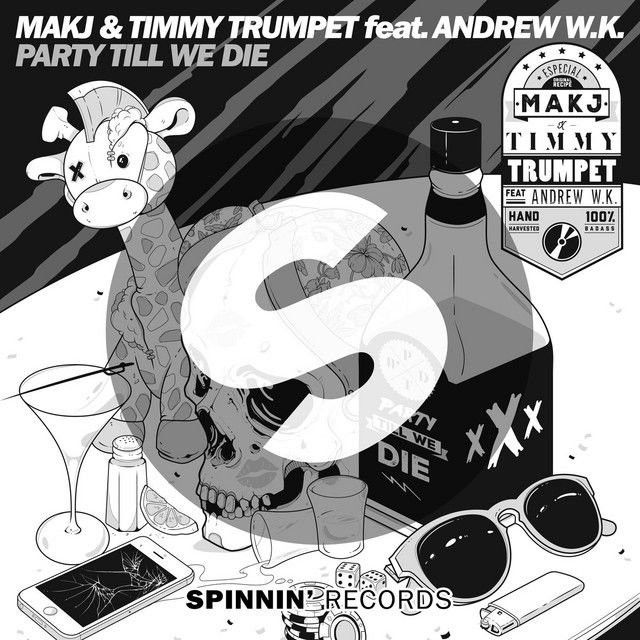
Why 'Party Till We Die' Hits So Hard
The meaning of Party Till We Die MAKJ, Timmy Trumpet, Andrew W.K. is not hidden behind complex poetry. They built this track as a blunt, loud festival mission statement. It is about total release: losing themselves in the crowd, treating the night like a shared identity, and pushing the feeling of celebration until it becomes bigger than common sense.
"Party Till We Die" - MAKJ, Timmy Trumpet ft. Andrew W.K.
All we are, we are
All we are, we are
Loading lyrics...
Unable to load lyrics
We're unable to display the lyrics at this time. Please try again later.
Released on September 27, 2016 through Spinnin' Records, the song brought together MAKJ, Timmy Trumpet, and Andrew W.K., an artist already closely tied to party-as-philosophy rock music according to coverage from Rolling Stone and artist discographies. Timmy Trumpet was already known for turning EDM sets into high-energy spectacles, mixing dance drops with live trumpet performance and stage-show intensity.
A Hook That Turns a Party Into an Identity
The key idea arrives immediately in the repeated line Party till we die
. Paraphrased, the song says the party is not just something they do for one night. It becomes who they are.
That is why the other repeated phrase, All we are
, matters so much. Instead of describing jobs, relationships, or private thoughts, the lyric reduces identity to one shared purpose. In simple terms, they are saying: in this moment, the crowd exists to celebrate, shout, jump, and forget limits.
Interpretation: That reduction is both the song’s strength and its message. It captures how festival culture often works. For a few hours, thousands of people agree to feel the same thing at once.

Watch the official Party Till We Die
music video
The Lyrics Are Simple on Purpose
This is not a song that unfolds in verses with plot twists. It works more like a chant. Nearly every line feeds the central slogan, which is why repetition is essential rather than lazy.
The phrases Always getting crazy
and Always say forever
push the song from a normal party track into a kind of exaggerated oath. They are not making a careful life plan. They are dramatizing the way people talk in peak moments, when one night feels endless and every promise sounds permanent.
Always getting crazy
Always getting high
Always say forever
Party till we die
Paraphrased, that section links excess, euphoria, and the fantasy of permanence. The party is framed as eternal, even though everyone knows real life returns when the music stops.
Celebration, Excess, and the Edge of Self-Awareness
A lot of listeners will hear the song as straightforward fun, and that reading is valid. The track celebrates wild behavior without apology. It is designed for the peak of a set, when the goal is not reflection but release.
Still, there is a slight tension inside the lyric. The promise of forever sounds knowingly over-the-top. When they repeat these ideas again and again, the song starts to feel almost cartoonish in its intensity.
Interpretation: That exaggeration may be the point. The track understands that festival language is often hyperbolic. Nobody literally lives inside the drop forever. But for a few minutes, the music lets them act as if they can.
Why Andrew W.K. Fits the Theme Perfectly
Andrew W.K. has long treated partying as both joke and creed, so his role here is more than a guest feature. His persona gives the song cultural context. He brings the rock-world version of extreme positivity and total commitment, which makes the track feel less like a random EDM single and more like a crossover anthem.
That matters because MAKJ and Timmy Trumpet already operate in high-energy dance spaces. Timmy Trumpet, in particular, built his name on explosive live performance and blending EDM with live trumpet, a style noted in major bios and press coverage. Pairing that kind of festival force with Andrew W.K.'s overdriven party philosophy makes the song’s message feel unified.
The Production Sells the Meaning
The production is crucial to understanding the song. The lyrics alone are minimal, but the arrangement turns them into a huge communal statement.
Instead of detailed storytelling, the track leans on:
- a punchy, festival-ready beat
- a chant-like vocal delivery
- rising tension before the drop
- oversized synth energy
- a crowd-commanding structure
That design supports the theme of surrendering to the moment. Every musical choice points outward, toward a live audience. This is not inward headphone music. It is engineered for mass reaction.
Interpretation: In that sense, the song means exactly what it sounds like. The drop becomes the emotional argument. They do not explain freedom in abstract terms; they make the listener feel it physically.
Why the Song Connected in EDM Culture
By 2016, Timmy Trumpet had already built momentum through major dance releases and a reputation for crowd-hyping performances. His broader career, including crossover hits and a festival-friendly sound, made him a strong fit for a slogan-heavy anthem like this one. The track landed during an era when big-room EDM still relied heavily on simple hooks that could unite huge crowds fast.
That helps explain why the meaning of Party Till We Die MAKJ, Timmy Trumpet, Andrew W.K. feels so direct. It was made for instant recognition. The song does not ask listeners to decode symbolism. It asks them to join.
The Best Way to Read Its Message
The clearest reading is that the song celebrates shared escape. It turns partying into a temporary worldview where joy, noise, and intensity matter more than tomorrow.
A second reading is slightly more critical: by repeating the same slogans so hard, the song also reveals how thin and fragile those slogans are. The magic works because it is temporary.
Both ideas can be true at once. That is why the track still works. It is both sincere and excessive, both fun and knowingly ridiculous.
Final Take on the Anthem
In the end, this song is about communal abandon. They strip life down to one feeling and then amplify it until it sounds immortal. That is why it hits in clubs and festivals: it gives the crowd a simple sentence to live inside.
Disclaimer: This interpretation is based on the song’s lyrics, performance style, and public artist context. Meaning can vary from listener to listener.









