
Why “L'horloge tourne” Hits So Hard
The meaning of L'horloge tourne Mickael Miro comes down to one simple fear: life moves faster than people can process it. In this French pop song, Mickael Miro turns a catchy hook into a story about growing up too quickly, facing consequences, and realizing that time never waits.
"L'horloge tourne" - Mickael Miro
J'ai dix-huit ans
Envolée, ma virginité
Loading lyrics...
Unable to load lyrics
We're unable to display the lyrics at this time. Please try again later.
Rather than telling one single dramatic event, the song moves in snapshots. Each verse jumps to a new age and a new crisis, all sparked by the same ordinary image: an incoming text. That choice makes the song feel modern, intimate, and universal at once.
A Pop Song About Time, Not Just Youth
On the surface, the track sounds light and melodic. But the lyrics are more serious than the bright arrangement first suggests. The narrator moves from age 18 to 30, and every stage brings a new emotional test.
Early on, the song links desire with the end of innocence. A short phrase like J'ai dix-huit ans
marks the start of adulthood, but not in a triumphant way. Instead, the moment feels rushed and unstable, as if maturity arrives before the narrator is ready.
From there, time becomes the real subject. The repeated line L'horloge tourne
is not just a reminder that minutes pass. It turns the clock into a force pressing on every choice, every regret, and every memory.
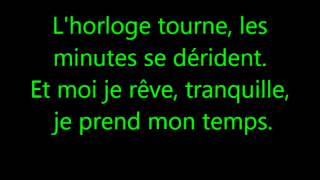
Watch the official L'horloge tourne
music video
The Life Story Hidden in the Verses
The song works almost like a timeline of emotional shocks. Each verse adds another layer to the narrator’s relationship with time.
- At 18, they step into adult sexuality and immediately feel how fast innocence disappears.
- At 20, pleasure turns into fear when the possibility of pregnancy appears.
- At 21, that fear changes shape, and time briefly feels calmer.
- At 25, outside tragedy enters the story, widening it beyond private life.
- At 28, family decline brings mortality close to home.
- At 30, the narrator looks back and wants to freeze what is left.
That structure is one reason the song connects so easily. It does not argue a message. It lets listeners feel how one decade can contain a whole emotional education.
How the SMS Motif Makes It Feel Modern
The recurring text message image is clever because it is so ordinary. The phrase Un SMS vient d'arriver
sounds casual, but each arrival changes the emotional weather of the song.
Interpretation: the SMS works like a symbol of modern fate. News now comes instantly, often without warning, and can alter a life in seconds. By repeating that trigger, the song suggests that adulthood is shaped by abrupt alerts: love, panic, tragedy, illness, and reflection all arrive through small interruptions.
For U.S. listeners, this detail helps explain why the song still feels current. Even though texting technology has changed, the emotional idea remains familiar: life-changing updates often appear on a screen before the heart can catch up.
The Chorus Turns Time Into an Enemy
The chorus is simple, but its simplicity is the point. The hook circles back to the clock, while the playful vocal refrain softens the blow. That contrast between catchy sound and anxious meaning gives the song much of its power.
In different verses, the narrator wants opposite things. They want to speed time up, reverse it, survive it, and finally stop it. One especially revealing phrase is D'arrêter le temps
. By the end, the song shows that people do not really want one fixed relationship with time. They want control over it, especially when life becomes painful or fragile.
Et moi, je rêve
D'arrêter le temps
Those lines summarize the full arc. Dreaming becomes the only place where time can be negotiated.
Loss, Regret, and the Fear of Aging
One reason the meaning of L'horloge tourne Mickael Miro resonates is that it keeps broadening its scope. What starts as a coming-of-age song slowly becomes a song about mortality.
The later verses move from personal choices to larger losses. A disaster wipes away childhood symbols. A grandmother grows weak. At 30, the body itself becomes a clock, with age appearing in the face. The phrase les minutes sont des rides
captures that shift with unusual directness.
Interpretation: the song suggests that adulthood is not one clean transition. It is a chain of endings. Innocence ends, certainty ends, family stability ends, and eventually even youth ends. That is why the refrain feels heavier each time it returns.
Why the Bright Sound Matters
Musically, the song is built to be memorable. Its pop structure, singable chorus, and rhythmic bounce create easy momentum. That makes sense for Mickael Miro, a French singer-songwriter known for pairing accessible melodies with emotional storytelling.
This production choice matters to the meaning. If the song were arranged as a dark ballad, it might feel too heavy. Instead, the upbeat surface mirrors real life: difficult truths often arrive in the middle of ordinary days, not with cinematic warning.
The cheerful refrain also creates tension. Listeners can sing along even as the lyrics move through anxiety and grief. That split between sound and subject reflects how people often cope with time itself—by keeping moving, even when they feel shaken.
Final Take on the Song’s Meaning
The meaning of L'horloge tourne Mickael Miro is ultimately about the impossible wish to manage time. The narrator wants to rush it, undo it, survive it, and preserve it, but the song keeps returning to the same fact: the clock keeps going.
That is why the track lasts. It turns everyday life into a series of emotional deadlines, then wraps that idea in a tune listeners can carry with them. What sounds light at first becomes a moving portrait of how quickly a life can change.
Disclaimer: This article offers an interpretation of the song based on its lyrics and public context. Different listeners may hear its meaning differently.








