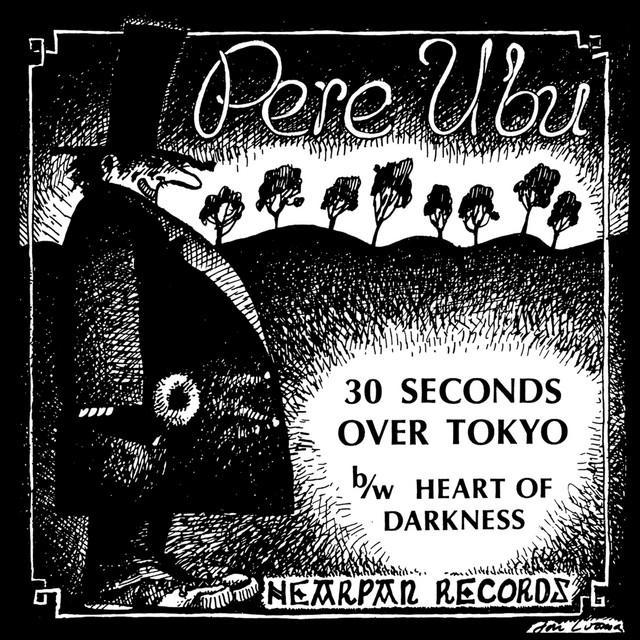
30 Seconds over Tokyo by Pere Ubu
A war song that sounds like a nightmare
The meaning of 30 Seconds over Tokyo Pere Ubu starts with a concrete story: a bomber crew heading toward Japan on a one-way mission. The lyrics draw from the 1942 Doolittle Raid, and the title echoes the well-known memoir Thirty Seconds Over Tokyo. According to Wikipedia, the song was written by David Thomas, Peter Laughner, and Gene O'Connor, first tied to Rocket from the Tombs before Pere Ubu released it as their debut single in December 1975.
"30 Seconds over Tokyo" - Pere Ubu
In a metal dragon locked in time
Skimming waves of an underground sea
Loading lyrics...
Unable to load lyrics
We're unable to display the lyrics at this time. Please try again later.
But this is not a tidy history lesson. Pere Ubu turn the mission into something stranger and more haunting. The opening image of a flight at dawn, inside a machine that feels both real and unreal, makes war sound like a fever dream. When the lyric describes a metal dragon
, it turns the airplane into a monster. That one phrase helps explain the whole song: technology is powerful, cold, and barely under human control.

Watch the official 30 Seconds over Tokyo
music video
What the narrative is doing
From departure to doom
Factually, the song moves in sequence. They leave early, cross toward enemy territory, face anti-aircraft fire, and approach the target with no escape route left. David Thomas later said this was probably the last time he wrote in a straightforward narrative form, which matters because the plot is unusually clear even as the sound becomes chaotic.
The key emotional turn comes when the lyrics stop treating the mission like duty and start treating it like fate. The crew are not heroes in a clean movie sense. They are trapped. Phrases like strange gods' hands
and suicide ride
make the raid feel less patriotic than sacrificial. The song does not celebrate war; it puts listeners inside its dread.
Thirty seconds
And a one way ride
Thirty seconds over Tokyo
That hook reduces a huge historical event to a tiny slice of time. Interpretation: the song suggests that life-and-death decisions can collapse into seconds, and once the crew reaches that moment, history becomes pure terror.
The chorus shrinks history down to panic
The refrain is simple, but that simplicity is the point. Instead of grand speeches, the song gives a countdown feeling. No place to hide
is not just about combat conditions. It also points to psychological truth: once someone has crossed a line, they cannot return to innocence.
This is one reason the track still feels modern. Many war songs explain or argue. Pere Ubu do something else. They trap the listener in pressure, repetition, and narrowing options. The line about thirty seconds makes time feel warped. In the verses, time stretches into dream imagery. In the chorus, it snaps shut.
Images of dream, distance, and dehumanization
Several images connect the song’s themes. The sea below becomes an underground sea
, enemy land looks alien, and the city below turns into a toy-like miniature. These details show how distance changes moral perception. From the air, a real city can start to look unreal.
That matters because the song is partly about dehumanization. The bomber crew are detached from the people below, yet they are also losing their own human scale. They become tiny figures inside a machine, suspended between sky and target. When the streets look like a toy city and explosions resemble grotesque growths, the listener hears how war scrambles perception.
Interpretation: the song may also be about modern alienation beyond war. Pere Ubu came from Cleveland’s damaged industrial landscape, and their art often turned machines, noise, and urban decay into emotional symbols. In that reading, Tokyo is both a real place and a mental zone where technology, fear, and detachment take over.
Why the music matters as much as the words
Pere Ubu build the cockpit in sound
A big part of the meaning of 30 Seconds over Tokyo Pere Ubu comes from production. The band recorded the single in Cleveland in 1975, with Pere Ubu and Bill Cavanaugh credited as producers. The arrangement mixes riffs with extended improvisation, so the song feels half-composed and half-out-of-control.
Allen Ravenstine’s synthesizer is crucial. Research on the song notes that he used an EML ElectroComp 200 to mimic World War II aircraft engines and the radio static at the end. That means the sound design is not random noise; it is part of the storytelling. The track does not merely describe a mission. It sonically reenacts one.
The guitars lurch instead of soar. The drums push forward without offering comfort. David Thomas sings with a voice that sounds alarmed, detached, and nearly theatrical at once. Near the end, the radio-like filtering makes the vocal seem to break apart in midair. This is where the song earns its reputation as a proto-punk landmark. As AllMusic put it, the music’s noise fits Thomas’ apocalyptic vision.
Context, reception, and lasting meaning
Pere Ubu originally planned to be a one-off studio project after Rocket from the Tombs ended badly. Instead, this debut single reached listeners in places like London, Paris, and Minneapolis and helped keep the band alive. Critics later called it ahead of its time, and that sounds right. It carries garage rock force, art-rock structure, and the nervous edge that post-punk would soon refine.
So what is the song finally about? Factually, it tells a wartime bombing mission. Interpretation: at a deeper level, it is about what happens when people enter systems bigger than themselves—war, machines, history, even ideology—and realize too late that there is no safe exit. Its power comes from refusing triumph. It offers awe, fear, and dislocation instead.
That is why the track remains so gripping. They turned a historical raid into a study of dread, compressing vast violence into one unbearable approach.
Disclaimer: This interpretation combines documented context with critical reading. Songs can hold more than one valid meaning, and listeners may hear different emotional or symbolic layers in it.








