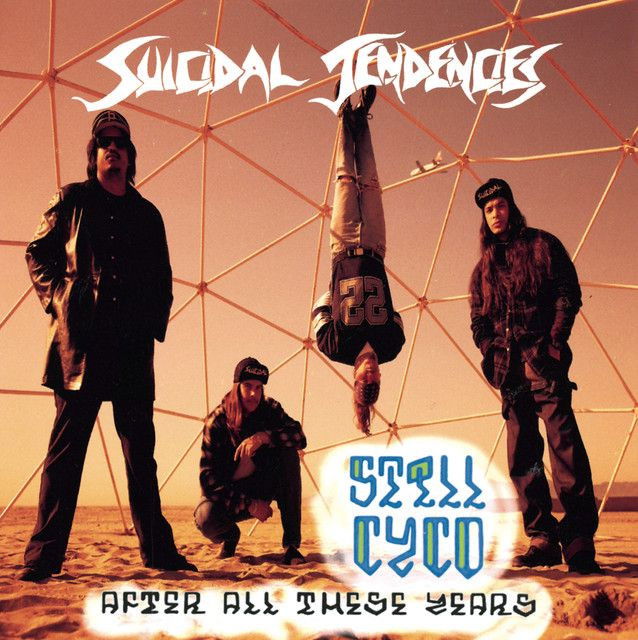
Why 'I Shot the Devil' Feels So Dangerous
The meaning of I Shot the Devil Suicidal Tendencies starts with provocation. This is a song built to shock. Its narrator boasts about impossible crimes, throws religion into chaos, and turns punishment into a sick joke. In a very short space, Suicidal Tendencies create a world where moral order has broken down.
"I Shot the Devil" - Suicidal Tendencies
I'm gonna shot you dead in heaven you'll rot
You're gonna rot in heave, hear an angel's voice
Loading lyrics...
Unable to load lyrics
We're unable to display the lyrics at this time. Please try again later.
That does not mean the song should be read as literal. Interpretation: it works better as a piece of punk-metal theater, where exaggeration exposes fear, hypocrisy, and social collapse. That approach fits a band known for confrontational songs like Institutionalized, one of their signature tracks and a long-running live staple in their catalog, as widely documented in coverage of the band’s early years.
A Violent Voice, Not a Simple Story
The song opens by naming famous targets and then raising the stakes further. Phrases like I shot Reagan
and I shot the Pope
are not there to build a realistic plot. They are there to make the listener recoil.
From there, the title line, I shot the devil
, pushes the song into allegory. If the devil is gone, then evil is not defeated in any comforting way. Instead, the song says the listener or target now has no hope
. That twist matters. Killing the symbol of evil does not save anyone here. It only leaves a ruined moral landscape.
Watch the official I Shot the Devil
music video
Heaven, Hell, and a Broken Moral System
The strangest idea in the lyric is its reversal of religious judgment. The repeated thought that someone will rot in heaven
while being too bad for hell
sounds absurd on purpose. The song flips the normal rules of reward and punishment.
Interpretation: this could mean two things at once:
- The narrator is mentally and morally unreliable.
- The world itself is so corrupt that even heaven and hell have stopped making sense.
That second reading is where the song gets its bite. In many punk songs, institutions that claim moral authority are shown as hollow or cruel. Here, even the afterlife sounds bureaucratic, warped, and useless.
rot in heaven
too bad for hell
Those two short lines carry most of the song’s meaning. They turn religion into irony. Instead of comfort, heaven becomes another place of punishment.
What the Song Seems to Be Attacking
Because the lyric is so compressed, readers have to look at its targets and tone. The famous names are not random. They are public figures tied to power, belief, and media attention. The song seems less interested in individuals than in what they represent.
Interpretation: the narrator may be attacking:
- political authority
- religious authority
- the culture of martyrdom and spectacle
- the idea that violence can purify society
That last point is crucial. The song never sounds triumphant in a healthy way. Its swagger is ugly. The speaker sounds trapped inside destruction, not freed by it.
Why Suicidal Tendencies Were Built for This Kind of Song
Suicidal Tendencies emerged from a Southern California scene where hardcore punk was getting faster, heavier, and more chaotic. Coverage of Institutionalized often describes the band as important to hardcore punk and crossover thrash, and that larger context helps explain why a song like this exists. Their music often mixes social alienation, sarcasm, and aggression.
Mike Muir, credited here as the writer, built many songs around unstable narrators, pressure-cooker emotion, and anti-authority tension. In that sense, “I Shot the Devil” feels consistent with the band’s identity even though it is more blunt and shocking than some of their better-known material.
How the Sound Carries the Meaning
Even with limited lyric detail, the song’s metal framework matters. A track like this depends on speed, distortion, and vocal attack to sell its worldview. The riffing likely functions less as melody than as pressure. The drums would drive the song forward like a chase, while the vocal phrasing turns each line into a threat or taunt.
That sound matters for the meaning of I Shot the Devil Suicidal Tendencies because the music makes the ideas feel unstable. If these same words were spoken softly, they might sound like satire alone. In a harsh metal setting, they sound like satire mixed with collapse.
The Most Plausible Reading
The strongest reading is that the song is about moral inversion. It presents a speaker who thinks in absolutes, acts in fantasies of total violence, and still ends up in a universe with no justice. Even the devil’s death solves nothing.
A second reading is more psychological. Interpretation: the song could represent a disordered mind trying to speak with authority while revealing confusion at every turn. The mixed-up heaven-and-hell imagery supports that idea.
Either way, the song is not offering a careful argument. It is staging a breakdown.
Final Take on the Song’s Meaning
So, what is “I Shot the Devil” about? At its core, it is a short blast of nihilistic satire. It uses blasphemy, political violence, and reversed religious imagery to show a world where judgment has failed and destruction has become its own language.
For listeners asking about the meaning of I Shot the Devil Suicidal Tendencies, the key is not whether the narrator means what they say. The key is how the song turns shock into a portrait of chaos.
Disclaimer: This interpretation is based on the song’s lyrics, tone, and artist context. As with many punk and metal songs, meanings can remain open to more than one reading.








