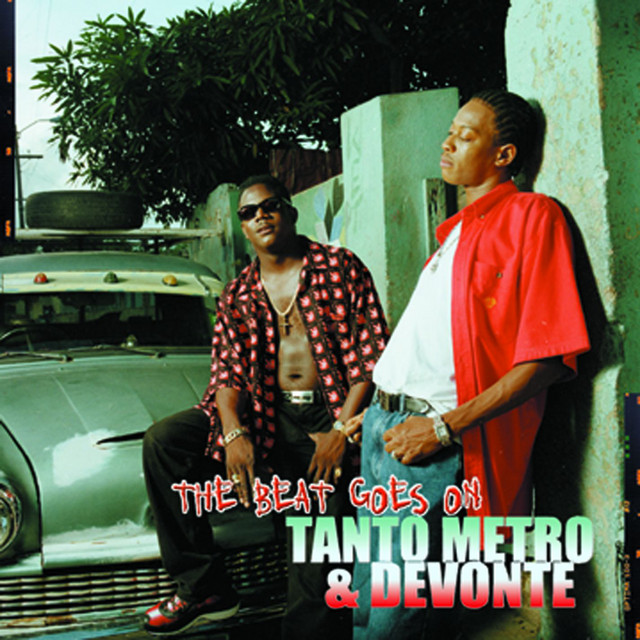
Give It To Her by Tanto Metro & Devonte
A dancehall hit built on command and energy
The meaning of Give It To Her Tanto Metro & Devonte starts with its most obvious feature: it is a fast, physical, party-centered dancehall song. The track is not subtle. Its hook pushes one idea again and again—if a woman asks for attention, affection, or sexual energy, the man should respond without hesitation.
"Give It To Her" - Tanto Metro & Devonte
(She can't get a way - no) Could never - Could never - eh-eh (no no)
Give it to her hard (more with me-e-e)
Loading lyrics...
Unable to load lyrics
We're unable to display the lyrics at this time. Please try again later.
That makes the song feel simple on the surface, but its appeal comes from how it turns that idea into performance. Tanto Metro & Devonte were known in the late 1990s and early 2000s for catchy, rhythm-first dancehall records, including songs from the era around Everyone Falls in Love. Here, they lean into the side of dancehall that prizes hype, movement, and directness.
Watch the official Give It To Her
music video
What the song is really saying
At its core, the song presents desire as something open and urgent. The chorus frames the situation in simple terms: if she says she wants it, give it to her please
. In plain language, the singers are describing a woman who clearly asks for satisfaction, and a man who is told not to delay.
That repeated instruction matters because it shapes the whole track. Rather than telling a detailed story, the song keeps circling one central command: don’t hold back, and don’t make her wait. Even the phrase give it to her hard
pushes the song toward physical intensity rather than emotional nuance.
Interpretation: This is less a love song than a performance of confidence. The men are not reflecting on a relationship. They are acting out a fantasy of sexual readiness, masculine stamina, and public bravado.
The hook turns desire into a public performance
The chorus is catchy because it sounds like advice shouted across a dance floor. The lines about if she said she wanted
and don’t you keep her waiting
make the woman’s request the trigger for the song’s action.
That is an important detail. The lyric does not center seduction through mystery. Instead, it imagines clear demand and immediate response. In that way, the song fits a club setting where messages must be loud, repeated, and easy to grasp.
If she said she needed
don’t you keep her waiting
Those short lines sum up the song’s engine. Everything in the verses expands that same mood of readiness, pressure, and sexual boasting.
The verses are full of swagger, not plot
Large parts of the verses use patois-heavy phrasing, vocal runs, and rhythmic fragments that land more as texture than as a clear narrative. That is common in dancehall, where voice can work like percussion. The singers pile up images of action, movement, and bedroom athleticism, including phrases like bed
and floor
to suggest variety and stamina.
They also move into boasting language. The men sound eager to impress, almost competing with an imagined standard of what a strong lover should be. There are references to women with different body types and styles, which broadens the fantasy world of the song: it is not about one person, but about a scene full of attraction and attention.
Interpretation: Because the verses are fragmented, the meaning comes more from attitude than from literal detail. The song sells confidence as spectacle. The point is not who these people are, but how forcefully the performers can deliver the mood.
Sound and production do a lot of the meaning
The production is crucial to why the song works. Credited writer Jeremy Harding was a major dancehall producer linked to hitmaking in this era, including the widely influential Jeremy Harding catalog. Even without overreading every line, listeners can hear how the beat shapes the message.
The rhythm is quick and springy, built for movement. The vocal delivery alternates between chanting, singjay phrasing, and bursts of melody. That gives the song a teasing, push-forward feel. Instead of sounding romantic or tender, it sounds playful, loud, and competitive.
This matters for interpretation. If the same words were sung over a slow R&B track, they might feel intimate. In this dancehall setting, they feel public. The beat turns desire into crowd energy.
Artist context helps explain the tone
Tanto Metro & Devonte often balanced melody with rougher dancehall swagger. They were good at songs that crossed from Jamaican sound system culture into broader pop and club spaces. That crossover helps explain why this track is so repetitive and hook-driven.
For U.S. listeners, the song may sound more blunt than emotional. But in context, that bluntness is part of the form. Dancehall often uses exaggeration, call-and-response, and bold sexual imagery to energize a crowd. The song’s meaning comes from that tradition as much as from any single lyric.
Is there a deeper message?
There are two useful ways to read the meaning of Give It To Her Tanto Metro & Devonte.
- Straight reading: It is a sexual party anthem about satisfying a woman who clearly asks for pleasure.
- Interpretive reading: It is also about performance itself—how masculinity gets staged in dancehall through boasting, rhythm, and public display.
The second reading helps explain why the song feels bigger than its literal words. It is selling an image: the man who is always ready, always confident, and always able to match the moment.
Why the song still stands out
The track lasts because it is built around immediacy. Its hook is easy to remember, its delivery is animated, and its meaning is direct. It captures one lane of late-1990s dancehall: sexy, physical, funny, and unapologetically showy.
For many listeners, that is the whole point. They are not meant to treat it like a diary entry. They are meant to feel its momentum.
Final takeaway
The meaning of Give It To Her Tanto Metro & Devonte is less about romance than about desire turned into performance. Through repetitive commands, sexual bravado, and a beat made for motion, the song presents pleasure as something immediate, public, and rhythmic.
That reading is an interpretation, not a confirmed statement from the artists. Like many dancehall songs, its meaning lives in the mix of lyrics, delivery, and culture around it.







