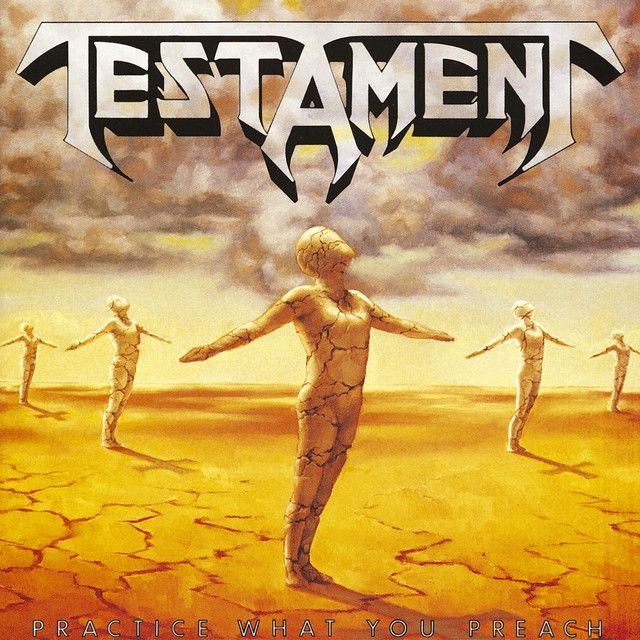
Practice What You Preach by Testament
The meaning of Practice What You Preach Testament starts with a simple idea: the song attacks hypocrisy. Testament build the track around a direct confrontation with someone who talks big, makes promises, and acts morally superior, but does not actually live by those words.
"Practice What You Preach" - Testament
You don't believe a word you say
Your feet aren't on the ground
Loading lyrics...
Unable to load lyrics
We're unable to display the lyrics at this time. Please try again later.
Released as the title track from the band’s 1989 album Practice What You Preach, the song arrived when Testament were broadening their themes beyond the occult and into social criticism. According to the album’s documented history, this record marked a lyrical shift toward issues like corruption, greed, and hypocrisy, while still keeping the band’s thrash core intact. It was also a commercial breakthrough, reaching No. 77 on the Billboard 200 and selling more than 450,000 copies in the U.S. by 1992.
A Thrash Song Built on Calling Someone Out
The verses are aimed at a person who seems lost behind their own image. They act like everything is fine, but the song argues that they do not even believe themselves. Early lines describe someone whose feet aren't on the ground
, which suggests ego, denial, or a shaky sense of reality.
From there, the writing gets more pointed. The narrator says this person lets life slide away, makes empty promises, and then spirals when pressure hits. In plain terms, Testament are not just mocking weakness. They are criticizing a gap between public words and private truth.
Interpretation: That makes the song less about one mistake and more about a pattern. The target keeps performing certainty while lacking discipline, honesty, and self-knowledge.

Watch the official Practice What You Preach
music video
Why the Chorus Hits So Hard
The chorus repeats Practice what you preach
like a slogan, but it does not sound gentle or helpful. It sounds like a verdict. In thrash metal, repetition often works like a hammer, and here that hammer lands on the same point again and again: credibility has to be earned.
That is why the hook is so effective. Anyone can say the right thing. The song argues that words mean little if actions do not match them.
More Than Advice, It Is an Accusation
The title phrase could sound like common advice in another genre. Testament turn it into a challenge. Their version says: stop pretending, stop lecturing, and live up to your claims.
A key supporting image is the bridge you burned
. The song suggests that dishonesty and arrogance damage trust. Once that damage is done, the person has to pay the burnt bridge toll
—in other words, face the consequences of broken relationships and broken credibility.
How the Verses Support the Theme
The writing stays focused on instability. Phrases like you lose control
show that the target’s confidence is fragile. They may sound self-assured, but the song paints them as hollow underneath.
That tension matters. Testament do not describe a cartoon villain. They describe someone whose words have outrun their character.
Practice what you preach
Practice what you preach
Even in that brief refrain, the meaning is clear. The song keeps returning to action over speech.
The Album Context Makes the Meaning Stronger
The title track fits the larger album perfectly. Practice What You Preach was released on August 8, 1989, produced by Alex Perialas, and recorded at Fantasy Studios in Berkeley, California. Reports on the album note that Testament were leaning more into social and political subjects at this stage, rather than the darker fantasy themes of earlier releases.
That context matters because the song does not feel isolated. It sits among tracks dealing with religion, environmental damage, personal crisis, and social disorder. AllMusic even summarized the album as emphasizing topics like freedom of choice, political corruption, hypocrisy, and greed. So this song’s attack on false virtue is part of a larger worldview, not just a catchy chorus.
How the Sound Carries the Message
Musically, the song helps its own argument. Testament were still a thrash band here, but this album also showed a slightly cleaner, more controlled approach than their earliest work. The riffs are tight and heavy, the tempo drives forward, and Chuck Billy’s vocal delivery sounds forceful without losing clarity.
That clarity is important. Because the message is direct, the band do not bury it under chaos. The groove gives the chorus a chant-like quality, while the guitars from Alex Skolnick and Eric Peterson add pressure and edge. Reviews of the album often praised that balance between aggression and precision, and it helps explain why the song worked both as a single and as a live staple.
Interpretation: The music mirrors the lyric’s moral demand. It is disciplined, sharp, and unsentimental—exactly what the target of the song lacks.
A Personal Attack or a Wider Warning?
There are two strong ways to read the song.
- Personal reading: It is a direct confrontation with one unreliable person.
- Broader reading: It criticizes a type of person often seen in public life—leaders, preachers, authority figures, or anyone who judges others while ignoring their own failures.
Both readings work. The second may be especially strong because the album as a whole moved toward wider social commentary.
Why the Song Still Connects
The meaning of Practice What You Preach Testament still lands because hypocrisy never goes out of style. Every era has people who make promises they do not keep and claim values they do not live by. Testament distilled that frustration into one of their most memorable choruses.
That staying power shows in the song’s long concert life and the album’s reputation as a key moment in the band’s rise. It is heavy, catchy, and morally blunt in the best way.
Final takeaway
Testament’s song is about the cost of empty words. It challenges people who speak with confidence but lack honesty, self-control, or integrity. Interpretation: more than anything, it argues that character is proven in action, not in performance.
Disclaimer: This interpretation is based on the lyrics, album context, and documented history, but song meaning can remain open to individual listeners.








