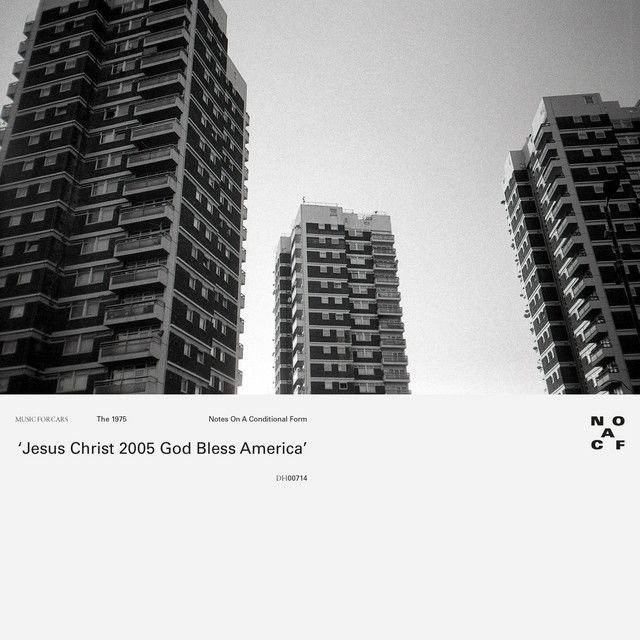
Jesus Christ 2005 God Bless America by The 1975
A quiet song with a painful split at its center
The meaning of Jesus Christ 2005 God Bless America The 1975 starts with a deep contradiction: the song speaks in the language of belief, but it also reveals desire that feels forbidden. Released in 2020 as a single from Notes on a Conditional Form, the track features Phoebe Bridgers and stands out as one of the band’s most stripped-back recordings. It was written by Matty Healy, George Daniel, Adam Hann, and Ross MacDonald, and produced by Healy and Daniel.[1][2]
"Jesus Christ 2005 God Bless America" - The 1975
(One, two, three, four)
I'm in love with Jesus Christ
Loading lyrics...
Unable to load lyrics
We're unable to display the lyrics at this time. Please try again later.
At its core, the song is about people trying to hold two truths at once. They believe in God. They also love someone they feel they cannot openly love. That tension gives the song its ache.
Watch the official Jesus Christ 2005 God Bless America
music video
Two voices, one shared burden
The lyrics are built like a duet, and that choice matters. One voice describes devotion in near-childlike terms, using the phrase I'm in love with Jesus Christ
. But almost immediately, the song turns and admits love for another person that must stay hidden. The short line a feeling I can never show
becomes the emotional center of the track.
Phoebe Bridgers’ verse mirrors that conflict from another angle. Instead of making the story only one person’s confession, the song becomes a shared portrait of repression, longing, and loneliness. That is why the duet format is so effective: it suggests this is not one unusual case, but a common wound.
Interpretation: The song is not simply saying religion is false. It is showing how religious identity and queer identity can collide inside the same person. That makes the song sadder and more compassionate than a simple protest song.
Why the title matters so much
The title is provocative, and it invites cultural reading. Critics have often linked 2005
to a period in U.S. culture when anti-LGBT attitudes were especially visible in politics and public life.[1] The phrase “God Bless America” adds a patriotic layer, so the title sounds like religion, nationalism, and morality are all tied together.
That matters because the song itself is small and intimate. The title sounds huge, almost like a slogan. The song beneath it is fragile. That contrast may be the point.
Interpretation: The title frames private pain as something shaped by public culture. In other words, the narrators are not only struggling with personal shame. They are living inside a system of beliefs that tells them what kinds of love are acceptable.
The lyrics move from confession to irony
The song’s first half is direct: desire is named, then immediately restricted. That simple structure creates the feeling of someone stopping themselves in real time.
Later, the writing gets stranger and more poetic. The phrase searching for planes in the sea
points to something impossible or misplaced. The narrator seems aware of the absurdity of trying to force certainty onto a life that feels fractured. They even call it irony.
Then the imagery shifts toward growth and interdependence, with soil just needs water
leading into a tree image. This is one of the song’s gentlest ideas: life needs the right conditions to become itself.
So if we turn into a treeCan I be the leaves?
Paraphrased, that closing image suggests a wish not just to survive, but to belong as part of something living and whole. It is a tender ending because it replaces shame with connection.
The sound makes the words feel even more exposed
Musically, the track is a minimalist folk ballad with acoustic guitar at its core, plus quiet drums, soft electronic textures, and touches of pedal steel, trumpet, and saxophone.[1] Reviewers compared its intimacy to Bruce Springsteen’s Nebraska and to singer-songwriters like Elliott Smith.[1]
That sparse arrangement is important to the song’s meaning. There is no giant chorus to hide inside. The vocals are hushed, almost careful, which makes the lyrics feel like thoughts spoken out loud for the first time.
Bridgers’ harmonies deepen that effect. She does not overpower the track; she widens it. Her voice adds another layer of vulnerability, helping the song feel like a dialogue between isolated people who recognize themselves in each other.
Artist context helps explain the ambiguity
Matty Healy said the song went through several versions before reaching its final form. According to reported background on the track, it began with a more singular focus, then moved through ideas about the prison-industrial complex and religious oppression before becoming what Healy described as a patchwork assembled from favored lines.[1]
That history explains why the song feels both specific and dreamlike. It has clear themes, but it resists becoming a neat thesis statement. Healy reportedly saw it as the “ultimate” Notes on a Conditional Form song because of that layered ambiguity.[1]
This also helps explain why listeners connect with it so strongly. Rather than arguing one clean point, the song captures confusion itself.
Why the song still resonates
The track was praised for its emotional honesty and understated production, with critics calling it poignant, crushing, and deeply heartfelt.[1] It also reached the U.S. Billboard Hot Rock & Alternative Songs chart, showing that such a quiet song still found a wide audience.[1]
Its staying power comes from how gently it handles hard material. They do not turn the conflict between faith and sexuality into a slogan. They turn it into a human voice.
For many listeners, that is the real meaning of Jesus Christ 2005 God Bless America The 1975: a song about what it feels like when love, identity, and belief do not fit neatly together, yet still remain real.
Final takeaway
The song works because it is soft without being vague. It names hidden desire, keeps faith in the frame, and uses a fragile duet to show how people can feel divided against themselves.
That makes this article’s reading an interpretation, not a final answer. Like the song itself, its meaning stays open enough for listeners to bring their own history to it.
[1] https://en.wikipedia.org/wiki/Jesus_Christ_2005_God_Bless_America
[2] https://en.wikipedia.org/wiki/Notes_on_a_Conditional_Form








