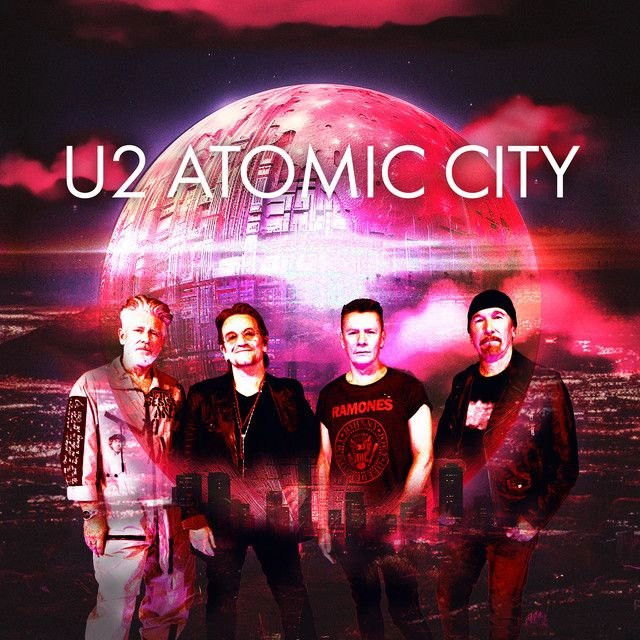
Atomic City by U2
U2’s single channels Las Vegas’s glow and danger to ask a simple question: How does a band—and its audience—find freedom together under the brightest lights? This guide breaks down the meaning of Atomic City U2, from its neon-soaked imagery to its punchy, post‑punk engine.
"Atomic City" - U2
Come all you angels forgetting to fly
Come all who feel we're not on our own
Loading lyrics...
Unable to load lyrics
We're unable to display the lyrics at this time. Please try again later.
Neon Faith, Fallout Glow: What It’s Really Saying
At heart, Atomic City is a love letter: to fans, to the city that hosts the band’s spectacular Sphere era, and to the idea that community can turn risk into renewal. The lyrics gather misfits and believers—angels, UFOs, skeptics—into one chorus. When the song warns Alone, that's no way
, it pushes back against isolation and invites a crowd to form.
Interpretation: The “atomic” metaphor fuses danger and awe. Vegas once sold mushroom-cloud breakfasts; today it sells immersive tech and reinvention. The track suggests that power—spiritual, artistic, communal—can be hazardous if hoarded but life‑giving when shared. That’s why the call to Come all who serve above and below
frames the floor and the rafters as equals.
The Voice on Fremont Street
The narrator is unmistakably first-person and present-tense, a frontman who sees himself as the conduit between band and audience. He offers a promise of proximity and presence, then stakes his identity on it.
I’m free
Where you are is where I’ll be
I’m free
So unexpectedly
That vow reframes freedom as a shared state, not just a personal escape. The “you” is the crowd—and anyone who shows up in good faith. The chorus becomes a pact: the band meets the audience in the same electric moment, no back row required.
Symbols Under the Neon
Atomic City (the 1950s nickname for Las Vegas) ties glitz to fallout: spectacle born beside the test site. Around that core image, the song threads recognizable Vegas signs—roulette, bright lights, front‑row fights—into a spiritual language.
- Risk:
Roll the dice
turns gambling into an artist’s creed—bet on the next song, the next night. - Inclusion: The chant
Atomic Sun for everyone
flips the fearful “atomic” into a universal spotlight. - Faith as feedback loop:
Love is God and God is love
compresses belief into a feedback hum—sacred and secular currents powering the same stage. - Liberation: When he grabs the
keys to the cages
, he’s not just escaping; he’s modeling release for the crowd. Freedom is contagious, not solitary.
Interpretation: The song treats Vegas not as sin or salvation, but as amplifier. Whatever you bring—doubt, devotion, ambition—gets louder. That’s both the risk and the thrill.
How the Sound Sells the Spark
Musically, Atomic City is a high-contrast snap of staccato verses exploding into a thumping, sing‑back chorus. U2 frames it as a homage to ’70s post‑punk and to Blondie’s Moroder-era momentum. That’s why Debbie Harry and Giorgio Moroder share songwriting credit alongside Adam Clayton, Bono, The Edge, and Larry Mullen Jr.—the chorus cadence nods to Blondie’s classic pop propulsion.
Produced by Steve Lillywhite and Jacknife Lee at Sound City in Los Angeles, the track blends tight, dry drums with a bassline that keeps the verses coiled. The Edge’s guitar toggles between percussive chop and wide-screen shimmer, opening the stereo field when the hook lands. Bono’s vocal rides the downbeat like a rallying cry—precise on the verse, then lifting into open vowels for the chorus to make the promise feel communal.
Context matters too: it arrived as a tie-in to U2’s U2:UV Achtung Baby residency at the Sphere. The video—shot on downtown Vegas’s Fremont Street—echoes their 1987 clip for I Still Haven’t Found What I’m Looking For, linking past street-preacher warmth to present-day spectacle. Larry Mullen Jr., sidelined from early residency dates while recovering from surgery, still tracked drums on the single—an old-school heartbeat anchoring a new stage era.
Two Readings, One Resonance
- Interpretation: Audience vow. The song is a public pledge to show up—physically and spiritually—where the fans are. The first-person chorus makes that contract explicit, while the closing fight-night image casts the show as a high-stakes bout they’re eager to enter together.
- Interpretation: Artist manifesto. The atomic metaphor refracts creative risk. Being “free” isn’t drifting; it’s choosing to step into blinding light, accept the odds, and keep betting on the next chorus to connect.
Final Word Before the Lights Go Up
If you’re searching for the meaning of Atomic City U2, here it is in plain terms: it’s about finding freedom in company, under neon that once signaled danger and now signals possibility. The band pulls history, faith, and nightlife into one spark, and invites everyone to stand in it together.
Disclaimer: Song meanings are interpretive. Listeners may hear different nuances based on personal experience.








