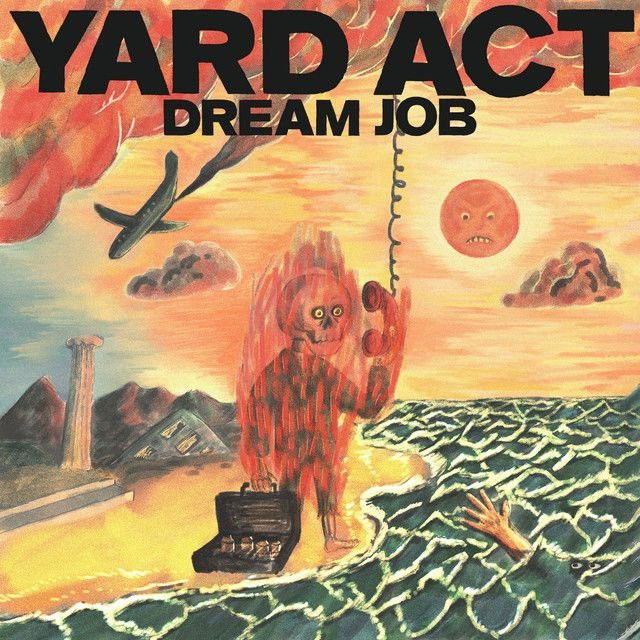
Dream Job by Yard Act
Why does landing the gig you always wanted still feel uneasy? That’s the tension at the heart of Yard Act’s Dream Job, a danceable satire that smiles while its eye twitches. If you’re searching for the meaning of Dream Job Yard Act, think of it as a pep talk delivered in a mirror—half victory chant, half warning label.
"Dream Job" - Yard Act
And we like criminals when criminals are treating us kind
For the subliminal freaks with their invisible style
Loading lyrics...
Unable to load lyrics
We're unable to display the lyrics at this time. Please try again later.
Hype Versus Headspace: What the Title Promises
Dream Job sounds like a success story. But the lyrics sketch a worker-performer who’s constantly judged—hence the jab of You're on trial
. They keep up appearances with a barrage of upbeat superlatives—It’s ace, top, mint, boss
—while doubts creep in.
Interpretation: The song captures the gap between how a career looks from the outside and how it feels from the inside. Yard Act’s frontman has described telling himself everything was great as a coping strategy, even while admitting it wasn’t that simple. That push-pull sits at the core of the track.
Who’s Talking, and Who’s Being Sold?
The narrator speaks in first person but addresses a shifting “you.” Sometimes it feels like a boss or gatekeeper—Step into my office
. Other times, it’s an audience or even the narrator’s reflection, as if they’re selling themselves the fantasy of success—Welcome to your dream job
.
Interpretation: The song blurs the line between corporate onboarding and music-industry onboarding. The “office” is both a literal workplace and the backstage world where artists get managed, marketed, and measured.
What Actually Happens: A Quick Timeline
- Opening scene: A collective falls in line with “a singular mind,” chasing acceptance while feeling judged.
- The narrator bets on a game no one can win, a neat image for the career rat race.
- Superlatives pile up—ace, top, mint—as a shield against creeping doubt.
- The sales pitch escalates:
Welcome to the future, paranoia suits ya
. The promise of progress comes bundled with anxiety. - The refrain returns like a slogan:
Step into my office
…Welcome to your dream job
. It’s enticing and a little menacing.
The Hook’s Double Edge: Celebration With Side Effects
The song’s catchiest lines sound like a company town hall. The narrator beams confidence, then undercuts it with a shrug—God knows what you’re talking about
. That refrain lands like a comic aside, but it also hints at confusion inside the hype.
Interpretation: The chorus is a mask. The grin is big, the beat is upbeat, but the eyes are scanning for the exit.
Symbols and Motifs: Office Speak, Trials, and Travel Perks
- Trial imagery: Being “on trial” frames success as constant judgment—by bosses, fans, peers, or oneself.
- Office theater: Invitations to an “office” and process talk mimic onboarding scripts and management-speak.
- Superlatives barrage: The ecstatic list feels like a social feed flexing wins. It’s persuasive and hollow at once.
- Status perks: Business-class dreams and “pass the pop” nod to consumption that papers over fatigue.
- The future as brand: “Welcome to the future” feels less like progress and more like a product demo, sold with paranoia.
How the Sound Sells the Story
Dream Job leans into a looser, groove-led pulse compared to Yard Act’s earlier, tighter post-punk bite. The rhythm section keeps things buoyant, while talk-sung vocals punch lines with dry wit. It plays like a party the band is hosting to keep doubts at bay.
Context matters: the song previewed their second album, Where’s My Utopia?, co-produced with Remi Kabaka Jr. of Gorillaz. That pop-leaning, dance-forward sheen makes the satire land harder. The music is celebratory; the message is complicated.
Interpretation: By wrapping anxiety in a catchy, communal bounce, they mirror how people push through workdays—keep moving, keep smiling, keep selling it.
Why It Resonates Now
Dream Job taps into a broader creative-economy mood: the pressure to project success, the fear that algorithms or faceless systems set the terms, and the grind of always being “on.” The track’s humor keeps it humane. It admits ambition and gratitude while leaving room for frustration and fatigue.
Alternate Readings Worth Considering
- Corporate satire first: The narrator plays an HR avatar, grooming a new hire into compliance. The “dream” is an illusion of perks masking control.
- Artist diary first: It’s a backstage monologue about sudden success—the party is real, the imposter syndrome is, too. The office is the music biz; the trial is public opinion. Both readings work because the language is flexible—office or venue, boss or booker, staffer or singer.
Takeaway: The Promotion Is Perspective
If you’re chasing the meaning of Dream Job Yard Act, here it is: success isn’t a cure-all. The song toasts the win and names the worry. It’s catchy by design—so the mask can stay on just long enough to finish the shift.
Disclaimer: This article offers interpretation based on publicly available interviews, reviews, and the lyrics. Your own reading may differ—and that’s part of the fun.









