Why 'Our House' by Madness Still Feels Like Home
The meaning of Our House Madness is easy to recognize and harder to outgrow. On the surface, it is a catchy pop song about a busy family home. Underneath, it is a memory piece about childhood, routine, and the strange ache of looking back at ordinary days that now feel precious.
"Our House" - Madness
Mother's tired, she needs a rest
The kids are playing up downstairs
Loading lyrics...
Unable to load lyrics
We're unable to display the lyrics at this time. Please try again later.
Released in 1982 as the lead single from The Rise & Fall, the song became Madness's biggest U.S. hit, reaching No. 7 on the Billboard Hot 100 while also hitting No. 5 in the U.K. It was written by Cathal Smyth and Chris Foreman, and produced by Clive Langer and Alan Winstanley. It later won an Ivor Novello Award, which shows how deeply it connected beyond its singalong hook.
A Family Portrait Hiding Inside a Pop Hit
The song works because it does not chase grand drama. Instead, it shows small domestic snapshots: a father dressing up, a tired mother, noisy children, and siblings moving through their own little worlds. Those details make the house feel lived in rather than idealized.
When the chorus lands on our house
and in the middle of our street
, it turns a single address into something larger. The home is both a real place and a symbol of belonging. It is modest, loud, and crowded, but it is also the center of their emotional map.
Interpretation: The song suggests that home is not valuable because it is peaceful or perfect. It matters because it holds the rhythms of family life.
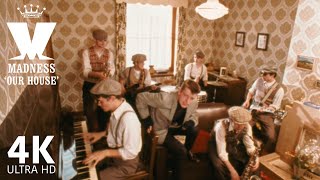
Watch the official Our House
music video
The Chorus Turns an Address Into Identity
The repeated refrain is so simple that it can sound almost childlike. That simplicity is the point. By repeating the location again and again, Madness makes home feel fixed and public, like a landmark everyone can see.
But the hook also carries tension. In one brief line, the song hints that you've got to move away
. That changes the mood. The house is beloved, yet life pushes people outward. Childhood homes stay in memory even after they stop being daily reality.
This is why the song feels bigger than novelty pop. It is not just saying, "Here is our home." It is saying, "Here is the place that made us, even if we cannot stay there forever."
Memory Makes the Middle Section Deeper
The emotional center arrives when the song shifts into recollection. Instead of listing family actions, it looks backward at shared happiness. The phrase way back then
signals that the speaker is no longer living inside those moments. They are remembering them from a distance.
That distance adds bittersweet feeling. The song remembers days when everything seemed solid and relationships felt unbreakable. It even describes the people as two dreamers
, which gives the memory a youthful innocence.
Our house, was our castle and our keepOur house, that was where we used to sleep
That short passage is important because it lifts the house from ordinary building to emotional fortress. A "castle" and "keep" suggest safety, pride, and protection. Yet the phrase "used to" quietly confirms that this world belongs to the past.
How the Sound Carries the Story
Part of the song's lasting power comes from its arrangement. According to American Songwriter, Chris Foreman's early demo was slower and gloomier before the band reshaped it into a more Motown-like groove. That change matters.
The final recording feels bright, springy, and communal. The beat keeps things moving like a household in constant motion. Horns add humor and bustle, while strings give the chorus lift and warmth. Suggs later noted that arranger David Bedford helped give the track what it needed, a reminder that the song's emotional glow is built into the production as much as the words.
Interpretation: The upbeat sound does not cancel the nostalgia. It makes the memory feel alive. They are not mourning the past in silence; they are celebrating it in motion.
Why It Connected So Strongly in America
Madness had many U.K. hits, but in the U.S. this became the breakthrough. American Songwriter reports that Geffen A&R executive John Kalodner recognized the song's crossover appeal, and MTV helped carry it further. The video's playful family imagery made the theme instantly clear.
That success also makes sense on a human level. The setting is distinctly British, yet the feeling is universal. Almost anyone can recognize the mixture of noise, rules, affection, embarrassment, and comfort that defines family life.
The Real Meaning of Our House Madness
So what is the meaning of Our House Madness in the end? It is a song about how ordinary family scenes become sacred in memory. It honors parents, siblings, clutter, repetition, and all the little things people do not always value until later.
Its genius is that it sounds fun without being shallow. The house is noisy and imperfect, but it also stands for safety, identity, and the passage from childhood into adulthood. That is why the chorus still feels so immediate decades later.
Madness turned a simple street into a universal memory. And that may be why the song still feels like home.
Interpretation disclaimer: Song meanings can vary by listener. This reading is based on the lyrics, recording context, and documented background, but it remains an interpretation rather than an official final answer from the band.








