Why 'Big Iron' Still Feels Larger Than Life
The meaning of Big Iron Marty Robbins starts with a simple Western showdown, but the song lasts because it tells that story with mythic force. Marty Robbins turns a brief gunfight into a lesson about justice, fear, and reputation. They do not need a complicated plot. They build suspense, give each character a role, and let the ending land with clean finality.
"Big Iron" - Marty Robbins
Hardly spoke to folks around him, didn't have too much to say
No one dared to ask his business, no one dared to make a slip
Loading lyrics...
Unable to load lyrics
We're unable to display the lyrics at this time. Please try again later.
Factually, Big Iron
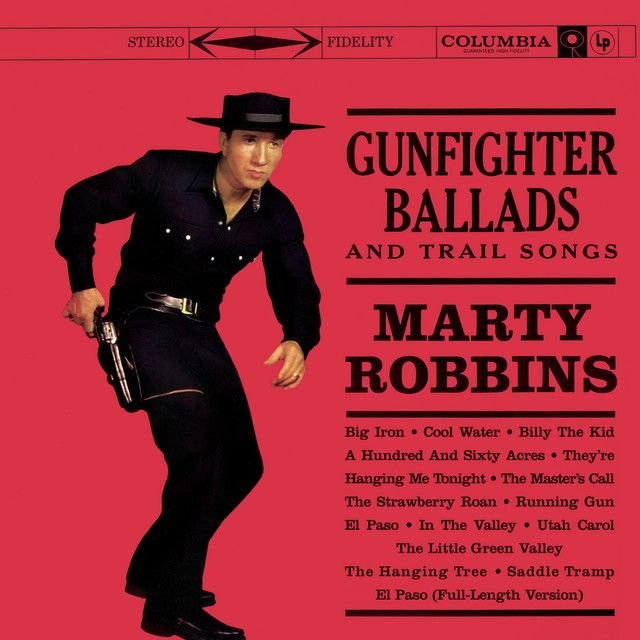
was written and recorded by Marty Robbins, first appearing on Gunfighter Ballads and Trail Songs in 1959 before its 1960 single release. It became one of his signature songs and later found a new audience through Fallout: New Vegas and its long afterlife in internet culture.
A Western Tale With a Moral Center
On the surface, the song follows a stranger entering Agua Fria, where locals fear what is coming. That stranger is soon revealed as an Arizona Ranger sent after Texas Red, a young outlaw with a deadly record. The town expects another failed attempt.
The core idea is straightforward: law arrives quietly, while violence depends on fear. Robbins frames the ranger as a man who barely speaks, yet everyone notices the big iron on his hip
. That image matters because it makes him look legendary before he even acts.
Interpretation: the song is not praising violence for its own sake. It treats the duel as the end of disorder. Texas Red has built a name through killing, but the ranger carries duty instead of ego.
Watch the official Big Iron
music video
How the Story Builds Tension
Robbins writes the song like a short film. Each verse adds one new step:
- A stranger rides into town.
- The townspeople whisper about danger.
- Texas Red is described as a feared killer.
- The ranger declares his mission.
- The showdown arrives.
- The outlaw falls almost instantly.
This structure is a big part of the meaning of Big Iron Marty Robbins. The story keeps saying the ranger should lose. The crowd assumes Texas Red will win because he has history, numbers, and fear on his side.
Then the song flips that expectation. The key moment comes when Red has not cleared leather
before the ranger fires. Robbins uses that brief detail to destroy the outlaw’s legend in seconds.
The Hook Turns a Gun Into a Symbol
The repeated phrase big iron
is catchy, but it also carries the song’s symbolism. Literally, it means the ranger’s handgun. In the ballad, though, it grows larger than a weapon.
It becomes a sign of authority, readiness, and fate. Every repetition reminds listeners that the stranger came prepared, and that his calm is more important than any boast. The outlaw has numbers behind his name. The ranger has purpose.
Interpretation: the gun also symbolizes mythmaking. Western songs often turn simple objects into emblems of character. Here, the weapon stands for the ranger’s identity as much as his skill.
Why the Third-Person Voice Works So Well
The song is told in third person, almost like a campfire legend passed from one generation to another. That choice gives it distance and grandeur. Rather than hearing the ranger brag, listeners hear a community witness the event.
That matters because the town acts like a chorus. They whisper, watch, and predict the outcome. When the ranger wins, the whole social mood changes. The story becomes less about one man and more about a public correction of fear.
A short multi-line passage shows how Robbins uses crowd tension before the duel:
Everybody held their breath
about to meet his death
Even here, Robbins points attention to what the crowd believes, not what is true. The ballad thrives on that mismatch.
Sound, Style, and the Power of Restraint
Part of the song’s meaning comes from how it sounds. Robbins recorded it in Nashville in 1959 with producer Don Law. The original session personnel included Robbins on lead vocal, Grady Martin on guitar, Bob Moore on bass, Louis Dunn on drums, and the Glaser Brothers on backing vocals.
The arrangement is lean and steady. The rhythm moves like a horse at an even pace, while the guitar and vocal delivery keep the scene clear and unfussy. There is no rush in the performance. That calm mirrors the ranger himself.
This is why the song feels confident rather than chaotic. The production does not overplay the violence. Instead, it lets the narrative do the work. The clean tempo and plainspoken vocal make the final shot feel inevitable.
Marty Robbins Context and Lasting Impact
Robbins was especially gifted at story songs, and Gunfighter Ballads and Trail Songs became one of the defining Western albums of its era. According to chart records summarized in widely cited discographies, Big Iron
reached No. 5 on the U.S. Hot Country Songs chart and No. 26 on the Billboard Hot 100.
Its legacy also grew far beyond its first release. The song became newly famous through Fallout: New Vegas, where its use on the game’s radio helped introduce Robbins to younger listeners. That second life matters because it proves how durable the song’s story is. Even outside classic country radio, the tale still works.
The Lasting Meaning of the Ballad
So what is the meaning of Big Iron Marty Robbins? At heart, it is a song about justice arriving without fanfare. It contrasts loud reputation with quiet competence, and public fear with private resolve.
Interpretation: listeners can also hear it as a myth about order returning to a broken place. The ranger does not just defeat Texas Red. They erase the outlaw’s hold over the town’s imagination.
That is why the song still feels so satisfying. It is brief, vivid, and morally clear without being preachy. Robbins gives listeners a legend where calm wins, evil runs out of time, and one image, big iron on his hip
, says almost everything.
Disclaimer: This interpretation mixes established facts about the song with critical reading of its lyrics, themes, and cultural legacy. As with any work of art, listeners may hear different meanings in it.









