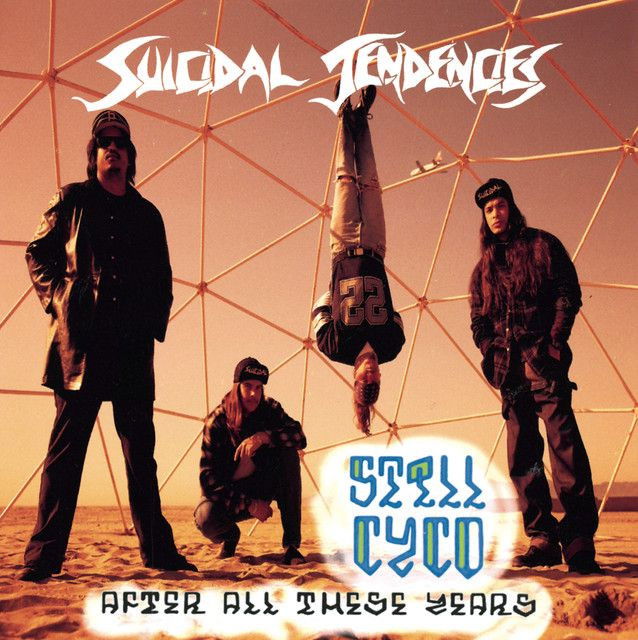
Two Sided Politics by Suicidal Tendencies
Suicidal Tendencies' "Two Sided Politics" is one of those songs that says a lot in very little time. Running just 1:03 on the band's 1983 self-titled debut, it delivers a compact attack on hypocrisy, punishment, and selective freedom. For listeners searching for the meaning of Two Sided Politics Suicidal Tendencies, the core idea is simple: the song argues that social systems claim to protect liberty while often using their power to control, shame, and criminalize people instead.
"Two Sided Politics" - Suicidal Tendencies
I'm not anti-religion, religion is anti-me
I'm not anti-anything, I just want to be free
Loading lyrics...
Unable to load lyrics
We're unable to display the lyrics at this time. Please try again later.
A One-Minute Protest With a Clear Target
Factually, "Two Sided Politics" appears on Suicidal Tendencies, released July 5, 1983, through Frontier Records. The album was produced by Glen E. Friedman and is widely seen as a key early hardcore punk record that also helped point toward crossover thrash, according to the album's documented history and reception. The song is credited to Mike Muir and Louiche Mayorga.
That context matters. Suicidal Tendencies came out of a Southern California punk scene that often mixed alienation, dark humor, and anger at authority. On this record, critics later praised Mike Muir as a sharp observer of nonconformity and social pressure. "Two Sided Politics" fits that description exactly.

Watch the official Two Sided Politics
music video
The Main Message: Freedom for Some, Punishment for Others
The song opens by rejecting easy labels. The speaker insists they are not driven by blind hatred. Instead, they argue that institutions act against them first. When the lyric says anti-me
, the point is not personal paranoia. It is a claim that society punishes people who step outside approved behavior.
That idea leads to the song's central complaint: freedom is offered conditionally. In one sharp phrase, the system promises liberty, then takes it away the moment someone uses it in a way authorities dislike. The lyric use self-expression
is quickly followed by lose your freedom
, showing how speech and individuality can become reasons for punishment rather than rights being protected.
Interpretation: The song is less about one specific law or party than about a pattern. Institutions speak the language of freedom, but enforce conformity.
Where the Song Finds Double Standards
The verses build their case through examples. One of the strongest compares violence in war with violence in daily life. The song suggests that killing in an approved national context makes someone a hero, while defending oneself in ordinary life can still lead to prison. That contrast is the heart of the title: politics has two sides, and they are not equal.
Another example targets class. The speaker argues that wealth changes the outcome of justice. The short phrase high-class lawyer
stands in for an entire system where money buys protection. By contrast, poor people are treated as guilty first and human later.
There is also a broader attack on institutions like religion and government. The song does not spend time on theology or policy. Instead, it treats both as structures that can demand obedience while refusing empathy.
I just want to be freeThat brief line works like the song's moral center.
It reframes all the anger. The speaker is not asking for chaos. They are asking for fairness and personal freedom.
Why the First-Person Voice Feels So Direct
Although this article uses third person, the song itself works because it is spoken in a blunt first-person voice. Repeated claims like I'm not anti-anything
create a defense against accusations. The speaker sounds cornered, as if they have already been labeled dangerous or deviant.
That makes the song emotionally effective. It is not written like a policy essay. It sounds like someone being judged in real time and pushing back fast.
Interpretation: The repeated self-definition may reflect punk's larger refusal to let mainstream culture define outsiders. In that sense, the song is political, but it is also personal.
How the Sound Carries the Meaning
Musically, "Two Sided Politics" is as important as its words. On the 1983 debut, Suicidal Tendencies were still rooted more in hardcore punk than in the heavier metal hybrid they would later become known for. That means fast tempo, tight drumming, clipped riffing, and a vocal delivery that sounds half-shouted, half-spat.
The arrangement does not leave room for subtle comfort. It rushes forward like an argument that has been building for too long. Because the track lasts barely more than a minute, it feels like a compressed outburst. That brevity actually strengthens the message. Hypocrisy is not explored slowly; it is exposed in flashes.
The production also helps. Early-'80s hardcore recordings often sounded raw and immediate rather than polished. Here, that roughness gives the song credibility. A cleaner, bigger studio treatment might have softened the urgency.
The Song's Place on a Landmark Debut
"Two Sided Politics" gains extra force when heard as part of Suicidal Tendencies. That album also includes songs about alienation, family conflict, social pressure, and institutional control. In that setting, this track becomes one piece of a larger worldview: young people are told to fit in, then punished when they cannot.
The album's legacy reinforces that reading. It became one of the most influential records in the bridge between hardcore punk and thrash. Even though "Institutionalized" became the breakout song, shorter tracks like this one show how quickly the band could sketch a whole political argument.
Final Take on the Meaning
So, what is the meaning of Two Sided Politics Suicidal Tendencies? At its core, the song says power is inconsistent on purpose. It celebrates violence in one setting, condemns it in another, praises freedom in theory, and punishes it in practice. The poor, the nonconforming, and the unwanted face the harshest version of the rules.
That message still lands because the song never sounds abstract. It turns politics into lived experience: who gets believed, who gets punished, and who gets to call themselves free.
Disclaimer: This interpretation mixes documented context with critical reading of the lyrics, so some meaning remains open to listener interpretation.







