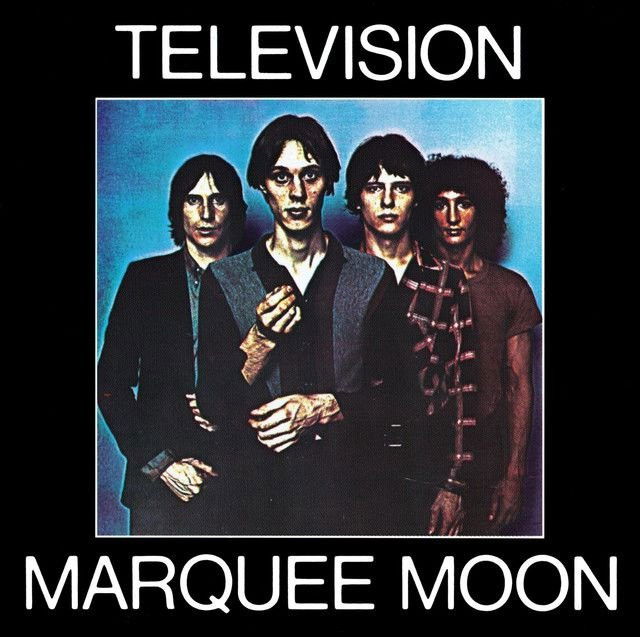
See No Evil by Television
The meaning of See No Evil Television starts with a contradiction. The song sounds excited, almost triumphant, but its words keep brushing against danger, manipulation, and despair. That tension is what gives the track its charge.
"See No Evil" - Television
And it's a whole lot more than "anyhow"
I wanna fly, fly a fountain
Loading lyrics...
Unable to load lyrics
We're unable to display the lyrics at this time. Please try again later.
As the opening song on Marquee Moon, released on February 8, 1977, it had a clear job: introduce Television’s world fast and vividly. Factually, it is track one on the band’s debut album, written by Tom Verlaine and co-produced by Verlaine with Andy Johns. It is also a compact, hook-driven song built on the group’s signature dual-guitar interplay, with Richard Lloyd credited for the solo.
The song’s core idea: wanting more than fear
At its heart, the song is about restless desire. The speaker does not want a small, safe life. They want motion, intensity, and a reality bigger than ordinary limits. Early lines push that feeling with phrases like I want now
and jump a mountain
, which suggest hunger without patience.
Interpretation: this is not just ambition in a literal sense. It feels like a fight against dead language, stale thinking, and emotional paralysis. When the singer rejects words tied to darkness and doom, they seem to be refusing a worldview, not merely a conversation.
The repeated hook I see no evil
can sound simple, but it is not naïve in a clean, innocent way. The verses show that the singer knows destructive urges exist. They say so directly. The point is closer to resistance: they will not let destruction become the final lens through which they see life.
Watch the official See No Evil
music video
Why the lyrics feel dreamlike instead of literal
Tom Verlaine’s writing on Marquee Moon often works through impressionistic images rather than tidy storytelling. Critics and band history around the album regularly describe the lyrics as moments of perception and discovery rather than straightforward plots. That matters here.
A line like boat made out of ocean
is a good example. On the page, it is impossible. In the song, it makes emotional sense. The image blurs object and environment, self and world. Interpretation: that paradox suggests a person so immersed in feeling and imagination that they want to build freedom out of the very substance around them.
This style fits Verlaine’s broader approach on the album, where urban life, waterfront imagery, and flashes of revelation matter more than linear detail. In that light, “See No Evil” feels like a mind in motion, grabbing at insight before it disappears.
The push and pull between love and control
One of the song’s most interesting turns comes near the end. What begins as a personal declaration opens into a relationship. The singer is not just chasing freedom alone; they are with the one I love
. That shift brings warmth, but it also brings risk.
The closing lines move from joy into something more unsettling:
You control the feelings
of the one you love
Those words change the emotional weather. Love can inspire liberation, but it can also slide into power. Interpretation: the song may be warning that intimacy can either expand the future or distort it, depending on whether love becomes mutual or controlling.
That ambiguity is one reason the track lasts in listeners’ minds. It never settles into a pure love song or a pure manifesto. It stays nervy, romantic, and slightly dangerous.
How the music carries the meaning
The sound is crucial to the meaning of See No Evil Television. Television were part of the New York scene around CBGB, but their debut did not rely on blunt punk power chords. Instead, Marquee Moon is known for interlocking guitar lines, counter-melodies, and a lean, unvarnished studio sound.
“See No Evil” puts that method in miniature. The guitars do not simply hammer the same rhythm; they weave around each other. That creates a feeling of pursuit, like one thought chasing another. The performance sounds urgent without sounding chaotic.
Richard Lloyd’s solo also matters. Rather than stopping the song’s momentum, it sharpens it. The result is a musical version of the lyric’s mental state: alert, hungry, and trying to break through ordinary limits.
Artist context makes the song clearer
Television had rehearsed heavily before recording Marquee Moon, and much of the album’s precision comes from that preparation. The record was cut in 1976 at A&R Recording in New York, and its stripped-back production helped define a model for later post-punk and alternative guitar music.
That context helps explain why “See No Evil” feels so direct even when the lyrics are elusive. The band gives Verlaine’s abstract language a hard outline. The song may describe confusion, revelation, and inner conflict, but the arrangement makes those ideas feel physical.
It also matters that Marquee Moon was later treated as a landmark, even if its first U.S. commercial response was modest. Listeners and critics came to hear this album as a blueprint for artful guitar rock, and “See No Evil” is one of the clearest entry points into that sound.
Final takeaway: a song about choosing vision
So what is “See No Evil” really saying? The best answer is that it stages a struggle between darkness and possibility. The singer knows destructive feelings are real, yet they keep reaching for love, imagination, movement, and a future that has not been closed off.
That is why the song still feels alive. It captures the moment when someone is almost overwhelmed by the world, but chooses intensity over surrender.
Disclaimer: This interpretation separates documented facts about the recording and release from critical reading of the lyrics. Like much of Tom Verlaine’s writing, the song remains open to more than one meaning.







