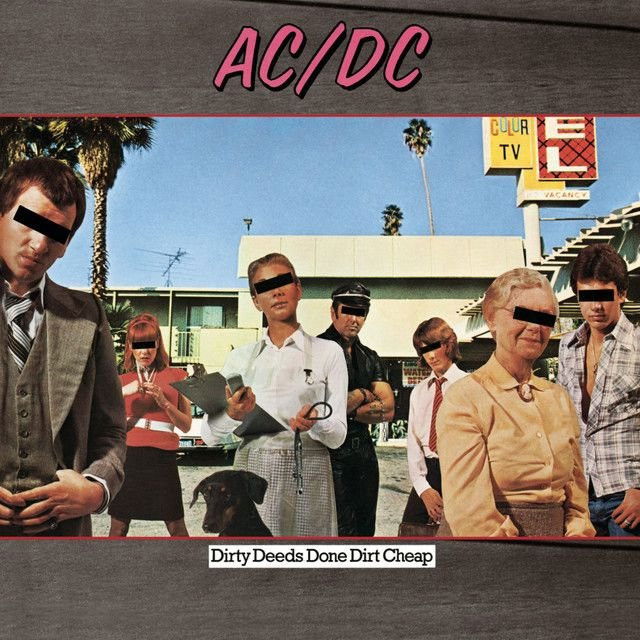
Big Balls by AC/DC
AC/DC took a simple party joke and turned it into one of hard rock's most shameless double entendres.
"Big Balls" - AC/DC
Provided by LyricFindI'm upper, upper class high society
God's gift to ballroom notoriety
And I always fill my ballroomLoading...Loading lyrics...
Unable to load lyrics
We're unable to display the lyrics at this time. Please try again later.
Why This Joke Song Still Lands
The meaning of Big Balls AC/DC starts with a very obvious trick: the song talks about formal dances, but it says everything in a way that invites a second, sexual meaning. That is not hidden subtext. It is the engine of the song.
Released on Dirty Deeds Done Dirt Cheap in 1976, the track fits AC/DC's early identity as a band that mixed brute-force rock with schoolboy humor. Songfacts summarizes it plainly: the lyrics describe a cocktail ball, but the title and hook are a sexual play on words. That reading lines up with the band's larger style of suggestive, often funny writing, a trait many critics connect to old rock 'n' roll humor and Chuck Berry-style wit.^1
What makes the song memorable is that AC/DC do not stop at one joke. They build a whole character around it.
Watch the official Big Balls
music video
The Narrator Is a Snob They Want Listeners to Laugh At
On the surface, the singer sounds proud of high society status. He introduces himself as upper class high society
and acts like gossip columns cannot stop praising him. In plain terms, he is presenting himself as a rich, admired host whose social events define his importance.
Interpretation: AC/DC are not asking listeners to admire this man. They are making him ridiculous.
The bragging gets bigger with every verse. He boasts about a packed ballroom, an exclusive guest list, and how everyone wants to return. Each detail raises the same point: this person measures worth through attention, class, and spectacle. The repeated claim that he has the biggest balls
turns that vanity into a comic punchline.
That is why the song works as satire as well as innuendo. It pokes fun at elite manners by making them sound dirty, childish, and inflated.
How the Lyrics Turn One Pun Into a Full Story
The song follows a simple arc, and each section stretches the joke a little further:
- Introduction of status. The narrator frames himself as a society figure with a grand reputation.
- Public boasting. He insists his events are always crowded and talked about.
- The chorus exaggerates everything. The repeated hook pushes the double meaning from playful to impossible to ignore.
- The final verses widen the joke. Charity balls, costume balls, and pleasure balls all become part of the same word game.
One of the funniest tricks is how innocent party language gets bent into something else. When the song mentions my ballroom always full
or says the balls are always bouncing
, the wording is technically about dances, but the repeated framing makes every line sound like a wink.
Some balls are held for charity
And some for fancy dress
That brief passage shows AC/DC's method. They start with proper, almost respectable images, then let the listener's mind do the rest. The comedy depends on contrast: polite vocabulary, rude implication.
Chorus, Repetition, and the Art of Overkill
The chorus is intentionally dumb in the best possible way. It repeats the central phrase so often that the song stops pretending to be subtle. That overkill matters.
Interpretation: The repetition turns the narrator's confidence into self-parody. He does not just sound proud. He sounds absurdly proud, trapped inside his own bragging.
AC/DC also widen the joke by adding lines like she's got big balls
. That move makes the song less about one literal body joke and more about comic escalation. Everyone gets folded into the bit. The language becomes more chaotic, more communal, and more ridiculous.
In other words, the chorus does not deepen the psychology. It deepens the laugh.
Why the Sound Matches the Smirk
Musically, "Big Balls" is lighter on its feet than many AC/DC staples. Instead of sounding menacing, it feels theatrical and bouncy. The groove has a pub-band swagger, and Bon Scott performs the vocal like a cheeky master of ceremonies rather than a dangerous rock frontman.
That matters for meaning. If the band had played it with total heaviness, the joke could have felt crude and flat. Instead, the rhythm keeps things springy, the gang-style responses make it feel like a rowdy singalong, and the whole arrangement suggests a party spinning slightly out of control.
This is also part of AC/DC's early craft. Angus and Malcolm Young's guitar work stays direct and catchy, giving the track enough muscle to feel like rock, while the vocal phrasing sells the comedy. The band understood that humor in rock works best when the musicians commit fully instead of acting embarrassed by the bit.
Artist Context Makes the Song Easier to Read
AC/DC were already building a reputation in the mid-1970s for loud, riff-driven songs with a grin behind them. Bon Scott, Angus Young, and Malcolm Young are credited as the song's writers, and their mix of toughness and mischief defined much of the band's early catalog.[^2]
Songfacts notes that AC/DC often used humorous, suggestive lyrics so they would not seem too self-serious.^1 That point is useful here. "Big Balls" is not a confession, a political statement, or a deep emotional diary entry. It is a performance piece built to entertain, provoke laughter, and get a reaction.
Still, the song lasts because it is not just random filth. The upper-class framing gives the joke shape. By setting everything in ballrooms, guest lists, and society pages, AC/DC aim their humor at class pretension as much as sexual bravado.
Final Take on the Meaning of Big Balls AC/DC
The meaning of Big Balls AC/DC is best understood as a comic double entendre with a satirical edge. It is about a boastful socialite on the surface, but really it is AC/DC making fun of status, masculinity, and polite respectability through one giant, unstoppable pun.
That is why the song still gets remembered. It is silly, shameless, and expertly delivered.
Disclaimer: Song meaning is always part fact, part interpretation. The reading above is based on the lyrics, known context, and AC/DC's established style rather than an official line-by-line explanation from the band.
[^2]: Album and writing credits widely listed for Dirty Deeds Done Dirt Cheap and AC/DC discographies.








